And at last, the final Assassin's Creed adventure arrives. It may seem strange to anyone who does not follow the series, but Assassin's Creed III is actually the fifth main game in the franchise! That is because Ezio, the protagonist of the second game, received two additional titles: Brotherhood and Revelations.
Ubisoft then decided to stop this and bring an end to the memories of the ancestors of Desmond, protagonist of the entire series, who relives the memories of his forebears embedded in his DNA through a machine called the Animus. This entire idea of reliving memories is based on an imminent cataclysm approaching humanity, and Desmond must place himself in his ancestors' shoes to find artifacts and clues that will help him stop the tragedy.
2012
With the Apple of Eden in hand, Desmond and his team now need to find a specific key that opens a portal in a cave built by beings beyond human understanding, where the end of the world could then be prevented. The final ancestor, Ratonhnhaké:ton, enters the story through the search for this key.
But because this name is in a Native American language, the game offers one friendlier to our tongues: Connor, an eighteenth-century Native American living before the American Revolution actually takes place.
Before meeting Connor, however, we are introduced to his father, Haytham Kenway, an Englishman who comes to the United States in search of information about “Those Who Came Before,” the mystical beings, well before Connor's birth. Meeting Haytham before the game's protagonist himself is excellent for the plot because he is a pivotal character in Assassin's Creed III. By getting to know him, we also end up meeting everyone around him.
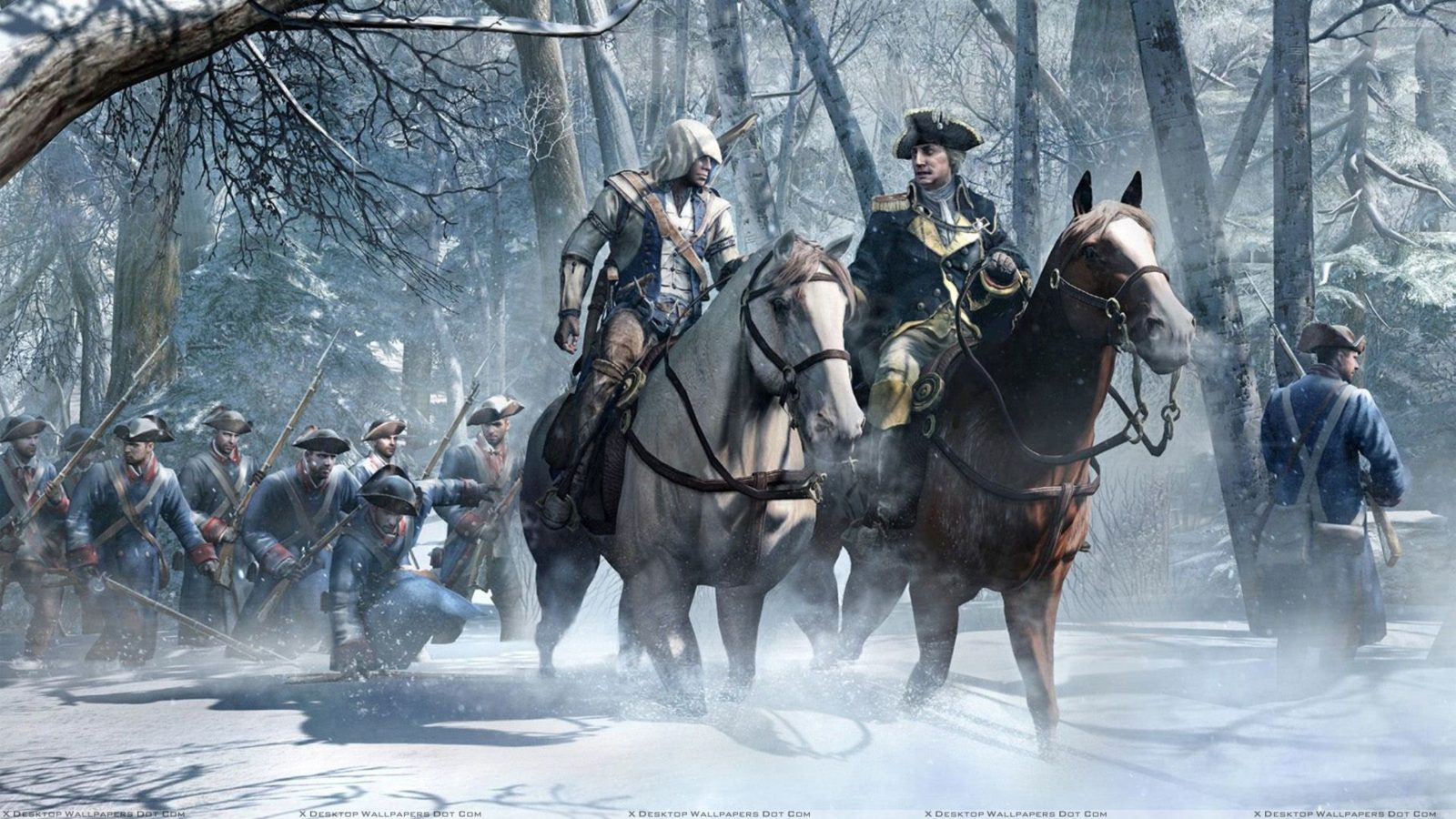
Connor and George Washington
All this succeeds in keeping players absorbed in the game's story. That has always been a hallmark of the series, but this time it reaches a much higher level. Assassin's Creed III creates a far stronger connection between players and characters than before, when our strongest connection was at most with protagonists Altair and Ezio. Now it is on another level: the characters are more expressive, and getting to know them in greater detail makes that possible.
Another phenomenal point in Assassin's Creed III's plot is the presence of several twists that leave the player stunned, including one that is a total “mindfuck,” worthy of “When you see it, you'll shit bricks.” This characteristic also makes players highly immersed in the plot, watching every detail and checking every scene and conversation because something different can happen at any moment.
As for the historical reconstruction of the American Revolution, the series once again puts on a show. The care taken in presenting famous characters such as George Washington is difficult to find even in films portraying the period, while the fidelity of the characters' clothing, the buildings and even the events themselves is extremely high-quality and sharpens players' curiosity to learn more about this entire world.
The game constantly bombards players with information that can be viewed in a highly detailed database, like a mini-Wikipedia. Absolutely anything famous, such as a building, event or well-known person, or at least someone pivotal to the game's story even if fictional, appears in detail, with interesting facts and a summary of the person's life and work.
There is no hesitation in calling this the best plot in the series, the most absorbing and the one that creates the strongest connection between players and its cast.
Native Arsenal
Assassin's Creed III is a sandbox game that drew heavily from Red Dead Redemption. Since Connor is Native American, it is natural for him to be an expert in hunting and wilderness survival, and it is in this regard that the game strongly resembles Rockstar's Western.
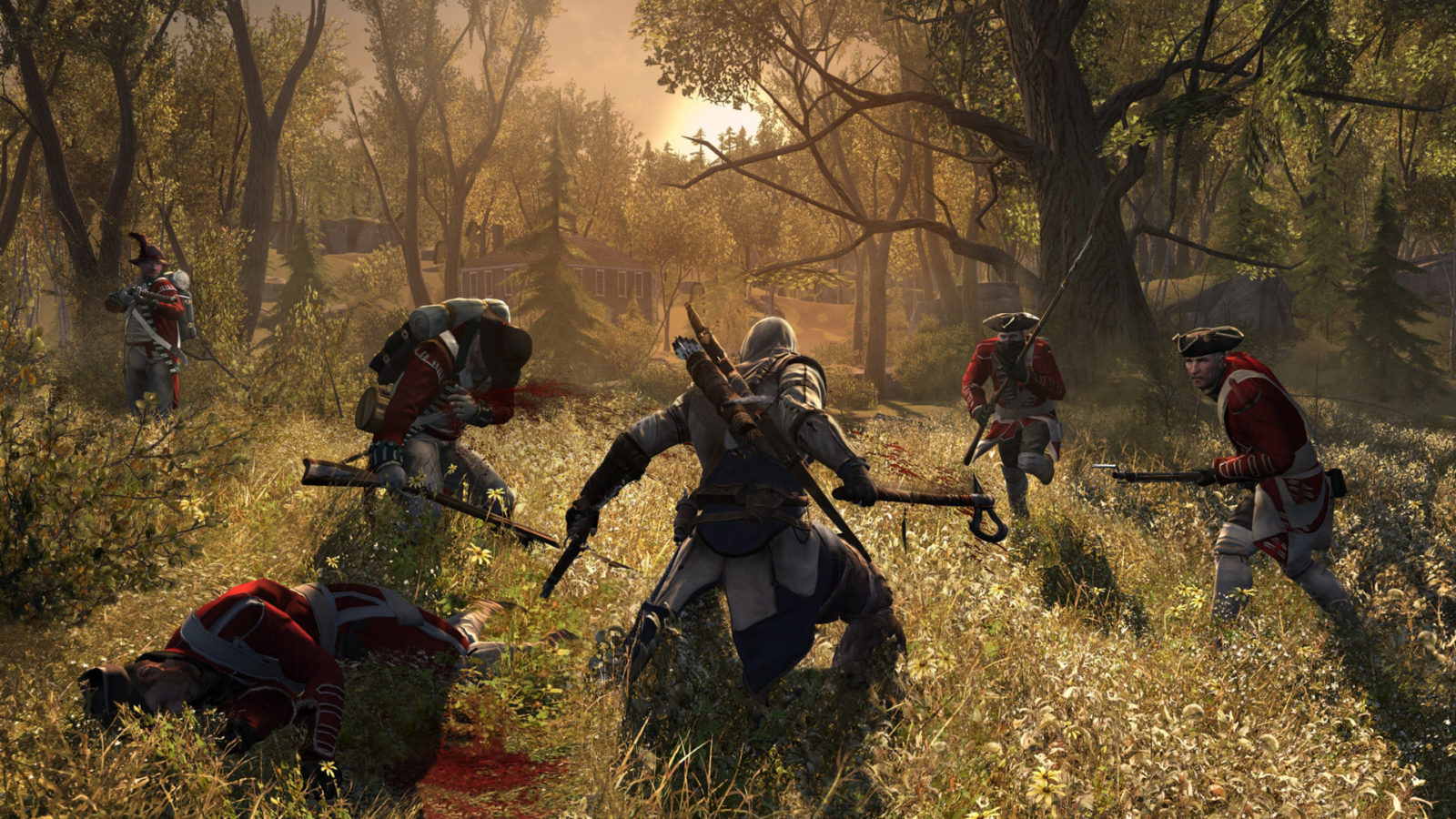
Assassin's Creed III
No longer concentrated in a single city, as Brotherhood and Revelations were, the game has two large cities, New York and Boston, a homestead and an enormous area called the Frontier. The most varied side quests are found in the Frontier, with hunting challenges, frontiersmen telling their stories, missions to improve the supplies of Achilles's homestead, Connor's mentor, and others. The Red Dead Redemption atmosphere can be felt in the Frontier through the vastness of the environment, random events, wild animals and challenges.
There is also a great deal to do in New York and Boston, including liberation missions, attacks on enemy forts, purchasing products and much more. The cities will rarely leave players bored, but the Frontier is where things truly happen with greater variety.
The problem is that this open world with so many possibilities takes far too long to truly appear for the player. Assassin's Creed III has the slowest beginning in the entire series, with an extremely long introduction that can be frustrating. It takes much too long for the Assassin Connor, dressed in his stylish Assassin Brotherhood robes, to actually appear.
This makes it look like a large tutorial. In fact, an enormous tutorial teaching several of the game's possibilities, whether new or old within the series. It was a wise choice for the plot, which became the series' most intimate, but it will not appeal to everyone. Assassin's Creed III therefore seems to have been made especially for existing franchise fans, who know the series' potential and fully understand that the game will reveal itself after those long introductory hours.
Another problem with the game, still concerning side quests, is the way they are presented. Many should have been introduced within mandatory missions, because then it would have been possible to understand why they were worth pursuing. This lack of presentation creates a certain reluctance and refusal among players to complete these missions, which pop up across the Frontier and cities. It is as though the game offers players absolutely everything, but only if they go looking for it themselves, very different from earlier entries, where the series presented absolutely all its features without requiring an enormous, discouraging introduction.
One example of this failure is the use of a new, powerful and stylish weapon: the rope dart. During a main mission, the game places the item in Connor's inventory but does not teach players how to use it properly. Its tutorial is in a side quest that does not even appear on the map! Such a new feature has no tutorial, yet climbing, which is far more intuitive and already a hallmark of the series, does. The developer's choice to handle it this way is strange, to say the least.
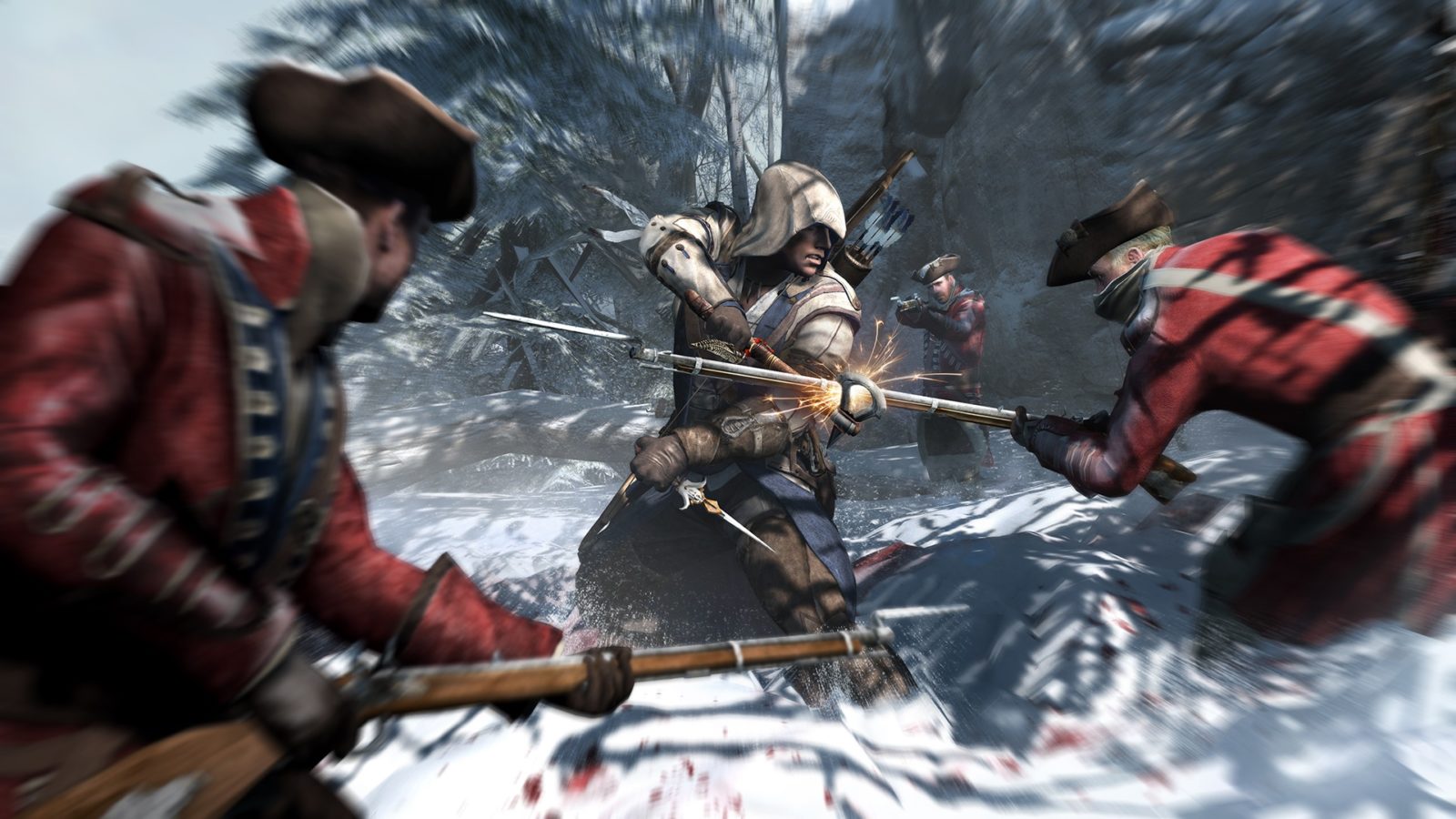
Assassin's Creed III
Managing the homestead's resources basically serves to generate more income, meaning money. By recruiting new settlers and putting them to work, it is possible to send carts everywhere. The problem is that money in Assassin's Creed III is far more superfluous than it was in the Ezio games. There is little need to obtain new weapons, apart from ammunition, hunting bait and traps, which are reasonably inexpensive; there are no more Assassin armor upgrades; and there are not even doctors selling medicine, something highly necessary in earlier entries. Having the homestead operate beautifully therefore serves the player's ego more than the game's actual purposes.
Combat has not changed greatly from earlier games, but enemies are now more aggressive and there are more ways to deal with them. Basically, the game operates through counterattacks that depend on the player's reflexes rather than their ability to perform combos, since attacking simply requires mashing a button. Timing is essential for a successful defense and for making the enemy leave an opening for a counterattack.
Since we are in the eighteenth century, it is natural for there to be many more firearms, and Connor will often be targeted. He can use human shields to defend himself, which is very good and simple. Enemy variety has also increased, not only through different weapons but also through different stances: some do not accept direct counterattacks, others block your advances, while others prefer to keep their distance and attempt a shot.
To fight these various enemy types, Connor primarily relies on his fast and deadly tomahawk, together with his hidden blades. Not every attack needs to be violent, however, and a stealthy approach is often far more advantageous, even if remaining unseen is much harder. If things become difficult, it is time to run, which is also much harder than before because far more guards join the chase, block the way and shoot at Connor. Finding a safe hiding place becomes extremely difficult, especially if the wanted level is high.
Movement is first-rate, although getting used to Connor's agility takes a little time. The buttons respond extremely well, his speed becomes natural, and the climbing mechanics follow earlier games, with everything intuitive and easy as long as you find the right points to access the next platform. The addition of tree climbing makes it even better, and the best way to reach a higher area is often through the treetops. Everyone knows how important climbing is in Assassin's Creed, especially for revealing new points on the map by synchronizing from extremely high locations.
The low point is movement on horseback, which is quite buggy and often leaves players stuck and unable to move.
The main missions are all highly varied and have optional objectives, which basically serve as achievements on PSN, Steam or Xbox Live. The desire to complete every optional objective will be strong, however, because of the challenge level, causing players to reload the last checkpoint many times! The optional objectives include killing without being seen, eliminating targets in certain ways, avoiding too much damage in battles, racing against the clock and similar tasks.
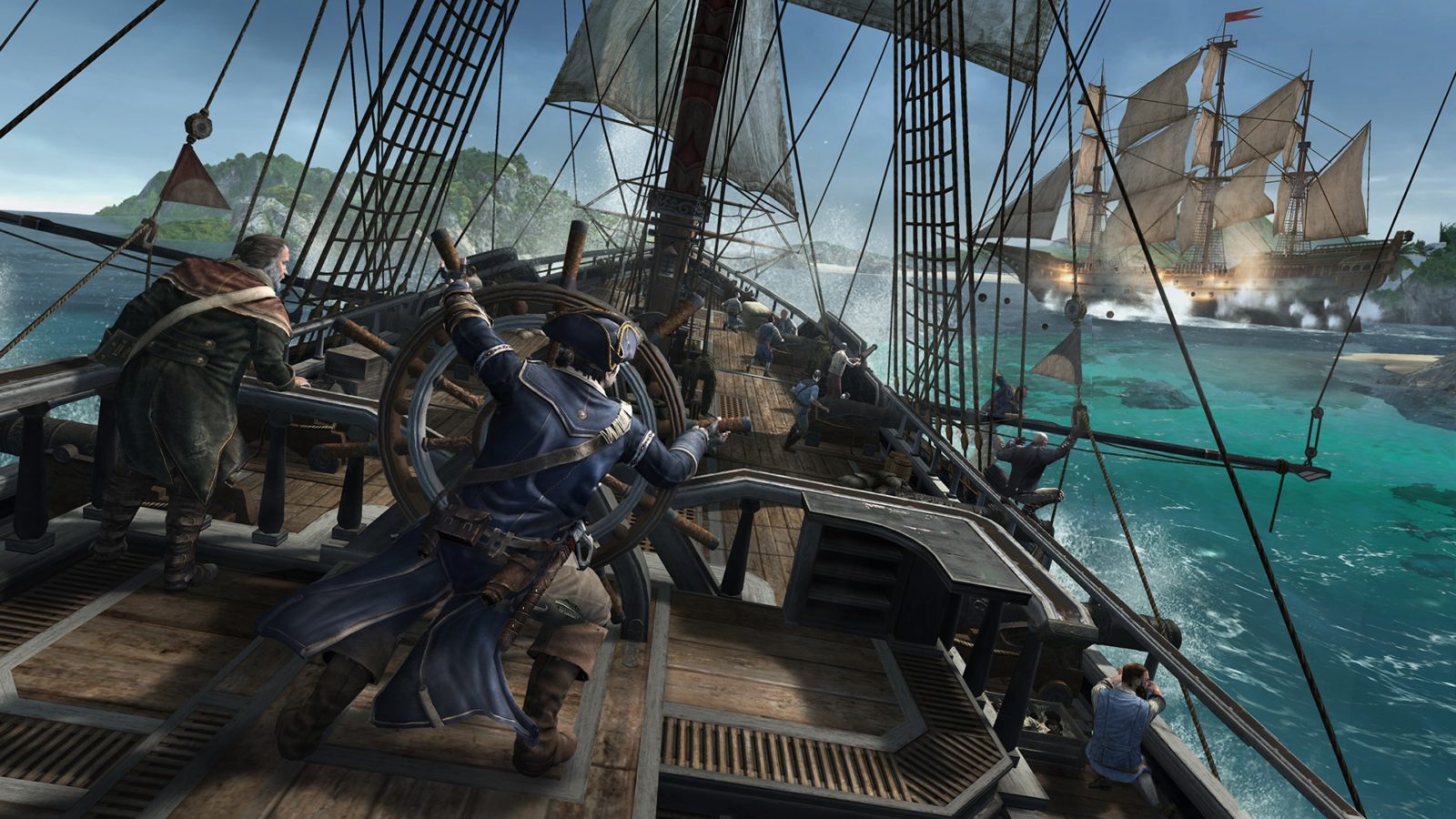
One of the most anticipated new features in Assassin's Creed III was naval combat. It exceeded every expectation! Connor takes possession of a warship and must adjust its sails according to the wind and need, fire cannons, select shots and much more. These missions are entertaining and challenging because they include changing winds, attacking ships, obstacles at sea and more. Without nimble fingers and the ability to control the ship, death is certain.
After the game's long beginning, once it truly reveals itself, it becomes clear that Assassin's Creed III is the most varied entry in the series, with a great deal to do, collectibles and more. The sandbox atmosphere is strong, and even doing nothing, simply walking through the Frontier and hunting, can become enjoyable.
The Sound and Look of Freedom
Simply first-rate. Jesper Kyd is gone, a shame because he is an excellent composer, but Lorne Balfe, who helped Kyd on Assassin's Creed Revelations, did not drop the ball. The series has always been synonymous with musical quality, featuring atmospheric tracks that fit their situations extremely well, and Assassin's Creed III is no different: top-level orchestration and music with a strong presence, much more than in the previous game.
The voice acting, the original since the Portuguese dub had not yet been released, is also fantastic, including characters who often speak bilingually. But because the story now takes place in the United States, it no longer has the Ezio cast's broken English. The Native Americans, for example, communicate among themselves only in their own language, hence Connor's name being unpronounceable to pale faces, but with subtitles, which are already in Portuguese.
The ambient sounds, explosions, shouting in the streets, conversations, gunshots and more are also excellent. The game's sound design is flawless.
Assassin's Creed III's main visual upgrade over earlier entries is its lip synchronization and facial expressions during cutscenes. It is superb, naturally not L.A. Noire, but phenomenal work, with far more realistic expressions and mouths moving much more closely with what is being said. If it is not a cutscene but an ordinary conversation, the detail is not as high, though that is not really necessary.
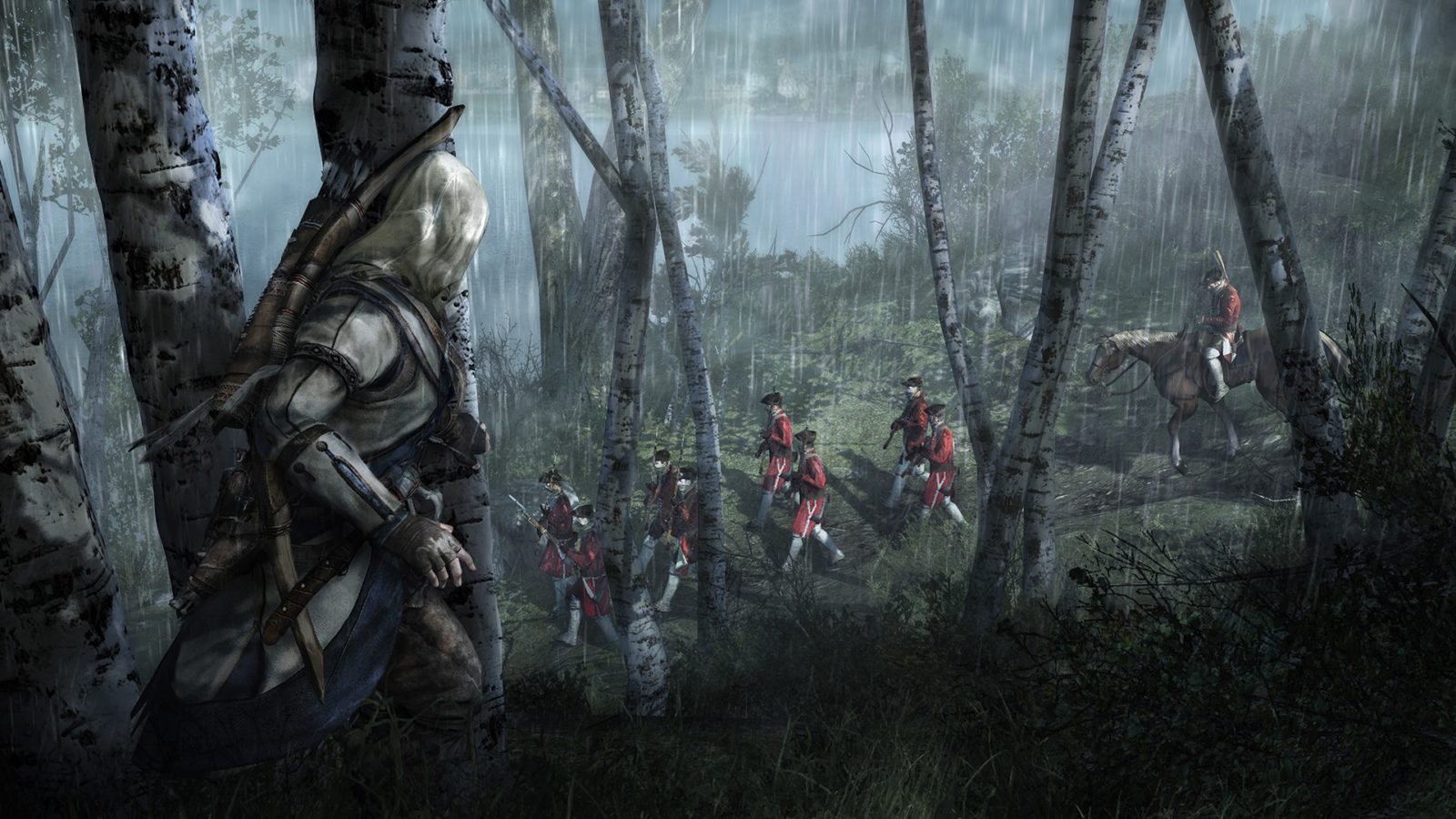
Assassin's Creed III
The models are also far more robust and beautiful. Connor's is naturally the main one, with smooth, realistic animations, but even the models for minor NPCs are well built enough to be convincing.
Weather changes are also beautiful to see, especially rain, with lightning illuminating the entire environment and water falling. It is one of the game's most beautiful effects, as well as one of the best in this console generation. Speaking of water, the open-sea effects during naval missions are also excellent, with a rough ocean full of waves and foam depicted quite realistically.
The same cannot be said of the water in rivers and bays while Connor is swimming, with strange splashes appearing even when the player stands still and does nothing, especially during one cutscene. It is a very strange effect.
The environments and buildings do not look greatly different from the previous game, but the lighting effects improved considerably. Try standing beneath a tree that casts shade, for example: every leaf makes a difference when the light reaches Connor's body.
The game has some graphical bugs. Once, a guard began climbing a fence and simply flew away; another time, an NPC disappeared and reappeared several times; and a horse became stuck on a fence and looked as though it were having an epileptic seizure. But the game is enormous and varied, so this is almost to be expected.
It Is Better to Have Faith in Something Than No Faith at All...
Assassin's Creed III had absolutely everything required to be the best in the series, but several strange choices, such as an enormously slow introduction and poorly presented side quests, prevent it from earning that position. It is a game made for existing franchise fans; starting with it is not advisable if the earlier games did not suit your tastes, even if you do not care about the story. Still, the game shines brightly and certainly ranks among the year's best because, after its options reveal themselves, or the player goes looking for them independently, the time comes to say: THIS IS ASSASSIN'S CREED!
Rating: 7.5
Tested on PlayStation 3.