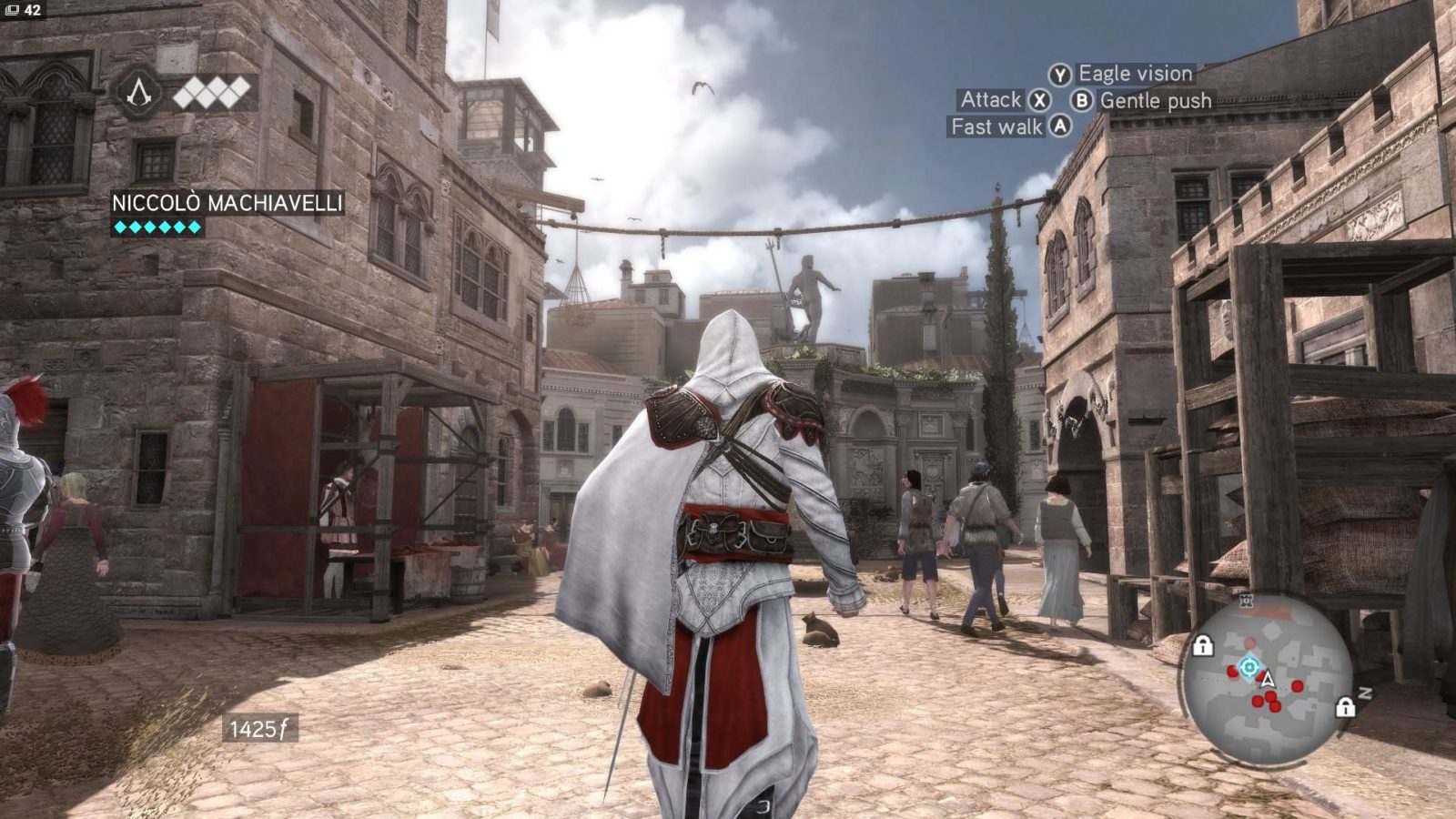
After the enormous success of Assassin's Creed II, including competition for numerous gaming awards such as Game of the Year from several websites, Brotherhood is the continuation of the conspiracy that drives the game. Once again, the player becomes involved in the life of Ezio Auditore da Firenze, the same protagonist from the previous title.
If Assassin's Creed II was the game in which Ezio discovered himself as an assassin, Brotherhood is where he establishes himself as one, taking the reins of the brotherhood on several occasions. This is the game in which Ezio's leadership is confirmed and discovered by both the player and Desmond's group, as Desmond is Ezio's descendant.
For those unfamiliar with the Assassin's Creed franchise's plot, the game is, in short, based on the memories of Desmond's ancestors that run through his veins. The first game showed the plot at its beginning, amid the fervor of the Crusades and a declared war between Templars and Assassins. In the franchise's second installment and in Brotherhood, the saga continues in Renaissance Italy, spanning the end of the 15th century and the beginning of the 16th.
Open-Air Coliseum
The plot now openly revolves around the Borgias, an influential family that truly existed and is now fictionalized in the game. The game lets the player see just how much intrigue and conspiracy the family was involved in, with Cesare Borgia as the principal enemy. It portrays the Borgia family causing an uproar in Rome, ruling it tyrannically and leaving the people poor while enriching itself.
In this context comes Ezio, whose villa was attacked while the Assassins' principal weapon was stolen: the Apple of Eden, whose power is little understood but known to be of vital importance. Taking this as the trigger for the final war against the Borgias, Ezio and Machiavelli, then the leader of the Assassins, set up camp in Rome and recruit new Assassins to the cause of "liberating Rome" from Borgia hands, also relying on the help of mercenaries, thieves, and prostitutes.
The 16th-century Rome recreated in Assassin's Creed Brotherhood reveals work performed with extreme care and affection. Every important part of the city is depicted meticulously, and there is always a database entry to access, whether about concepts such as what a bank was at that time, characters both fictional and real, or locations such as the Coliseum and the triumphal arches spread throughout the city. Anyone familiar with history and Machiavelli will see a few jokes about concepts used in his masterpiece of political thought, The Prince, such as the word Virtù. Beyond that, Ezio is Niccolò Machiavelli's Prince himself.
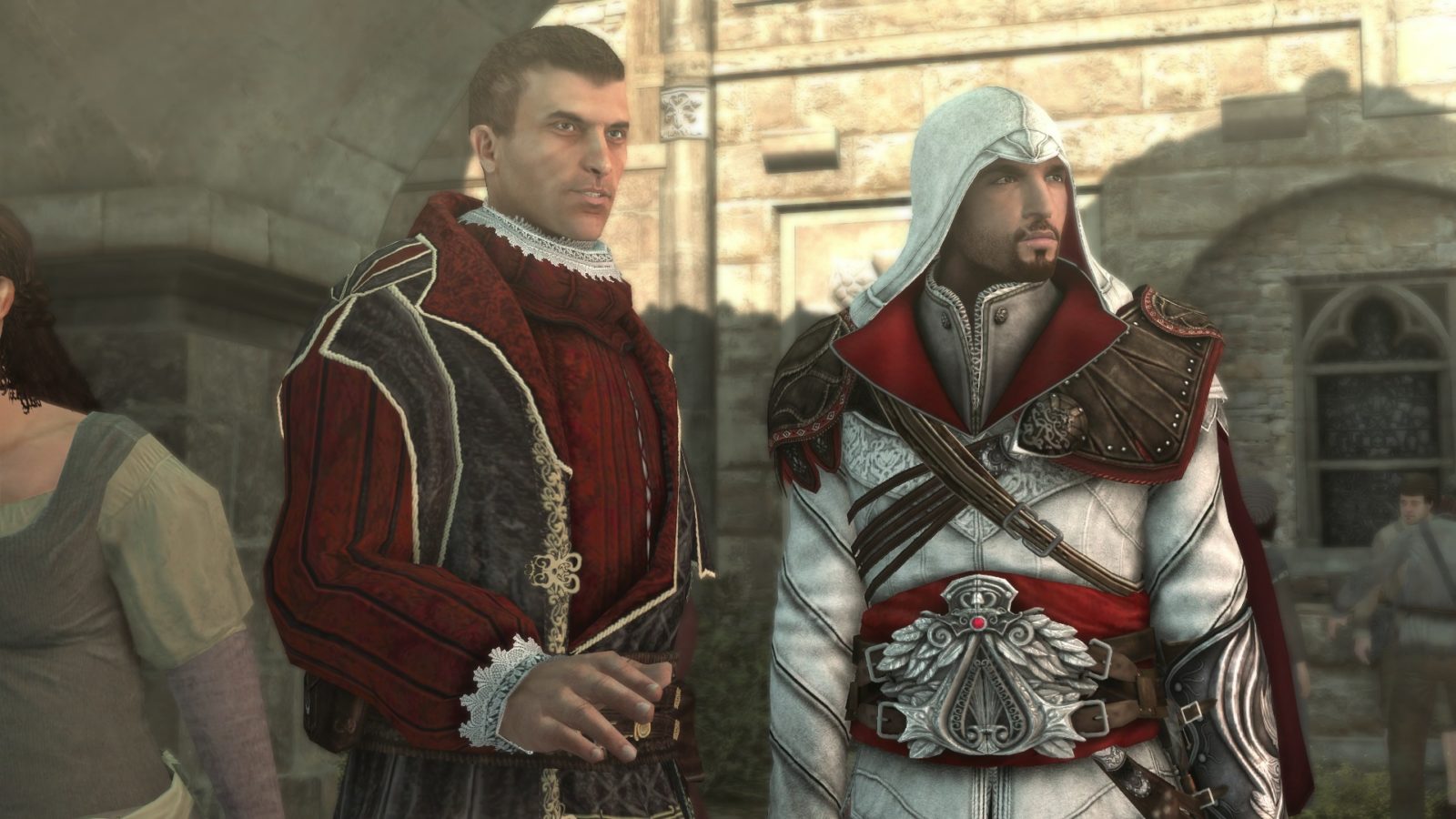
Machiavelli and his Prince
The Brotherhood
For the first time in the Assassin's Creed franchise, the player is treated to a multiplayer mode. Briefly, the game offers several multiplayer modes, from cooperative groups to free-for-all, with innovative gameplay. The most enjoyable is free-for-all, where the game resembles hide-and-seek with perks and abilities. It was certainly a good experience for the series.
Contrary to what many think, however, Brotherhood's focus is far removed from its online mode. It shows that, although the generation is packed with games emphasizing this mode at the expense of a single-player campaign, a game can present both modes magnificently and completely.
In gameplay terms, Brotherhood is an evolution of Assassin's Creed II. The game's focus remains the same: climbing structures and fighting enemies. But all of this has evolved. Combat continues to be based on counterattacks, but the camera often interferes, with game textures obstructing the view. It can be frustrating to take damage because part of a tree blocks your view of the enemy.
As the game's name itself indicates—Brotherhood—Ezio now has help from recruits in his Assassin clan. Combat is therefore much more strategic this time. Battles fought without any help have clearly become more difficult. Enemies no longer wait as long to attack, and some strike while the player is countering another.
With this in mind, the player must summon companions from the Order, who help in the heat of battle or simply enter a fight the player wants to avoid, whether to remain unseen during a mission that requires stealth or merely for fun.
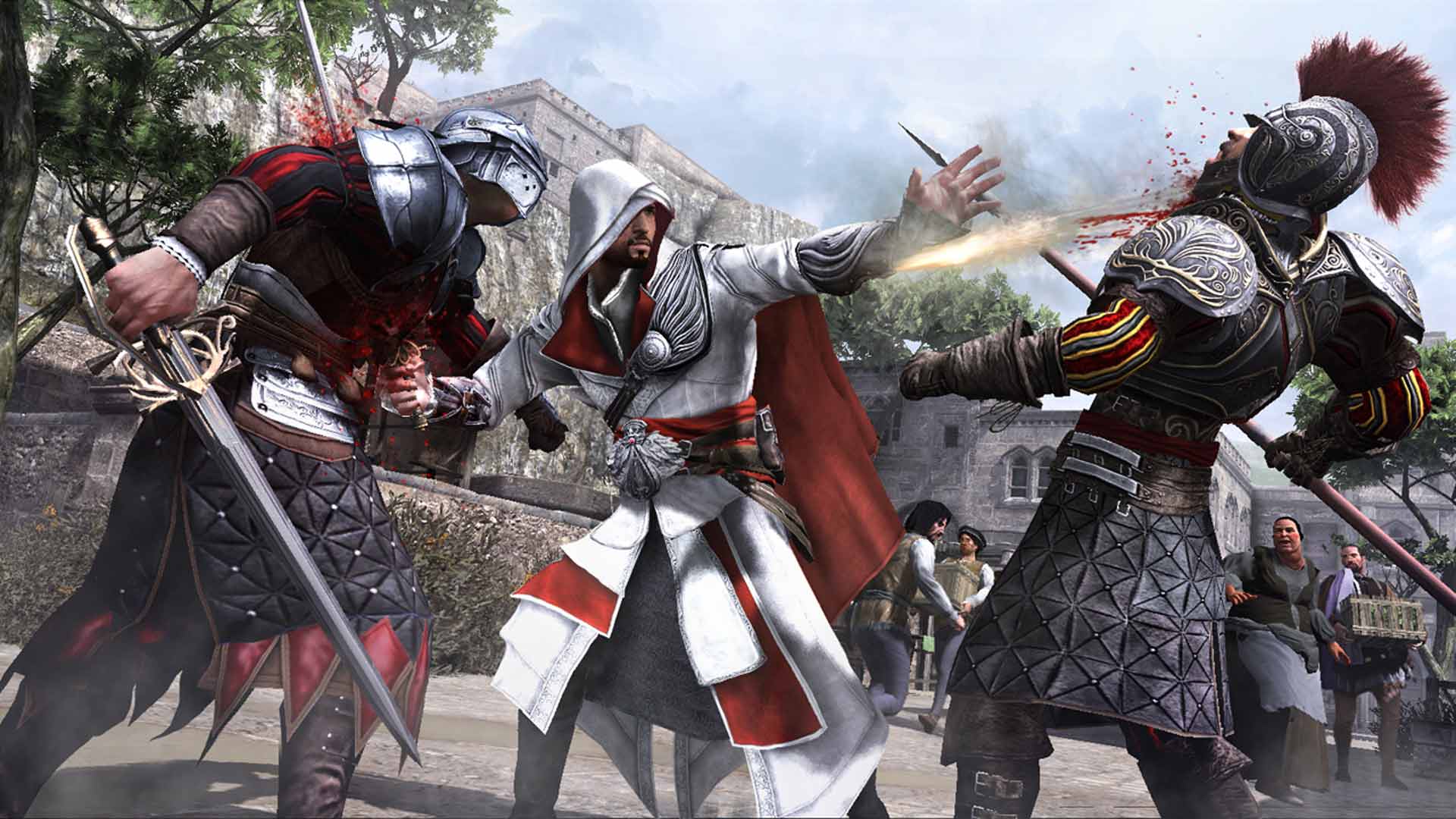
Finishing move with the hidden gun!
But Ezio's brothers do not appear from nowhere: the player must recruit them by helping them, in scenes strongly reminiscent of the first Assassin's Creed, where Altaïr aided citizens in danger. In Brotherhood, however, Ezio must help those who oppose Borgia tyranny. Once rescued, they automatically enlist in the army the player is assembling.
The more often your allies are sent to fight, the more experience points they gain, resulting in Skill Points spent on upgrades such as increasing their health bar and equipping new, more durable armor.
Since the prince must know how to use the nature of the beast well, he should choose the fox and the lion, because the lion cannot defend itself from traps and the fox cannot defend itself from the brute strength of wolves. It is therefore necessary to be a fox to recognize traps and a lion to terrify the wolves. - Machiavelli
To increase the number of allies who can be recruited, the player must set fire to structures called Borgia Towers, reducing Borgia influence in the area where they stand. To do this, a captain near the tower must be killed. The best choice is always to kill him silently, since he is invariably a powerful enemy surrounded by henchmen. Once that is done, all that remains is to climb and claim the tower, resulting in explosions and fire, after which it becomes an Assassin Tower.
Furthermore, when an area is freed from Borgia influence, establishments that were once closed and abandoned can be renovated by Ezio at a cost. This proves necessary for two reasons:
1) It is considerably more practical to always have a shop nearby, such as a blacksmith, than to travel to the other side of the map (even though you can ride a horse inside Rome, the city remains enormous);
2) The more establishments the player renovates, the more money they earn every twenty minutes. This money is deposited in banks, which must also be renovated so the player can withdraw it and increase the maximum amount the Assassins' current account can hold.
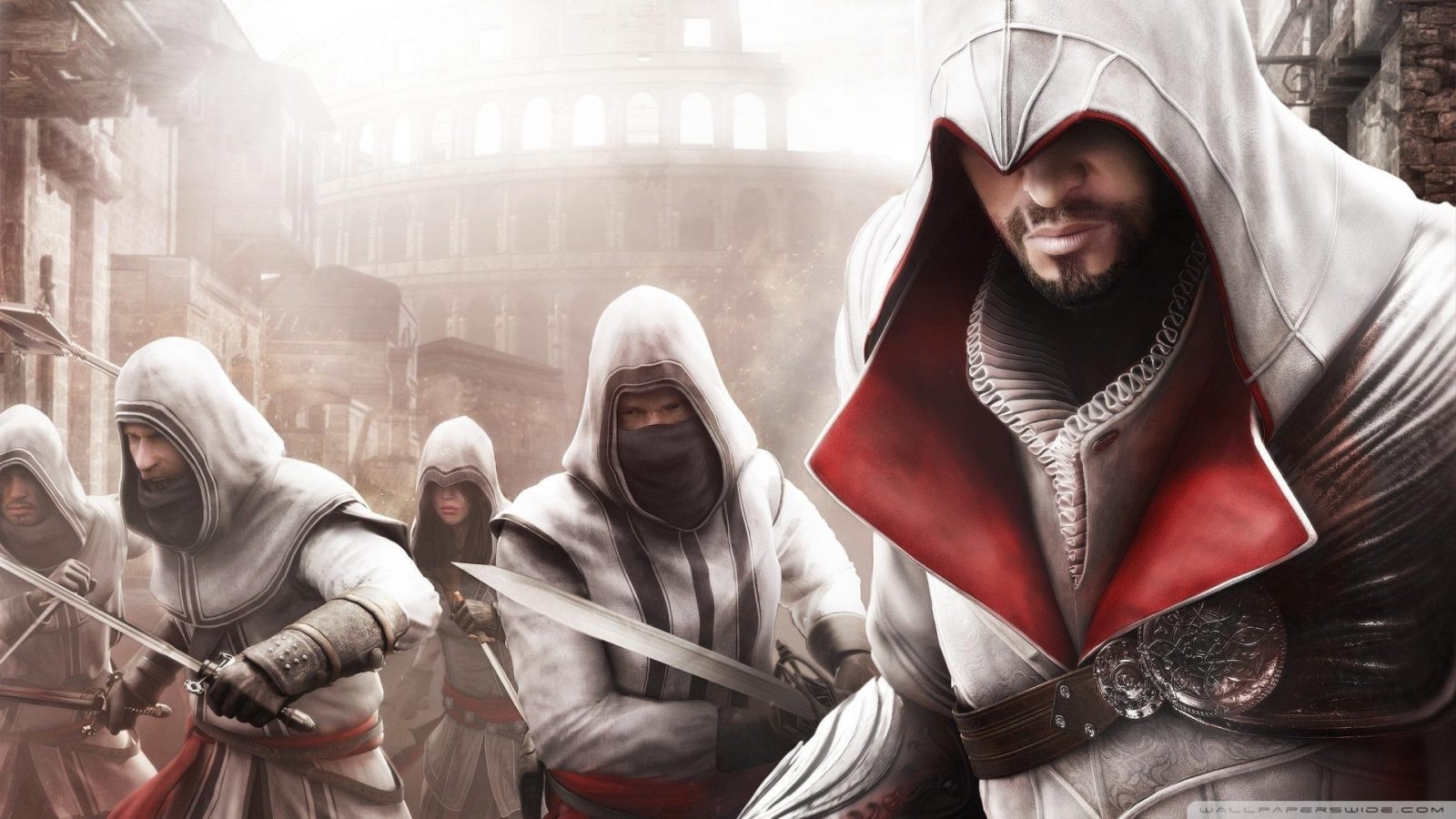
The brotherhood.
The choice to feature only one city—Rome—instead of several appears to have greatly benefited the series, since the number of possible side quests increased considerably and the map is used far more effectively. There is a great deal to do in Rome, which is an enormous city in the game.
Riding a horse in the city therefore proved an important addition to the gameplay, even though it seems strange—and sometimes even impossible—to ride through narrow, winding locations. In more open areas, however, it is effective and helps the game's flow, as completing it would take much longer without this option.
The stealth mode is often heavily criticized in the Assassin's Creed series, where it is judged to be easy or even nonexistent. Brotherhood manages to correct this problem by presenting a much more elaborate and rewarding stealth-and-espionage mode, with Ezio relying on his brotherhood to remain unnoticed on many occasions.
In addition, missions now have challenges: requirements that are not necessary for completion but make the game far more interesting and demanding, such as "do not lose more than five squares of health" or "do not be detected." This certainly raises the game's difficulty, since the player will realize it is far more enjoyable to complete missions while fulfilling their challenges than to do them linearly without any concern.
Renaissance Art
The audio work in Assassin's Creed Brotherhood continues the mastery shown in its predecessor. Jesper Kyd, the soundtrack composer since the first game, created new music for the title, which also borrows songs from the previous installment. The musical highlight is "The Brotherhood Escapes," the game's chase theme. It also seems that the soundtrack is heard much more often than before, since earlier games appeared to prefer ambient sound, whereas the balance is now roughly even.
The voice acting remains excellent and convincing, the broken English is back, and there is even a little French in the game. Ultimately, there is not much to say because all of this was already expected from a franchise that has always treated this aspect of the video game with great care.
The game remains one of the most beautiful open-world games in existence. Of course, being an open world with so many people walking around and doing many different things results in graphics with some aliasing, especially at a distance.
This does not, however, diminish the brilliance of one of the most fantastic settings ever created in a video game, a quality present since the first installment. Once again, the lighting stands out as magnificent work.
The characters' facial expressions and mouth movements synchronized with their dialogue remain superb work, made with great care and affection.
The Master Assassin
Assassin's Creed Brotherhood manages to surpass its predecessor by a great margin, especially in gameplay, which has been extensively expanded, made more difficult, and given greater variety. Rome is an enormous city with much to do, all amid a fantastic setting orchestrated by captivating music and wrapped in the most conspiracy-driven plot of the generation.
Rating: 9
Tested on a PlayStation 3.