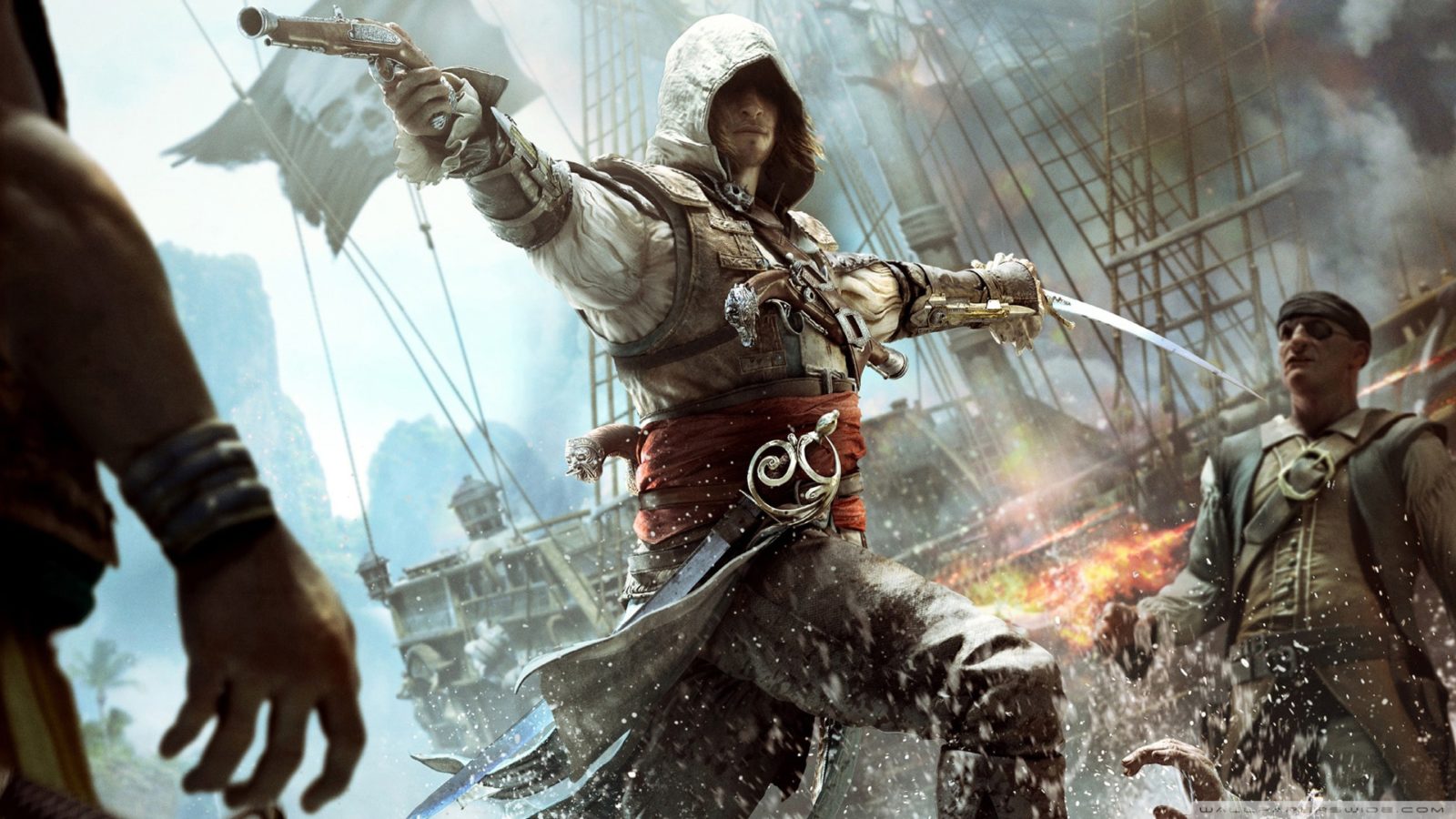
Assassin’s Creed IV Black Flag is the sixth game in the series for home consoles and PC, not counting Liberation, whose high-definition version is coming soon to PC, PlayStation 3, and Xbox 360.
Under the Black Flag
A sizable portion of the people I know regard Ubisoft's series as a cash grab. I acknowledge that by turning the series into a franchise with annual releases, Ubisoft did create some aversion among players who already find the games tiresome.
The fact is, however, that the series evolves considerably with every release. The only one I thought was a step backward was Revelations, the last game with fan favorite Ezio. III brought tremendous freshness to the series and, despite its flaws, implemented several mechanics and a variety of content while changing the game's location and period.
And then Black Flag finally arrives, perhaps the franchise's last game to appear on consoles from this seventh video game generation, to which we are already beginning to say goodbye.
We now embody a new ancestor: Edward Kenway, grandfather of Connor, the third game's protagonist, and a sea dog.
Assassin’s Creed III had already implemented the naval concepts that Black Flag used extensively and improved. The story is now much more about pirates than the Assassins' war against the Templars.
Assassin's Creed IV: Black Flag
The fact is that Edward pursues the Assassins' ideals less than Connor did. He is the greatest “Assassin by accident” in the entire series, and this is reflected throughout the game's story, whose essence contains far more bottles of rum than hidden blades.
This can be viewed from two perspectives: it can be considered bad because it strays somewhat from the story of the Assassin clans by giving greater prominence to Edward and his ship, the Jackdaw, or it can be seen as good because it presents a story closer to its main character.
Assassin’s Creed IV can indeed be regarded as the game with the weakest plot in the entire series. Although the historical component is strongly present, this is a subject we study very little in schools and universities and know much more through fiction books and films such as Pirates of the Caribbean.
Even so, it is difficult to ignore how the history of piracy's golden age appears through characters, famous vessels, and events that are somewhat unfamiliar to us Brazilians. This may create the false impression that earlier games in the series had greater historical authenticity. Our limited knowledge of the subject, however, should not lead us to that conclusion. I recommend Daniel Defoe's book A General History of the Pyrates—by the author of Robinson Crusoe—to learn more about the period and follow the rich universe presented by the game with a little more knowledge. In the book, Defoe recounts the lives of several pirates from the period, many of whom appear in the game.
An interesting approach in the game is its depiction of pirates as agents of freedom—like the Assassins, although almost none of them belong to the clan—and true fighters against the oppression of the English and Spanish monarchies. This approach is already somewhat familiar in the series. Indeed, it is a good reminder of the first Assassin’s Creed, where the Arabs, portrayed as villains in the Crusades when we learn about the period in the West, become the heroes. I believe this model of presenting the defeated as protagonists comes from the influence of the Annales School, the French school of historiography that certainly carried great weight when all the series' plots were conceived—after all, Ubisoft itself is French.
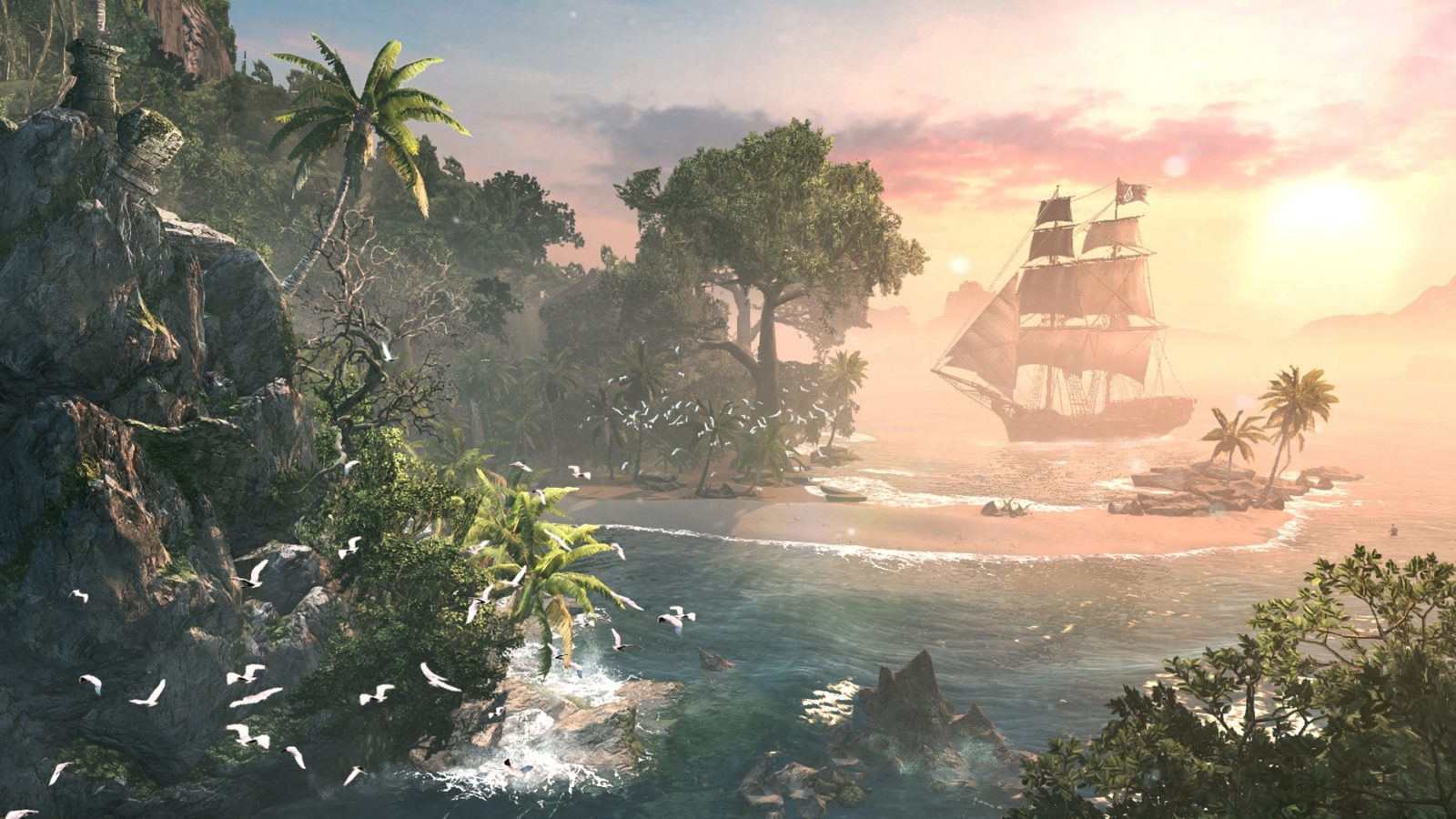 Assassin's Creed IV: Black Flag
Setting aside digressions about historiographical influences and returning to the game's central story, it is very rewarding to see how thoroughly Edward is humanized as the game progresses. Yes, he is wicked and identifies with the “band of robbers,” “vermin,” “vagabonds,” and “wretches who have nothing human about them”—Defoe's “compliments” for the pirate class—but it is impossible not to grow attached to his story.
It takes time to gain momentum and become more interesting. I would say the first half of the game is somewhat disconnected, but once we fully enter the pirates' world and get to know them, it is difficult not to grow attached to everyone and form strong bonds.
And one more thing: the ending of Edward's story is intensely emotional. It is the most moving in the entire franchise. That alone warrants a kinder view of the game's plot.
Meanwhile, in the Present...
This section contains possible spoilers for Assassin’s Creed III and the games before it. Skip to the next section if you do not want to read them.
With Desmond Miles's death at the end of Assassin’s Creed III, a question remained: “what happens now to the series' present-day arc?”
We now play in first person as a nameless, silent character. In the present, we are inside an Animus provided by Abstergo itself to create a mass-entertainment product through “footage” of interesting events in Edward Kenway's life.
Despite being another person, the story continues, and information about the entire plot can be uncovered by hacking computers. Although it somewhat treads familiar ground, it is good to see a new approach to the present, especially with a different camera. Despite always saying that Desmond was the franchise's main character—obviously, since he was present in every game—I did not much enjoy playing as him myself. Those sections were always extremely weak and short on content, unlike the amusement park of playing as the ancestors.
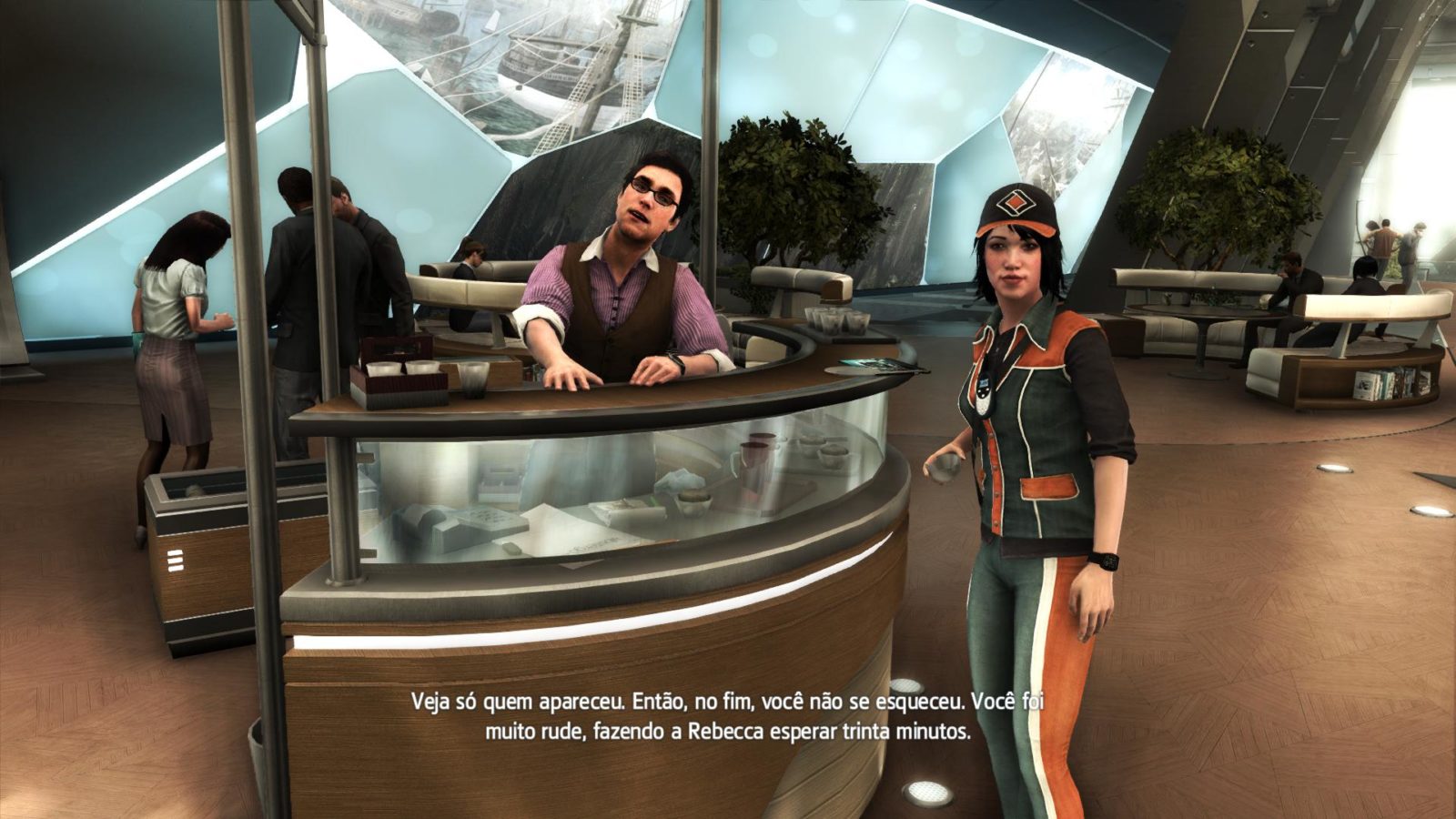 Some familiar faces will appear.
Our Flag Flies, We Teach Them Fear; Capture Them, the End Is Near!*
Assassin’s Creed IV is not only an open world: it is also an open sea. League after league separates the countless Caribbean islands, and there is much more between them than just the horizon and the sun overhead!
The Caribbean waters are filled with different kinds of ships carrying the finest cargo any pirate could want. Fortunately, we are well equipped with an excellent ship called the Jackdaw, one of the game's main characters—although it does not talk or anything like that; be aware that it is only an ordinary ship.
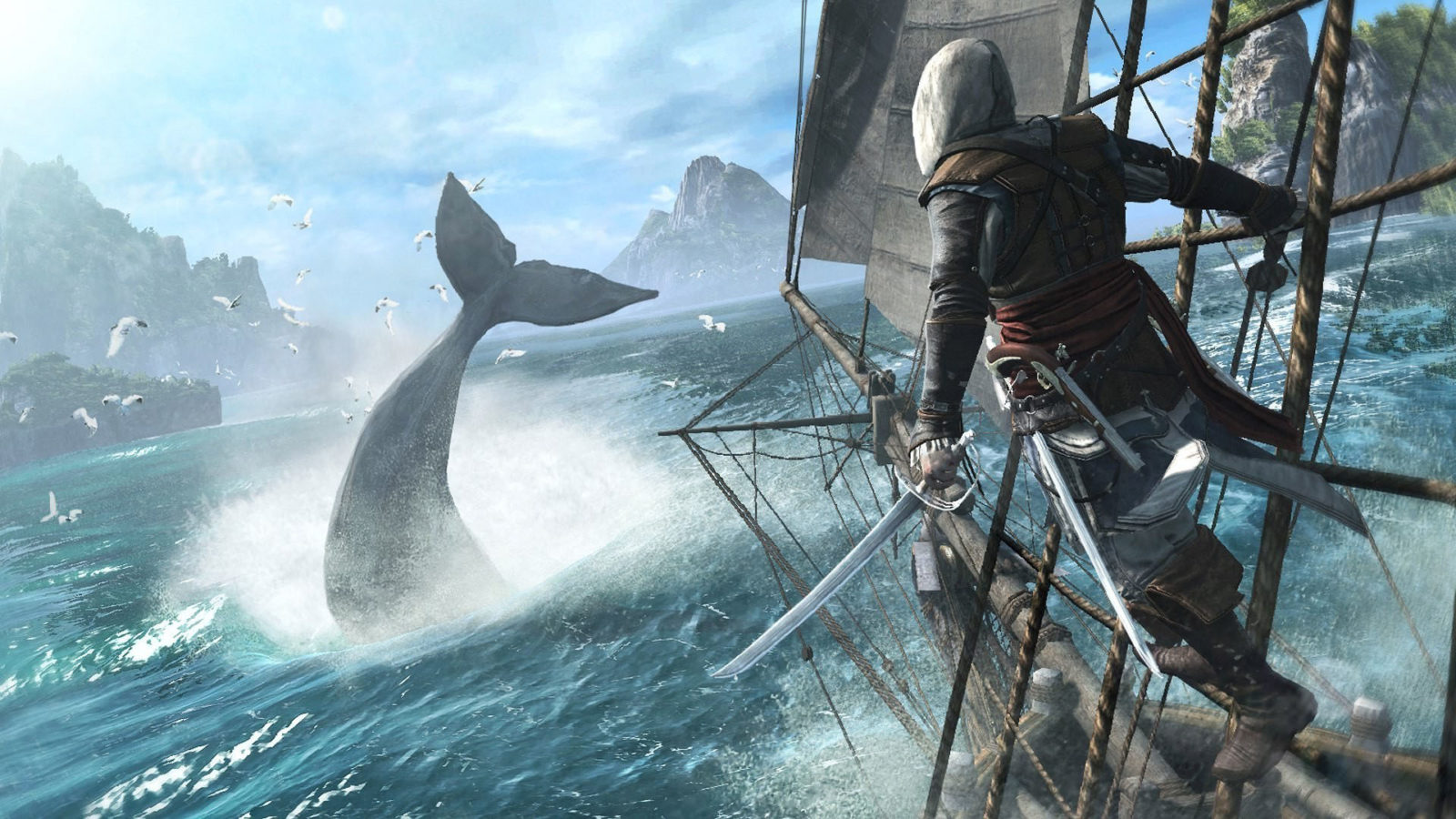 Sailing has never been so much fun.
The Jackdaw can be upgraded in every respect. It starts weak in every area, without the slightest chance against frigates or enormous, tremendously powerful man-of-wars—run from them at first! Initially equipped with a few cannons, stunning swivel-gun rounds, and explosive barrels, the Jackdaw needs upgrades to everything: its hull, firepower, mortars, ram strength, and more.
All of this is very expensive. Money truly makes a difference, as do iron, wood, and cloth. Upgrading the Jackdaw is the main motivation for being a pirate in the game. Black Flag gets this exactly right: fighting is not merely about satisfying an ego but contributes enormously to advancing the story and earning increasingly better rewards. There is no shame in saying that Black Flag's naval battles are the deepest combat any Assassin’s Creed has ever produced. Although they become progressively easier as we increase the ship's power, we can still find ourselves in terrible situations with several ships against ours alone—not to mention facing a dreadful storm that churns the sea while near an enemy fort doing everything it can to sink us with mortars and cannon fire.
Being the terror of the seven seas in Black Flag is tremendous fun. I saw many people who heavily criticized earlier games as boring fall in love with the piracy offered by the Jackdaw.
Edward has two options after fighting a ship: sink it completely and collect only half the cargo left floating on the sea, or board it like a true pirate. Each type of vessel has a different boarding process, but all invariably involve killing enemy sailors alongside a few other objectives, such as cutting down the ship's flag or destroying gunpowder stores. The smaller the ship, the easier it is to board; the larger it is, the harder.
Beyond boarding ships, there are many other things to do at sea: find collectibles, destroy forts to control an area and reveal everything the region offers—a kind of maritime “viewpoint”—visit small islands to hunt and collect items such as buried treasure chests and treasure maps pointing to other chests in other regions, dive at shipwrecks for underwater exploration, and hunt sea animals with a harpoon.
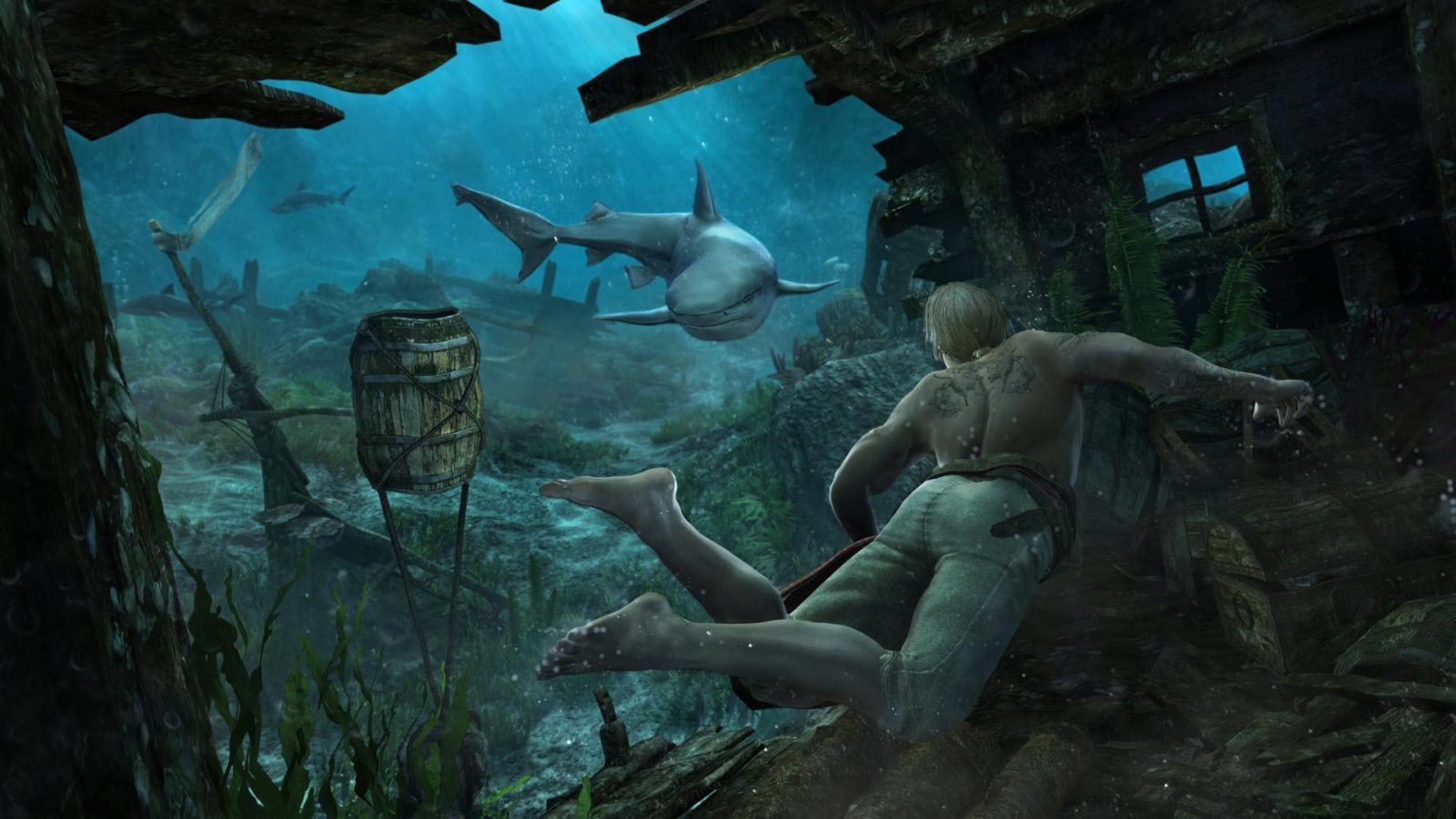 Assassin's Creed IV: Black Flag
This last activity was heavily criticized by the animal-protection organization PETA. I see no reason, however, to omit an action performed by pirates and everyone else at the time. The game is intended for a mature audience with established opinions, not people who might be influenced and develop the detestable desire to thrust harpoons into whales and sharks. Indeed, within the game itself, this is a disgusting activity. The developer made a point of showing the poor animals covered in blood and agony. I admit it is one of the most controversial actions a game has ever presented. The result of the hunt is honestly not pleasant, although the harpooning mechanic is very enjoyable.
Privateers with Loaded Weapons Still Wait at the Dock.*
Relax: not everything in Assassin’s Creed IV must be done under the Jackdaw's black flag. Much of the game appears in the classic form we know from the series: on land, with plenty of parkour and sword fights.
The content at sea is extremely rich, and so is the content on land. Black Flag features many islands and several cities, large and small. All contain numerous collectibles and several side missions, such as assassination contracts and smaller stories that award keys granting access to Templar armor. Several outfits, weapons, and visual upgrades for the Jackdaw are available only by completing certain actions rather than purchasing them, and warehouses can be raided for plentiful materials.
Land battles also improved considerably through the inclusion of several firearms at once. Edward can carry up to four guns and draw them quickly, eliminating several enemies in one stylish volley. Although this adds a little more variety to combat, it remains shallow and offers little variation, especially among enemies, who are basically the same as those in Assassin’s Creed III—even their clothing is similar, although that is due to the game's period.
I also think this can no longer be overlooked: the free-running mechanic needs to improve soon. Like Connor and Ezio, Edward often fails to understand your command and ends up stumbling over debris, jumping in the wrong place, or entering hiding spots against our wishes. This needs to be fixed. I do not know how, but at times it becomes irritating and can even cause a mission to desynchronize or cost you 100% completion.
Even so, Assassin’s Creed IV will make you cover many miles on foot for its collectibles and missions, not out of obligation but because it is fun. The variety the game offers is excellent, and unlike Assassin’s Creed III, it begins quickly and introduces almost everything at once, leaving you very free to act as you wish. It will be extremely difficult to stick solely to the main mission without collecting two or three items and completing a couple of side missions first. A point in the game's favor!
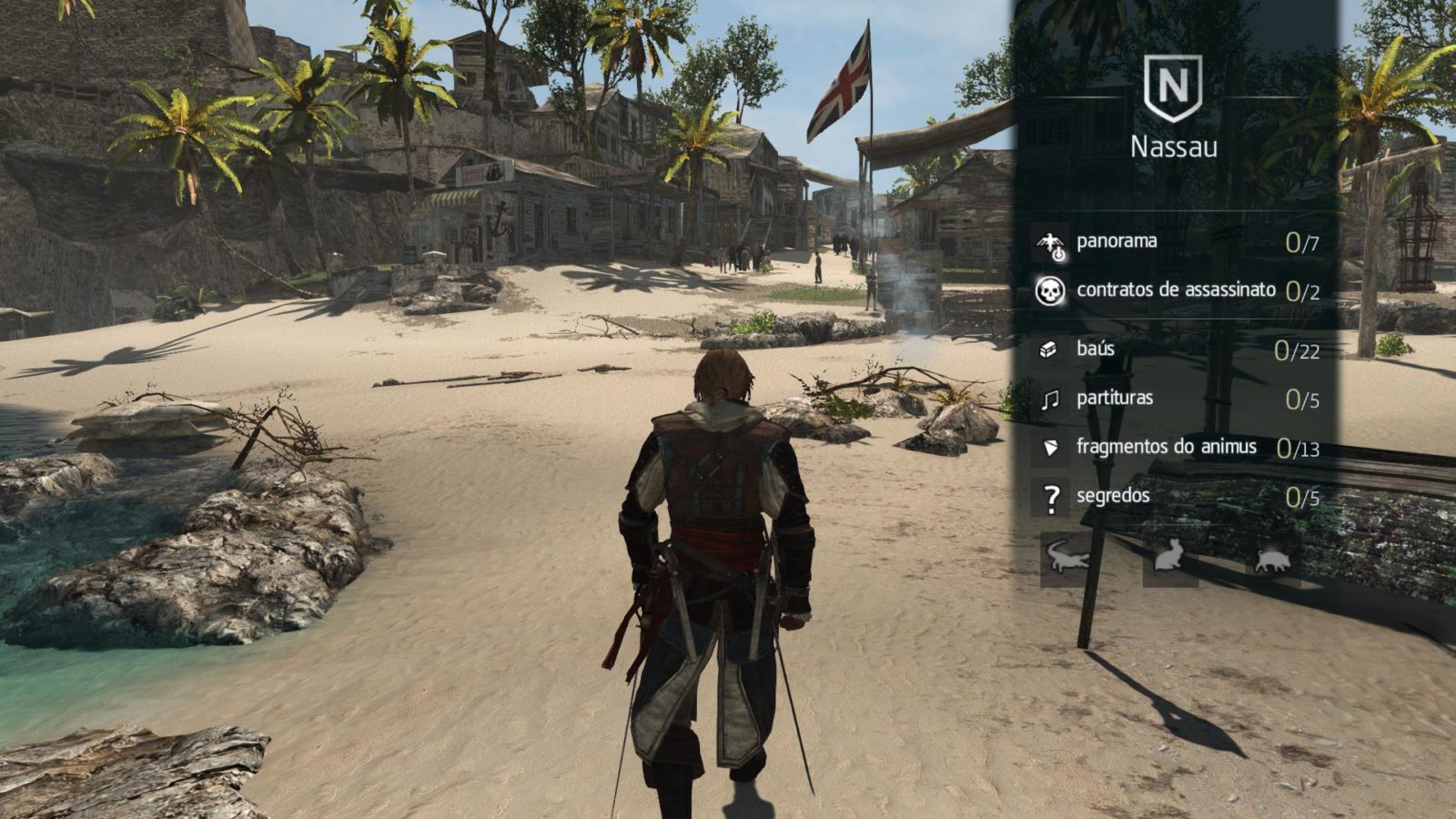 Cities and islands now have a pop-up menu that lets us see what remains to complete each set of activities.
We Take What We Have to Get What We Need.*
Although Edward is a pirate and pirates are known for being extremely fierce, stealth is the best option during missions. The game strongly encourages stealth, which is excellent! The level design of the main mission environments—and several side quests—is built entirely to make stealth the preferred choice. I missed this in Assassin’s Creed III, where achieving 100% in every mission was an arduous task. Assassin's Creed IV, by contrast, chose a more intelligent design in this respect and offers an arsenal that supports the option, with berserk and sleep darts.
The enemies are somewhat more aggressive and intelligent. Several alarm bells are now spread across many missions and summon more guards when rung. Remaining anonymous and hiding bodies is therefore necessary, whether in a haystack or tall grass, areas where Edward becomes invisible to enemy patrols.
Even naval missions include stealth. In restricted areas at sea, the best alternative is to stay out of enemy ships' sight and sail calmly without making much noise—or simply blow everything up; the choice is entirely yours! Few missions desynchronize the player because of chaos, whether at sea or on land, except for some in which the target cannot escape for a particular reason, such as when you need to overhear one of their conversations or follow them to a hideout or meeting.
Come Sing Along with the Pirate Song! Hail the Wind, Hooray for Glory!
Black Flag's compositions are not as memorable as those of Assassin’s Creed III or earlier games. We do, however, have highly energetic music that particularly drives the naval battles and storms that assail the Jackdaw. Although the compositions are not as elaborate, they therefore maintain the game's atmosphere well and are highly present, whether through grand symphonic pieces or simple accompaniment for our everyday parkour. The highlight is certainly the songs on the high seas. Grand Theft Auto and open-world games traveled by car feature countless radio stations; so that we are not left without ambient music aboard the ship, numerous songs can be collected in cities and taught to your crew, who sing them together a cappella. Some are well known, especially Drunken Sailor to anyone who played Dishonored, which adapted the song into Drunken Whaler. It is difficult not to sing the songs after learning them, or at least whistle along with the Jackdaw crew's chorus.
Vegetation and Waves
It is no exaggeration to say that Assassin’s Creed IV Black Flag is one of the most beautiful games of this generation. Even though the game is cross-generation—available for both the seventh and eighth generations—its foundation is in the seventh. Excellent work was done on character modeling and facial expressions, just as in Assassin’s Creed III.
The settings are even better! Despite being an open world with loading screens only when entering some larger cities, the game presents stunning vegetation. There truly is a great deal of brush and an abundance of trees, all very well made!
The other highlight obviously goes to the game's enormous sea, with its waves and extremely violent hurricanes. The sea's movement when aboard the ship is excellent and bears a tremendous resemblance to reality, but the same is not true when standing at a viewpoint in a city. Although watching the ocean stretch into the distance is beautiful, the waves could move more visibly.
Another feature is the transparency of the game's water. Seeing vegetation underwater in many parts of the game is beautiful! Despite this, swimming on the water's surface still looks strange; its movement comes nowhere near the motion caused by the ships.
I encountered only one or two bugs, but nothing that prevented me from progressing—except one that blocked a side mission and was later fixed with a patch; because it did not affect the main mission, I could continue without concern. The strangest occurred during a cutscene in which the pirate Blackbeard spoke to invisible characters. At first, I even thought he was going mad, until I noticed that the ropes around the prisoners moved while the prisoners did not. Bizarre!
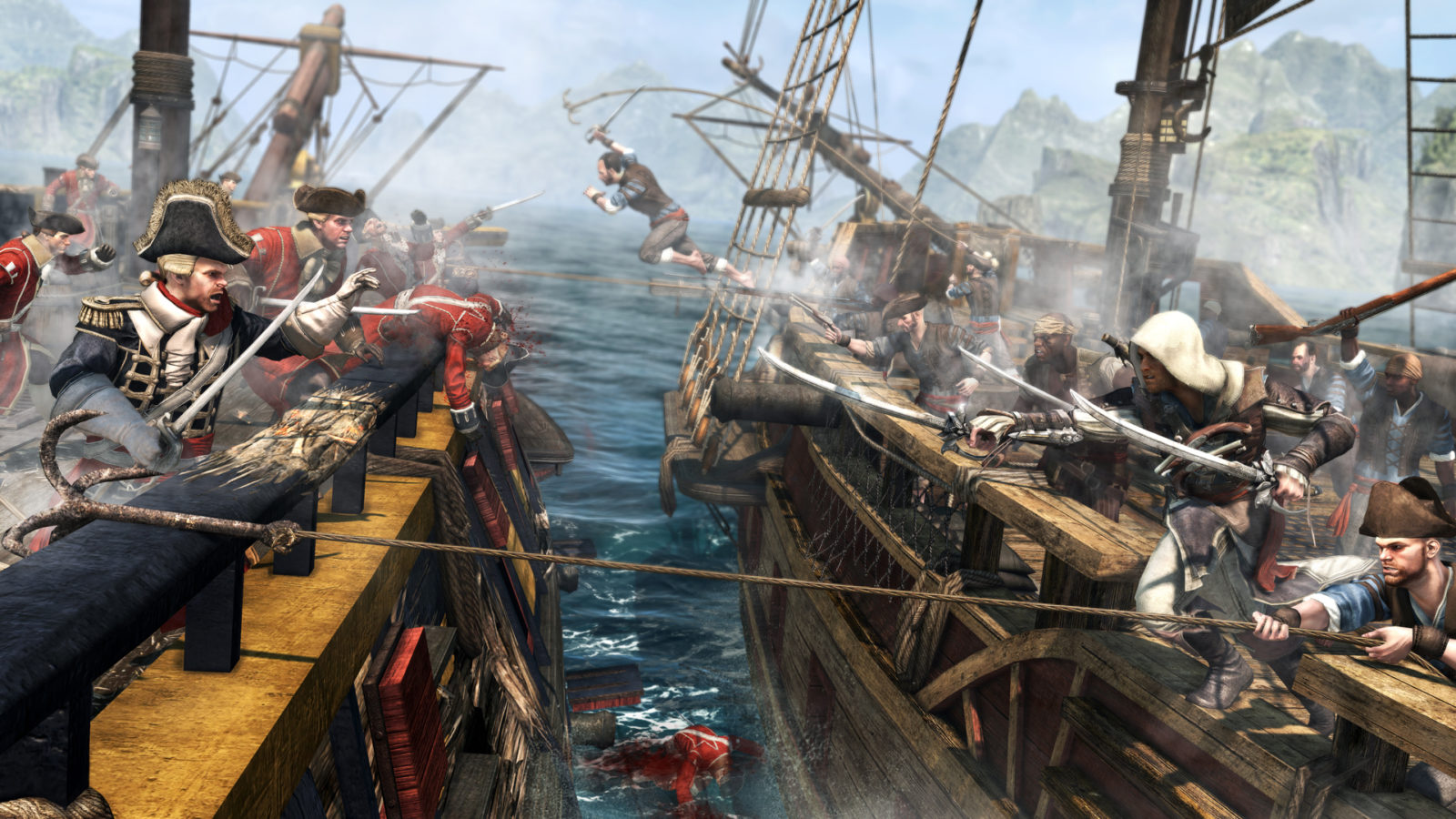
Assassin's Creed IV: Black Flag
Even so, the game's visual and performance work is excellent. On PC, it is incredibly well optimized on my machine, with very few slowdowns or frame-rate drops—at least nothing particularly noticeable. I can only imagine what the next game, which should appear exclusively on next-generation consoles, will bring!
A Pirate's Life Is the Life for Me
Assassin’s Creed IV Black Flag managed to bring the full essence of pirate life to video games. This theme is sorely lacking—while zombie games, for example, are plentiful—and few games manage to explore it despite the wealth of content it can offer. It took a series in which, a few years ago, I could not have imagined pirates fitting in to incorporate the theme so effectively, delivering an extremely rewarding and enjoyable pirate experience while fixing several problems from the previous game—including multiplayer matchmaking, which now finally finds matches easily. With content worthy of a robust sandbox, collectibles that make a difference—even to the soundscape!—and material that will hold you for hours while drawing you away from the main campaign simply because it is fun, I can finally say that Assassin’s Creed Brotherhood has been surpassed! Congratulations, Assassin’s Creed IV: Black Flag: you are the best Assassin’s Creed ever made!
* Lines taken from songs by the band Running Wild.
Rating: 9.5
Tested on the PC version.