With the release of a game based on Magic: The Gathering, it is increasingly clear that games inspired by card games and trading card games (TCGs), also known as cardgames, are becoming more relevant and capable of rivaling hits such as League of Legends and Counter-Strike. A combination of several elements brought them the fame they enjoy today.
This resembles the period when Yu-Gi-Oh! exploded in popularity and everyone had a deck, even if it was not an official one. Besides the anime's influence on its success, the collectible aspect attracted many people. Everyone wanted their favorite cards from the “collection list,” whether by trading or buying them. Yu-Gi-Oh itself is an example of a card-game video game that became a success: Yu-Gi-Oh Forbidden Memories sold 1.8 million copies on the PS1. Today, the Yu-Gi-Oh! brand has embraced online play with Yu-Gi-Oh! Duel Links, and below we will list other famous franchises:
Hearthstone
Hearthstone: Heroes of Warcraft is a card game developed by Blizzard Entertainment and inspired by the mythology of the Warcraft series. The game was announced at PAX West in 2013 and released in March 2014, earning critical and public acclaim. Available for PC, Android, and iOS, it stands out for being easy to learn while offering alternatives for creating more complex strategies and plays to those who master the game. Hearthstone has often been compared with Magic: The Gathering because of its game system, despite their major differences, and remains successful on mobile platforms.
Many people do not know that World of Warcraft, also from Blizzard, had its own physical trading card game. That was one of the foundations for the release of Hearthstone, which also received a physical version.
How the game works:
The player starts with thirty (30) health points and three (3) cards in hand. After a coin toss determines the order of play, the player who did not make the first move receives one extra card from the deck and the Coin card (with a mana cost of 0, it provides a full mana crystal during the turn in which it is played). Each round, the player receives another mana crystal until reaching the maximum of 10. Cards are divided into four types:
- Spell cards: Cast spells with different effects.
- Weapon cards: When used, the hero receives a weapon with durability, which decreases with each attack and is destroyed when it reaches zero (0).
- Minion cards: Summon minions, monsters that fight alongside you to destroy the enemy.
- Hero cards: Replace the hero's current form with a DK (Death Knight), changing the Hero Power and voice lines.
Gwent: The Witcher Card Game
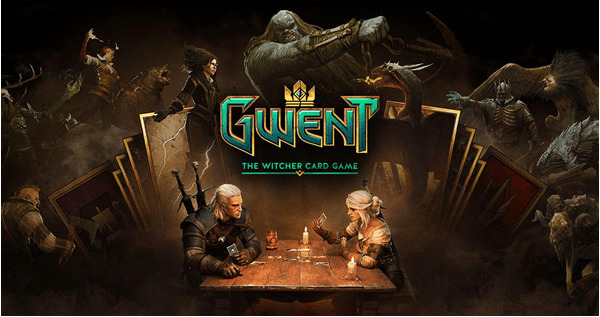
Like Hearthstone, Gwent takes place in an established universe. Set in the world of The Witcher 3, the card game was developed by CD Projekt Red and released on October 23, 2018, for Windows, and on December 4, 2018, for Xbox One and PS4.
Many people do not know that, even before Gwent was announced, CD Projekt released complete decks for this card game, sold separately and especially alongside The Witcher 3 DLCs.
How the game works:
The game consists of turns between two players, with each match lasting three rounds. Each player must play one card per turn from a deck of twenty-five to forty cards. A deck may contain no more than four gold cards and six silver cards. Gold and silver cards generally have more abilities and notoriety than bronze cards. Decks may contain no more than three copies of each bronze card. Each deck belongs to one of five factions: Nilfgaard, Monsters, Skellige, Northern Realms, or Scoia'tael. The game recently received an update called Homecoming, which revamped the environments and changed some battle mechanics to make the game even more strategic.
Magic: The Gathering - Arena
After the success of other virtual card games and the critical and public rejection of MTG Online, Wizards of the Coast decided to create a new version of Magic for the digital world, inspired by the card game's most recent sets. Interestingly, after Hearthstone was compared with Magic, Magic itself decided to take some inspiration from Hearthstone, making the game more accessible to more people.
How the game works:
MTG Arena works in the same way as the physical card game. Two players begin a match. Each player starts with a library, also called a deck, containing at least 60 cards and 20 life points. Each player may have an additional deck, a 15-card sideboard used to make exchanges between matches. Both the main deck and the sideboard are listed in official tournaments for verification and confirmed by both players before matches begin, to ensure fairness. Each library, together with its sideboard, may not contain more than four copies of the same card, unless they are basic lands.
The logical objective is to defeat the opponent. A player is declared defeated when:
- The player's life total reaches zero.
- The player cannot draw another card because the library is empty, or is forced to draw more cards than the library contains (overdraw).
- A specific card determines that the player loses the game.
- The player reaches 10 or more poison counters.
- The player voluntarily concedes.
Each of these experiences appeals to a different kind of player, but a duel to pass the time is always a good excuse.
Pokémon TCG Online
The classic Pokémon card game also received an online version for PC browsers and Android and iOS smartphones. Unfortunately, this version does not seem to have been localized in Brazil, so we have to make do with the physical releases made by Copag. Copag is an extremely well-known card brand, present everywhere from major poker tournaments to casinos. In the case of casinos, however, only online versions are available in the country.
Here is the video to learn how to play: