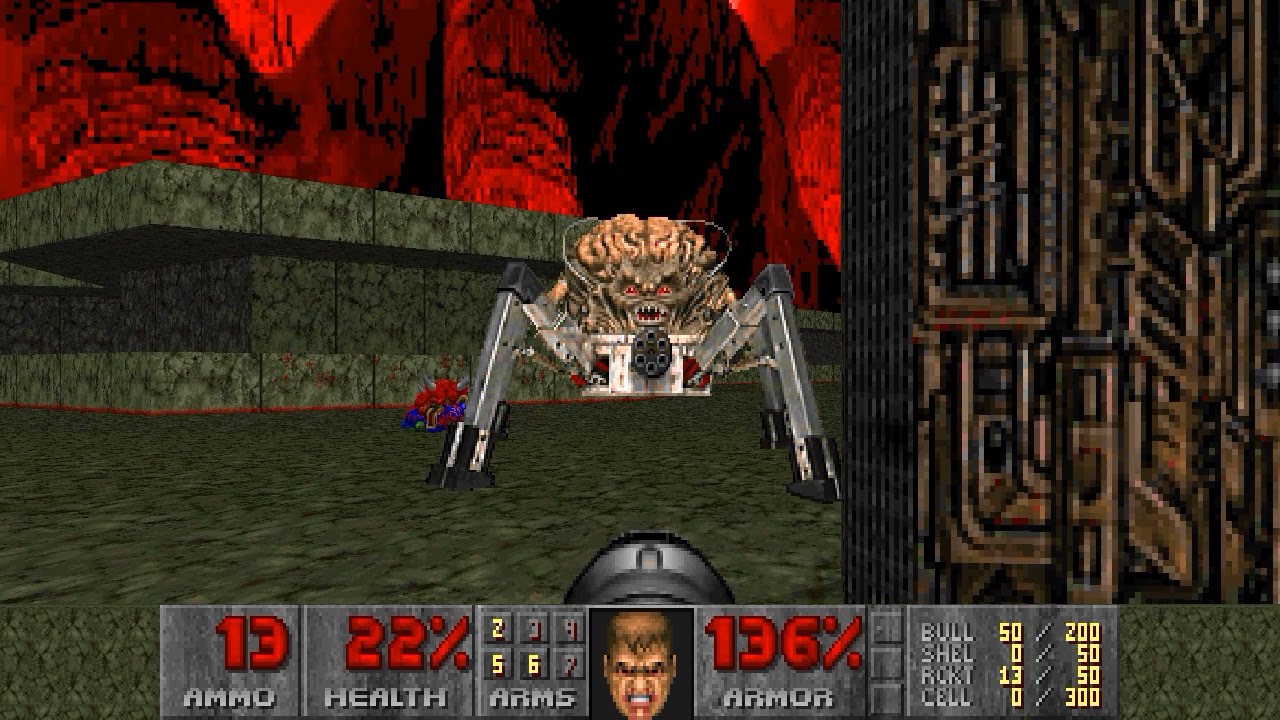

Nine seconds. That was the record set by Thomas “Panther” Pilger in 1998 for a speedrun of the classic game Doom. Run in “ultra-violence speed” mode, this speedrun covers only the game's first stage: the first level, called “Hangar.” It survived for more than 20 years and was finally broken that February by 4shockblast.
Speedrunning is a very common and competitive activity found in many games, particularly shooters, RPGs, and platformers. The objective is simple: finish the game, or a portion of it, in the shortest time possible while ignoring any side activities. In Doom, for example, what matters is reaching the endpoint of the map while ignoring enemies, item collection, your own health, and the score.
In Doom, the most common category is “Ultra-Violence Speed,” meaning that the run is performed at the “Ultra-Violence” difficulty setting. When only one level is used for the run, the game's timer measures the elapsed time. However, this timer has a limitation: it rounds times down to the nearest second. Therefore, when the time is given as 9 seconds, it could be 9.1 seconds or 9.9 seconds.

Rare artwork from the first Doom, shared by John Romero.
The Coveted Second
One of the difficulties in breaking the record lay precisely here. The original record was 9.91 seconds. Therefore, almost a full second had to be gained to break it—from a run that seemed ideal. It seemed so, but it was not. Although the run was technically well executed, using techniques such as strafe-running to accelerate the character's movement and taking the shortest routes, a close look revealed several mistakes.
For example, the timing used to open the three doors in the level was not ideal, and 0.14 seconds could have been saved on that alone. Thomas took the shortest routes when accounting for the enemies in the level, so if the stars aligned, there could be a run in which the monsters allowed a more direct path. But more than correcting these mistakes would be necessary.
“Infinite” Trial and Error
The runners who set out to break the record would have to use new strategies, specifically one called SR50 strafe-running. In Doom, the laws of physics are applied quite well to movement, with settings for acceleration and friction governing lateral and forward motion. SR50 involves changing the percentage acceleration settings applied to these two vectors when the keys are pressed. Combined with the right movement technique, it ultimately provides a 10% speed increase. However, this technique is much harder to perform, involving the use of four keys simultaneously instead of the two originally used. A great deal of training would be required. Two runners in particular coordinated their efforts and competed to set the new record: 4shockblast and Looper.
Over the course of a year and 50,000 attempts, they kept trying until, at last, 4shockblast achieved the magical 8 seconds the previous February, breaking a 22-year-old record. A memorable and probably unbeatable milestone, it demonstrates the determination video games can inspire in people in their pursuit of perfection.