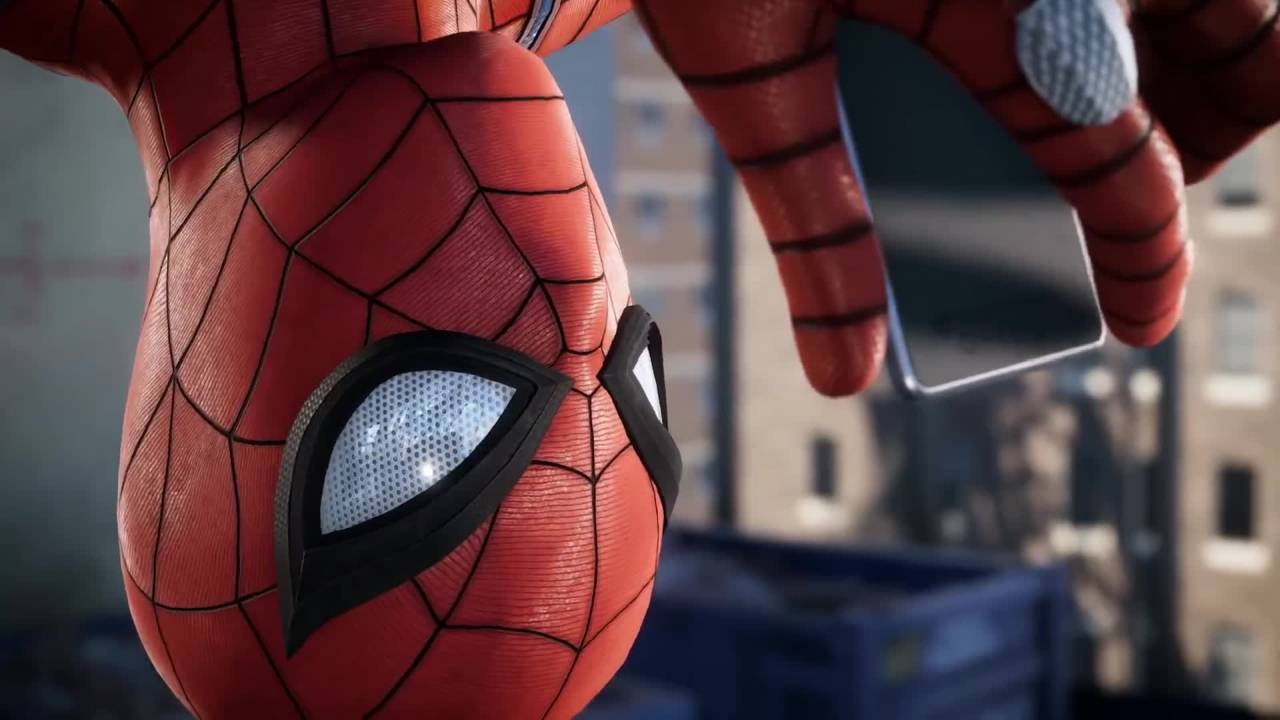

With the release of Spider-Man for PlayStation 4, the beloved web-powered hero once again stands out among superhero games! Marvel's Spider-Man became Sony's fastest-selling exclusive over the shortest period up to its release, selling twice as many copies as God of War when the first weeks of both were compared.
Since we are also fans of Peter Parker's adventures, we at Epic Play decided to present every game starring the hero, excluding only the LEGO series and other occasional special appearances. You probably encountered many of the games on this list throughout your gaming history, while you may have "had no idea" many others even existed. Without further delay, let us begin the list of Spider-Man games!
Spider-Man (Atari 2600 — 1982)
The first Spider-Man game was developed by Atari and distributed for the Atari 2600 in 1982. Supporting two players, the idea is to climb buildings using his powers with the objective of reaching the top.
Questprobe (PC — 1984)
In the early days of PCs, there was a genre called "graphic adventure," which evolved from text adventure games in which you simply selected what the character did, like an "interactive book."
Questprobe is a trilogy featuring Marvel characters, with its second game starring Spider-Man. With a strong emphasis on narrative, it became an extremely "underground" cult classic among fans of the hero and old games.
The Amazing Spider-Man and Captain America in Dr. Doom's Revenge (PC — 1989)
A crossover with Captain America, this was the first game with fighting elements. It was not very well received because of its linearity and strange controls, but the visuals are good by the standards of the period.
The Amazing Spider-Man (Amiga — 1990)
Blending platforming and puzzles, this game reached the Amiga in 1990 and was later converted for several other systems, including MS-DOS, Commodore 64, and Atari ST. Quite simple, its idea is to solve puzzles as Spider-Man.
The Amazing Spider-Man (Game Boy — 1990)
Developed by Rare, the same company that would become known years later for the Donkey Kong Country trilogy, The Amazing Spider-Man was highly successful on Nintendo's first handheld and received two sequels developed by a different studio.
Combining beat 'em up, action, and platforming, it has good graphics for the console and a good soundtrack by handheld standards. Curiously, the title's composer was David Wise, the same composer from the DKC trilogy.
The Amazing Spider-Man VS The Kingpin (Master System / Mega Drive / Sega CD — 1990 to 1993)
Developed by TechnoPop and released for several SEGA consoles, this action game features fighting and overcoming obstacles, like the vast majority of games from the period.
The idea is to collect keys throughout the stages to deactivate a nuclear bomb set by the villain Kingpin. Just as you are about to complete the mission, Venom appears "in the middle of the game" and kidnaps Mary Jane to complicate the hero's life even further.
The best-known version is the Mega Drive release, which achieved critical and commercial success through graphical excellence and fluid gameplay. The Master System game, however, was the first to reach the market.
Spider-Man The Videogame (Arcade — 1991)
Developed by SEGA for arcades, this is a beat 'em up and was also extremely well received by the media at the time, with praise for its graphics, music, and gameplay.
Interestingly, it supports up to four players, with the other three characters being Black Cat, Hawkeye, and Namor. Each has specific abilities, increasing replay value.
The Amazing Spider-Man 2 (Game Boy — 1992)
Continuing Spider-Man's saga on Nintendo's handheld, The Amazing Spider-Man 2 was developed by Bits Studios and offers a somewhat different experience from the first game, focusing more heavily on platforming and puzzle-solving.
Spider-Man: Return of the Sinister Six (NES, Master System, and Game Gear — 1992 and 1993)
Also developed by Bits Studios, it is striking that the game appeared on 8-bit consoles at a time when the Super Nintendo and Mega Drive were the market's leading systems.
Quite simple, it is a side-scrolling action game in which you defeat enemies with spider powers and continue to the end of the stage. Its gameplay was not very well received, but visually, the game is excellent considering the platforms for which it was released.
Spider-Man and the X-Men in Arcade's Revenge (Super Nintendo, Mega Drive, Game Gear, and Game Boy — 1993)
A crossover with the X-Men, this game has you complete each stage with a different hero while taking advantage of their individual abilities. There are environments for Spider-Man, Storm, Wolverine, Gambit, and Cyclops.
It was not particularly well received at the time, especially because of the controls in the handheld versions and the high difficulty level.
Spider-Man 3: Invasion of the Spider-Slayers (Game Boy — 1993)
Closing the trilogy of games for the original Game Boy, it continues the gameplay from Spider-Man 2 with puzzle-solving and platforming elements.
Spider-Man and Venom: Maximum Carnage (Super Nintendo and Mega Drive — 1994)
Probably one of the list's best-known titles among retro gamers, Spider-Man and Venom: Maximum Carnage received mixed-to-negative reviews from the media but became a commercial success and highly popular with the public.
Curiously, the soundtrack is one of the features that draws the most attention. Every track was created by rock band Green Jellÿ, and the game also includes a Black Sabbath song, "The Mob Rules."
Beyond that, it is the first game to follow events from the comics, complete with themed cutscenes. As for gameplay, it is a classic beat 'em up, effectively a "Spider-Man Final Fight."
The Amazing Spider-Man: Lethal Foes (Super Nintendo — 1995)
The only game restricted to the Japanese market, Lethal Foes is an action title with platforming elements and the objective of reaching the end of each stage. With decent gameplay and an enjoyable soundtrack, it is a shame this game remained limited to Japan.
Spider-Man/Venom: Separation Anxiety (Super Nintendo, Mega Drive, and PC — 1995)
Given the commercial success of Maximum Carnage, creating a sequel to the beat 'em up was only fair. This one was also not viewed "favorably" by the media at the time, however, which argued that it had "evolved little" from the previous game. Ultimately, it is another "Spider-Man Final Fight."
Spider-Man (Super Nintendo and Mega Drive — 1995)
Another Mega Drive and Super Nintendo action game with platforming elements that uses characters from Peter Parker's world. Curiously, the Mega Drive and Super Nintendo versions differ, with exclusive stages in each.
Neither was very well received because of weak visuals, especially considering that the game arrived near the end of the 16-bit generation, and gameplay that was not remotely original.
Spider-Man: Web of Fire (SEGA 32X — 1996)
One of the list's most underground titles, this game was released shortly after SEGA said it would no longer support the 32X in 1996. Probably as a result, it generated little attention from either the media or players. Those who played it, however, say that the game has decent gameplay and graphics that looked good at the time.
Spider-Man (PlayStation — 2000)
Developed by Neversoft, this title was Spider-Man's first 3D adventure and became highly successful among original PlayStation players in the early 2000s.
Curiously, the soundtrack features Tommy Tallarico, famous for Video Games Live, and the game also includes narration by Spider-Man co-creator Stan Lee.
The game received conversions for consoles of the generation, all very well received except the Game Boy Color handheld version. At the time, many people called it "the best Spider-Man game" ever made.
Spider-Man 2: The Sinister Six (Game Boy Color — 2001)
A sequel to the Spider-Man game released for Game Boy in 2000, it is a classic 2D action game. It was praised for its good handheld graphics, music, and gameplay.
Spider-Man 2: Enter Electro (PlayStation — 2001)
Highly similar to the previous game, this one stands out by allowing play on city streets, since the first had stages primarily on top of buildings, where "falling" meant death. It also seeks greater realism in its enemies and has subtly better graphics.
Because it was less well received than the first due to its "limited evolution," a third chapter in the saga for the original PlayStation was abandoned.
Curiously, Activision reissued the original game after the September 11 attacks in 2001, because the final battle was originally to take place atop one of the World Trade Center towers. Several cutscenes were also remade, some levels were renamed, and every reference to the WTC was removed.
Spider-Man: Mysterio's Menace (Game Boy Advance — 2001)
Developed by Vicarious Visions and published by Activision, this Spider-Man game follows the side-scrolling platform formula, with enemies and bosses to defeat.
Spider-Man: The Movie (GameCube, PlayStation 2, Xbox, PC, and GBA — 2002)
A kind of "natural successor" to the original PlayStation games, it is a beat 'em up with indoor stages and levels on the rooftops of New York City.
Following the story of the film starring Tobey Maguire, it was considered an excellent game at the time, despite some criticism of the camera and its short length.
Even so, it became a commercial success, selling around two million copies on PlayStation 2 alone and six million in total, excluding the Game Boy Advance version, which reached 750,000 copies.
Spider-Man 2 (GBA, GC, PC, PS2, Xbox, Nintendo DS, and PSP — 2004)
Curiously, the console version is completely different from the computer edition, probably because they were developed by different teams.
The realism of the webs when the protagonist shoots them at buildings is undoubtedly what draws the most attention. Considered by many the "GTA of Spider-Man" and the "best Spider-Man game" up to its release, every version was well received except the handheld editions, with reviews saying those games were merely "okay."
Ultimate Spider-Man (GBA, GC, PC, PS2, NDS, Xbox — 2005)
Following the beat 'em up formula, this game gives you more freedom than the others by allowing you to explore Manhattan and Queens, along with the option to play as Venom.
The Game Boy Advance and Nintendo DS versions, meanwhile, are platform games with a 2D perspective. Well received by most critics in both forms, this is considered another good game starring the Marvel hero.
Spider-Man: Battle for New York (Game Boy Advance, Nintendo DS — 2006)
Another 2D action platformer, this game reimagines the first meeting between Spider-Man and the Green Goblin. The cutscenes were created by Ron Lim of Marvel Comics itself.
Spider-Man 3 (GBA, PC, NDS, PS2, Wii, X360, PS3, PSP — 2007)
There are three versions of this game: one released for PC, Xbox 360, and PlayStation 3; another for PlayStation 2, Wii, and PSP; and the Game Boy Advance and Nintendo DS editions.
They are action-adventure games in every case, but unlike the previous two titles, this one was less well received because of weak graphics regardless of the console, short length, and numerous glitches throughout the adventure.
Spider-Man: Friend or Foe (PC, NDS, PS2, PSP, Wii, Xbox 360 — 2007)
Based on the Spider-Man film trilogy of the 2000s, this game aims to reinterpret all three films within a single title.
Developed by Next Level Games with a new engine and plenty of action, it had everything needed to be well received but ultimately earned mixed scores because of its low difficulty and repetitive missions.
Spider-Man: Web of Shadows (PC, NDS, PS2, PS3, PSP, Wii, X360 — 2008)
The DS version uses the Metroidvania formula, while the console editions follow the action-adventure genre. Every version was praised for its gameplay, original story, good voice acting, and style closer to an "open world." They were also criticized, however, for weak graphics, a poorly executed plot, and camera problems.
Spider-Man: Toxic City (BlackBerry, Windows Phone — 2009)
Made for mobile devices, this is a side-scrolling action game in which you defeat enemies, climb buildings, defeat a boss at the end, and advance through the stages.
Ultimate Spider-Man: Total Mayhem (iOS, Android — 2010)
Unlike the previous game, this is an entirely 3D beat 'em up with polygonal graphics developed by Gameloft. With excellent visuals and gameplay, it is another great Spider-Man game.
Spider-Man: Shattered Dimensions (NDS, PS3, Wii, X360, and PC — 2010)
As the name suggests, you control different versions of the hero from the Amazing, Noir, 2099, and Ultimate eras, each with individual abilities. Although the Nintendo DS version has the same premise, it differs drastically in gameplay, does not feature the Spider-Man from the Ultimate universe, and has different bosses.
Receiving positive scores from the media, the game was praised for its engaging story, good battles, and "old-school" gameplay style.
Spider-Man: Edge of Time (NDS, N3DS, PS3, Wii, X360 — 2011)
A sequel to the previous game, this title seeks to focus on the stories of the original protagonist and the 2099 version while omitting Noir and Ultimate. As a new gameplay feature, it adds a cause-and-effect system in which one Spider-Man's actions affect the other and vice versa.
Unlike its predecessor, this was received more "lukewarmly." The consensus was that instead of advancing the previous game, it regressed in both the number of characters and repetitive gameplay.
The Amazing Spider-Man (NDS, N3DS, PS3, Wii, X360, Android, iOS, PC, Wii U, PS Vita — 2012)
There are three versions of this game: the HD edition released for home consoles, a kind of open world in which you can go anywhere and must complete missions; the Wii and Nintendo 3DS version, which has the same story but uses a stage-selection system instead of an open world; and the DS version, which is a Metroidvania.
Receiving mixed-to-positive scores from the media, the consensus is that it is very entertaining and has enjoyable gameplay in every version, especially the open-world HD release, but that its story is generic and it has repetitive missions. According to most people, the game had the potential to be better than it was.
The Amazing Spider-Man 2 (N3DS, PS3, Wii, X360, Android, iOS, PC, Wii U, PS Vita — 2014)
Following the formula of the previous game's HD edition, this title was less well received because of bugs and below-expected graphics on every console for which it was released. The consensus is that it lacked polish and seemed to have been "released in a rush."
Spider-Man Unlimited (Android, iOS, Windows Phone — 2014)
Developed by Gameloft, this game arrived to ride the endless-runner wave and is a kind of Subway Surfers / Sonic Dash starring the Marvel hero. Since games in the genre were a craze at the time, it reached 30 million downloads.
Marvel's Spider-Man (PlayStation 4 — 2018)
After four years without a main Spider-Man game, Marvel's Spider-Man was released, this time developed by the acclaimed Insomniac Games and published by Sony Interactive exclusively for PlayStation 4.
Meeting the public's high expectations from previews, the game was well received around the world and praised for its graphics, story, music, gameplay, and faithful recreation of New York City. Its only point of criticism was a lack of innovation in the open-world style, making it seem that the developer decided to "play it safe" to ensure the game's success.
With no connection of any kind to a film or the Spider-Man comics, this is a new interpretation of Peter Parker's adventures.