The gaming market is one of the most profitable in the world. Within this universe, there is an endless variety of games aimed at many different audiences. As a result, numerous high-quality titles are released each year. These titles typically receive major investment in graphical improvements, storylines, and especially multiplayer modes, which have been a market trend in recent years.
With so many incredible releases becoming available every year, one might expect consumers to be entirely focused on new video games. However, a recent Newzoo study reveals that the reality is somewhat different.
The time the average consumer spends playing each year appears to be increasingly concentrated on a specific group of older titles, especially live-service games and already well-established franchises.
Growth in Video Game Revenue Is Driven by Older Titles
According to Newzoo's study, the industry experienced significant growth during 2023, reaching more than $93.5 billion in revenue. However, just 66 games accounted for 80% of users' playtime, and 60% of those were games released more than 6 years ago.
Fortnite leads on every platform, including the Nintendo Switch. Other games mentioned include titles such as GTA 5, Roblox, Minecraft, Rocket League, Fall Guys, Apex Legends, Valorant, Counter-Strike 2, and Call of Duty. In addition, an analysis of PlayStation and Xbox shows that Starfield is the only fully single-player game listed among the most played.
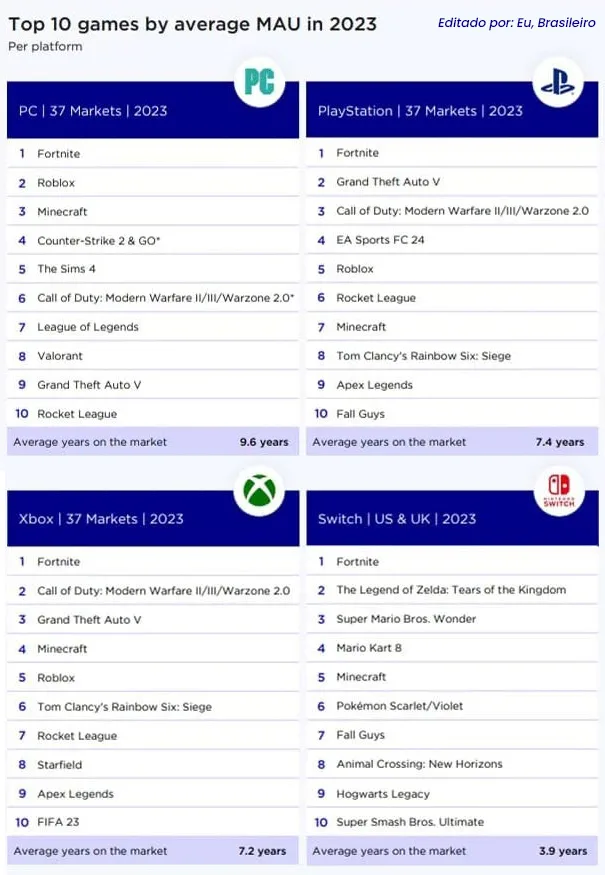
The study also shows that, of the 23% of playtime spent on new games in 2023—defined as games released two years ago or less—more than half was spent on annual sequels from major franchises, such as the latest Madden (American football) or NBA game. Just 8% of video game playtime was spent on new, nonannual titles such as Diablo IV or Baldur's Gate III.
The Landscape Is Likely to Remain “Hostile” to New Games
Although the Newzoo report indicates that new games can still succeed in this environment, the reality is that players are spending less and less time on new games and increasingly more time on established franchises and live-service titles, making it harder for publishers and developers to find an audience. This is because, unlike in previous decades, developers are not merely competing with every new game on store shelves; instead, they are fighting giants such as Fortnite and Roblox, entirely free games with “infinite” amounts of user-created content.
“It will become increasingly challenging to grow a game's player base,” Newzoo said in the report, “particularly in our current landscape, where evergreen titles and robust content pipelines reign supreme.”