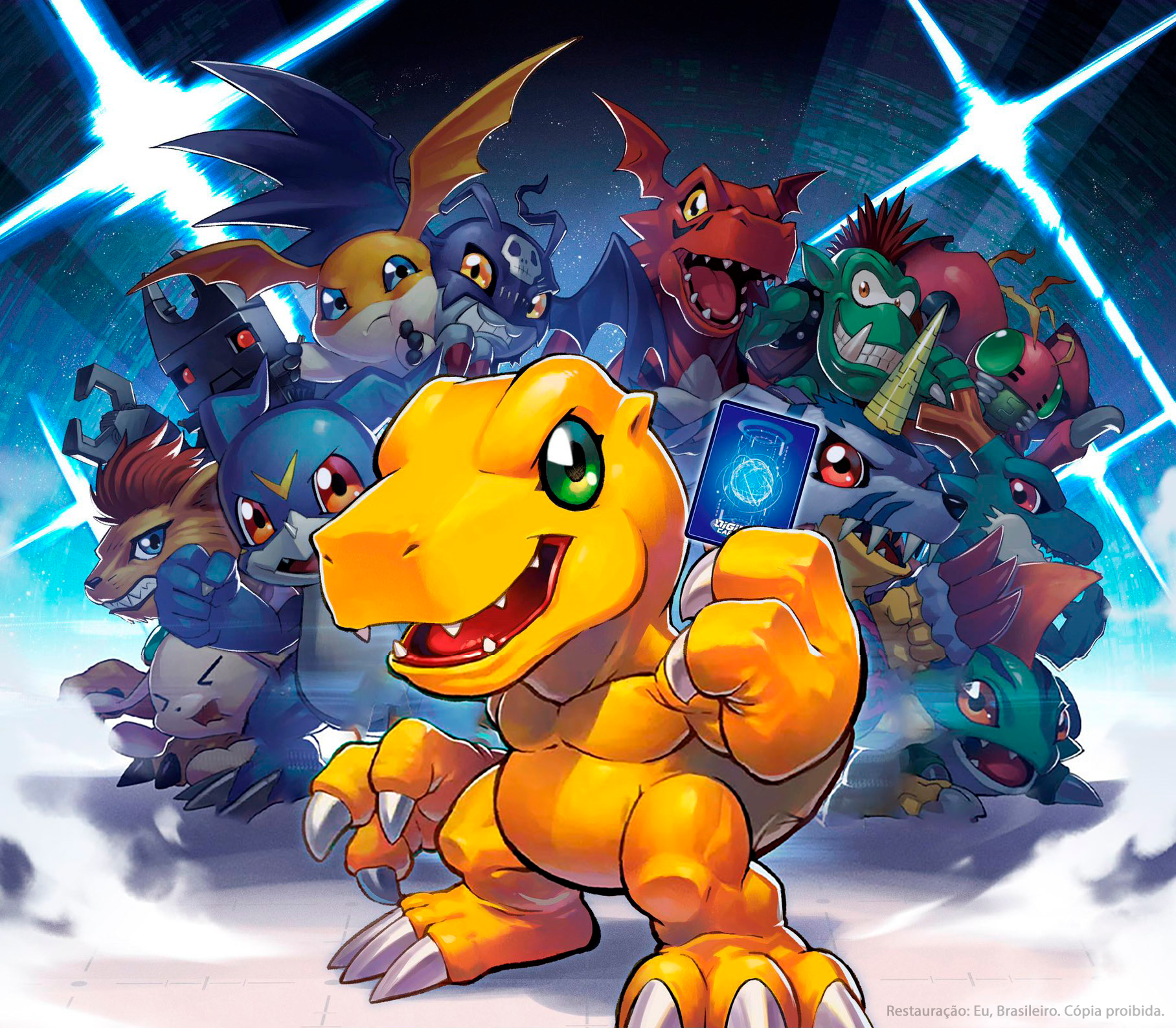

Distributed in Brazil beginning in the first half of 2023, the Digimon card game is produced by Bandai Namco and contains numerous references to both the classic Digimon Adventure anime and more recent series and films, as well as games such as Digimon World and Digimon Story: Cyber Sleuth and even manga, for example. While welcoming to franchise fans, this production also attracts casual and advanced players of collectible card games, or trading card games.
Achieving tremendous worldwide success and quickly becoming one of the world's five best-selling card games according to TCGplayer, the game offers a variety of possibilities and strategies and depends more on player ability than luck.
In Digimon Card Game, a deep understanding of the "synergy" among your cards is important. Your Digimon can evolve from any other Digimon of the same color, making the "metagame" highly diverse. First, however, let us cover the basic rules:
Basic Game Rules
Card Types
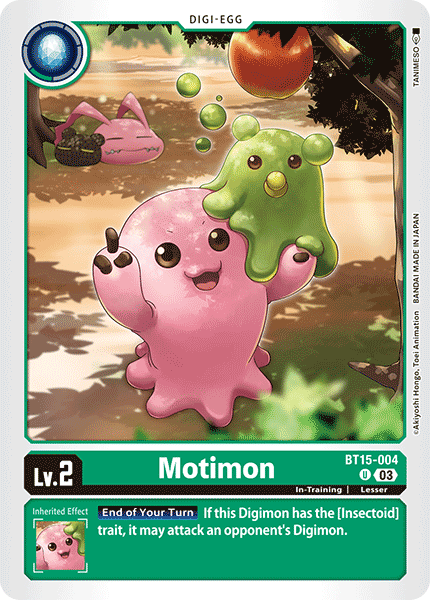
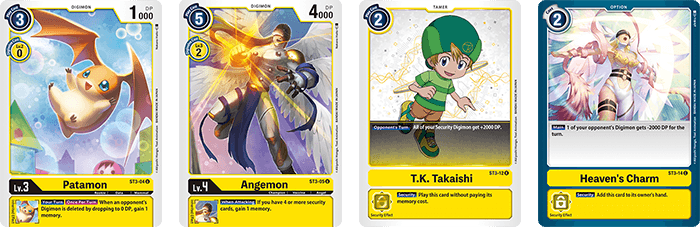
Digi-Egg: The base cards for an entire Digimon evolutionary line. At the start of a match, one will probably be the first Digimon you put into play, in the breeding area. After digivolving into more powerful stages, this Digimon can then enter the battle area. One Digi-Egg can be played at a time.
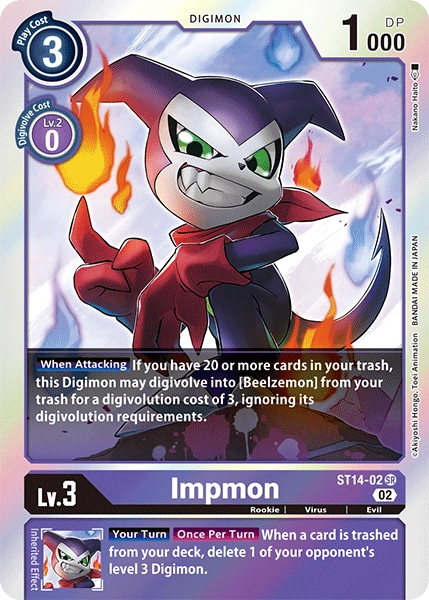
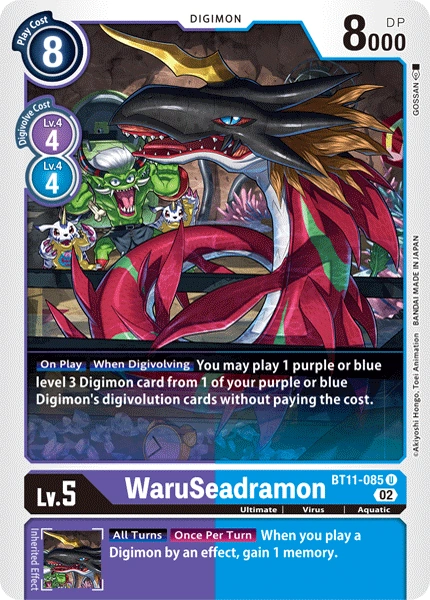
Digimon: While the Digi-Egg in the breeding area is level 2, Digimon used in battle are any Digimon cards from levels 3 through 7. Each Digimon has specific attributes, effects, costs, and colors. A card may also contain an "inherited effect" at the bottom. When it digivolves into a more powerful Digimon, the inherited effect of each Digimon underneath can be used as an effect inherited by the Digimon's current evolution. Each effect is valid and applied only according to its description, however.
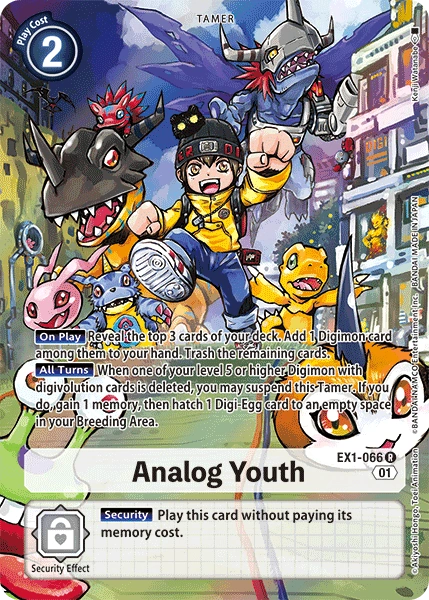
Tamer: These cards represent the humans who ally with Digimon, offering strategic advantages during the match through their own effects.
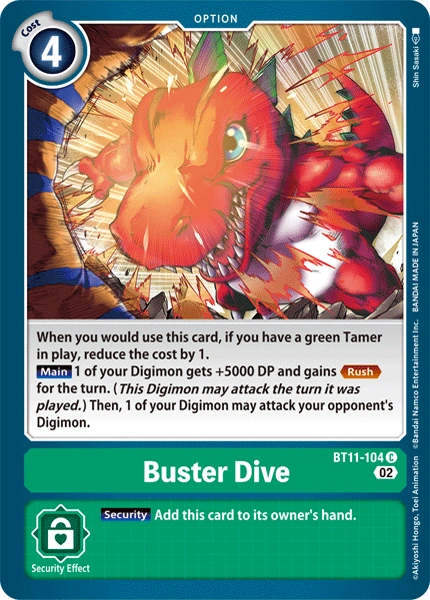
Option: Option cards provide immediate effects or conditions that can change the state of play. Specifically, before using an Option card on the field normally, you must have a Digimon or Tamer card of the same color in play.
Preparing to Play
There are seven colors in the game, including white, and they usually all function in the same way. A card can sometimes have two colors and functions normally as a dual-color card. You may have any card of any color in your deck, but Option cards can be played only if a matching color is in play, and a Digimon of one color can digivolve only into another of the same color, whether that is the Digimon's sole color or one of its two colors.
You may have up to four copies of the same card in play, and cards are considered identical only if they have the same set and number. In other words, you may have up to four Guilmon cards from set EX4-006 as well as four Guilmon cards from set ST7-03.
Before starting, players must prepare a deck of exactly 50 cards, taking the maximum-copy rule into account. They may also have up to five extra Digi-Egg cards under the same rules as the others, but these five extra cards are not mandatory because you can also play a Digimon directly onto the field without evolving it from a Digi-Egg.
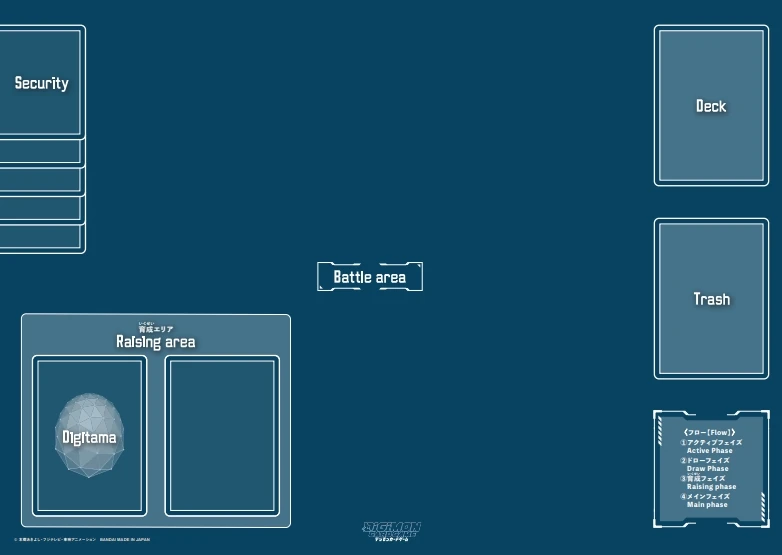
The Game's Turn Flow
When starting the game:
- Place your deck on the right, separate from your Digi-Egg cards, which sit at the lower left of each player's field.
- Draw five cards from the top of the deck. After checking them, if you do not like your initial hand, you may choose to shuffle them and draw five new cards one time only.
- Place five cards from the top of your deck in the security zone, stacked horizontally above the Digi-Eggs. These will be your "health points" in the game. Each player can attack either the security zone or a Digimon, but a Digimon can be attacked only if it is lying horizontally, as explained further below.
- Use a random method to decide who starts the game. In a best-of-three match, the player who lost the previous round chooses who starts.
Each turn is divided into four main phases:
- Unsuspend Phase: Turn back the cards that were suspended horizontally on previous turns.
- Draw Phase: Draw a card.
A player who cannot draw because no cards remain in the deck at the start of their turn loses the game.
The player who takes the first turn of a game does not draw a card during this phase. - Breeding Phase: Players may take only one of the following actions during this phase:
- Place a Digi-Egg in the breeding area if there is not already a Digimon there.
- Move that Digimon into the battle area if it has already digivolved to level 3 or higher.
- Do nothing and proceed to the next phase. - Main Phase: The game's main phase. During this phase, players may, for example:
- Play Digimon onto the field in the battle area.
- Digivolve their Digimon (there is no limit to how many evolutions you can perform with your Digimon per turn, but you need enough points on the memory gauge).
- Play Tamers.
- Use Option cards.
- Declare attacks if their Digimon is not already suspended. If you attack with your Digimon, or if an effect in play specifically asks you to do so, suspend it horizontally afterward, preventing it from attacking for the rest of the turn.
- Activate effects.
- End the turn automatically when the memory points you spend cross onto the opponent's side (after resolving all previously declared effects and attacks), or end the turn voluntarily while you still have memory points left, which gives the opponent three memory points regardless of your score. More details appear below.
Remember that certain effects activate at the beginning or end of a phase, or while one of your or your opponent's phases is active. Pay attention to each card's description. - End of turn.
Memory Gauge
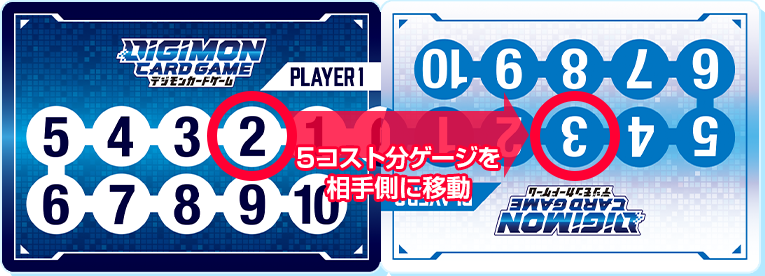
Running from zero to 10, the memory gauge is the tool that determines players' turns. On the first turn of the game, the player starts at zero, and their actions determine how these points are spent. If, for example, you play a Digimon with a play cost of four directly into the battle area during this turn, your opponent begins their turn with four points and takes actions from there. Effects and costs make them lose or gain points until the turn passes to the opposing player, continuing the flow of the game.
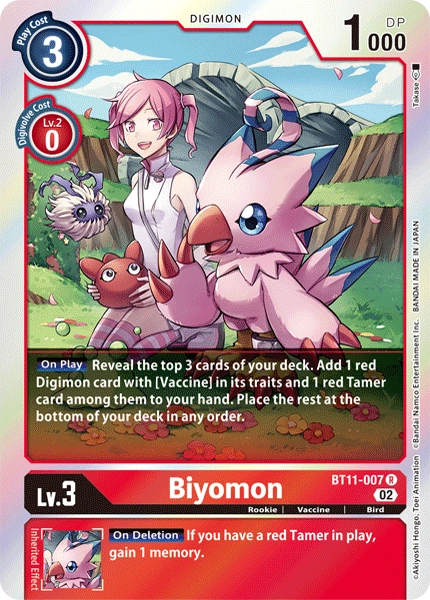
Digimon have two types of costs: the cost to play one directly without digivolving and the digivolution cost. For example, this Biyomon card can be played directly onto the field by spending three memory points, or it can digivolve from a red level 2 card at no memory cost.
In short, a player's turn ends only when this zero-to-10 gauge becomes "negative" and crosses onto the opponent's side. Otherwise, if you pass without finishing the use of your points, the opponent moves their score to three and begins their turn.
You may also use cards that give your opponent more points than this, as long as their side does not exceed 10 points when your points are included. For example, you have three points on your memory gauge and decide to play a Digimon with a cost of nine. Your opponent's counter moves to six points on their memory gauge, so they begin their turn that way.
Digivolution
Digivolution is a key process in the game that allows Digimon to become more powerful. To evolve a Digimon, the player pays the card's digivolution memory cost if necessary and places the new Digimon card over the previous one, keeping the evolutionary chain visible so that the inherited-effect portion at the bottom of each card remains displayed.
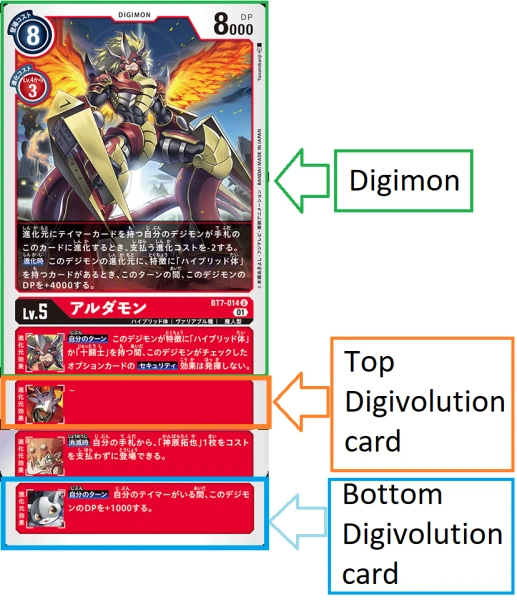
As mentioned earlier, this process allows each Digimon card's inherited effects to activate, but only when another Digimon is above it. A Digimon can also digivolve only if the one underneath is the same color as the next one, and the evolutionary line must follow the levels in ascending order—levels 3, 4, 5, 6, and 7—unless a specific effect says otherwise.
Combat, Security, and Victory Conditions
During the Main Phase, players with an active Digimon can attack the opponent's Digimon if they are suspended—turned horizontally—or attack the opposing security zone. If you choose to attack the security zone, one of its cards is revealed and destroyed, or, depending on effects, more security cards are revealed and destroyed. Some cards in the security zone may have a security effect; in that case, activate what the effect says.
Opposing Digimon can be attacked only if they are suspended or under certain specific effects. Your newly played Digimon cannot attack on the turn they enter the field, but they can attack if their evolutionary line has been in play for more than one turn, whether in the battle area or the breeding area. Digimon that have just entered the breeding area can likewise move to the battle area only after one turn.
When attacking, you automatically suspend your Digimon, and its DP in the upper-right corner is then compared with the opponent's. If your Digimon's DP equals the opponent's, both die. If yours is higher, only the opponent's dies. Remember that some effects in play can activate to increase or reduce Digimon DP.
If game effects reduce a Digimon's DP below zero, that Digimon is automatically deleted from the battle area. For example, three combined effects give a Digimon -8,000 DP and reduce the Digimon in question to zero DP, so it is deleted and sent to the trash.
When it comes to the security zone, a revealed Digimon card with higher DP is still destroyed unless an effect in play says otherwise. If the opponent's power is higher, however, the Digimon that attacked the security zone also dies in this action, unless prevented by effects.
If a player has no security cards left, the next attack can be directed at them. If no effect blocks this direct attack, the player loses the game. As already noted, a player who can no longer draw cards at the beginning of their turn also loses.
Common Glossary
Effect Keywords and Other Terms
- Block: When a Digimon attacks, the opposing Digimon with Block can suspend and become the target of that attack. This works only if the Digimon with Block is active.
- Security: Activates only when the card is in the security zone and is turned over during a check.
- Security Attack +x: When activated, this effect increases the number of cards checked in the security zone if an attack targets it. If the attacking Digimon is destroyed or returned to the player's hand while cards are being checked, the attack ends.
- Security Attack -x: The number of security checks this Digimon performs is reduced by x. When the number of checks becomes zero—it never becomes negative—no check is performed. If the attack is directed at the opponent, the player does not win the match even if the opponent has zero security cards.
- Recovery +x (Deck): Draw x card(s) from the top of your deck and place them in your security zone. Neither the player nor the opponent should look at the drawn cards. There is no maximum number of cards in the security zone.
- Piercing: When this Digimon attacks and deletes an opposing Digimon while surviving the battle, it performs all the security checks it would normally make. This effect allows a Digimon to check an opponent's security cards after a battle if your Digimon defeats the opposing Digimon and survives.
- Draw x: Draw x card(s) from the top of your deck. There is no maximum number of cards you may hold in your hand.
- Jamming: This Digimon cannot be destroyed in a battle against a security Digimon. If the Digimon in question can perform more checks thanks to "Security Attack +x," the checks continue even if the previous battle is lost.
- Digisorption -x: When one of your Digimon digivolves into this card from your hand, you may suspend one of your Digimon to reduce the digivolution memory cost by x.
- Reboot: Unsuspends your Digimon during your opponent's Unsuspend Phase.
- De-Digivolve x: Trash up to x digivolution cards from the top of one of your opponent's Digimon. Trash the specified number of cards from the opposing Digimon targeted by the effect, beginning with the top card. This lowers the target Digimon's level. Digimon cannot, however, be deleted or removed from the game by this effect. Once a Digimon has lost all its digivolution cards or has been reduced to level 3, you cannot trash more cards with this effect.
- Retaliation: When this Digimon is deleted after losing a battle, delete the Digimon it was battling. When a Digimon with this effect loses a battle against one of your opponent's Digimon, it deletes that Digimon regardless of DP.
- Digi-Burst x: Trash x digivolution cards from this Digimon to activate the effect below.
- Rush: This Digimon can attack on the turn it enters play. Digimon with this effect do not need to wait one turn before attacking.
- Blitz: When digivolving into a Digimon with this effect, you may attack with it before the turn ends even if paying the digivolution cost moves the memory gauge to one or more on the opponent's side. If the Digimon is suspended, has an effect preventing it from attacking, or otherwise cannot attack normally, however, Blitz does not work.
- Delay: Trash this card from your battle area to activate the effect below. You cannot activate this effect on the turn this card enters play. After placing an Option card with this effect in your battle area, you may trash it at the specified time to activate the Delay effect. You do not need to pay an Option card's memory cost or meet its color requirements when activating its Delay effect.
- Decoy (x): When one of your other Digimon (x) would be deleted by an opponent's effect, you may delete this Digimon to prevent that deletion. When several eligible Digimon are deleted simultaneously, you may use this effect to prevent only one of them from being deleted. If the Digimon with this effect is deleted, you cannot activate this effect.
- Armor Purge: If this Digimon would be destroyed, you may trash its top digivolution card to prevent that destruction.
- DNA Digivolution: To digivolve a Digimon using DNA Digivolution, stack all Digimon specified by the DNA Digivolution requirements on top of one another. Place the card you are DNA digivolving into from your hand on top of both Digimon and pay the DNA Digivolution cost. Then draw one card from your deck for this digivolution.
- ACE: During your opponent's turn, after they declare an attack on a specific Digimon that meets the digivolution requirements of an ACE Digimon in your hand, you may play that ACE Digimon directly from your hand without paying a memory cost. The opponent then activates their "When Attacking" effects, after which your Digimon's effects such as Block and the DP comparison between you and your opponent proceed normally. Drawing a card for digivolution follows the standard rule, and your Digimon remains in play if it survives.
Advanced Rules, Restrictions, and More
In this article, I introduced the most basic rules of the Digimon card game, or TCG. Remember that the game's universe is full of complexities, including an extensive, detailed glossary as well as specific restrictions and guidelines for tournaments and other official game modes. For a deeper understanding, we recommend consulting Bandai Namco's official website.
More about Digimon Card Game rules:
If there is interest in detailed explanations and the inclusion of other additional effects and game terms, which are constantly evolving, I will add more content to Eu, Brasileiro on this page or other, more specific pages. You can also follow our website for Digimon news.