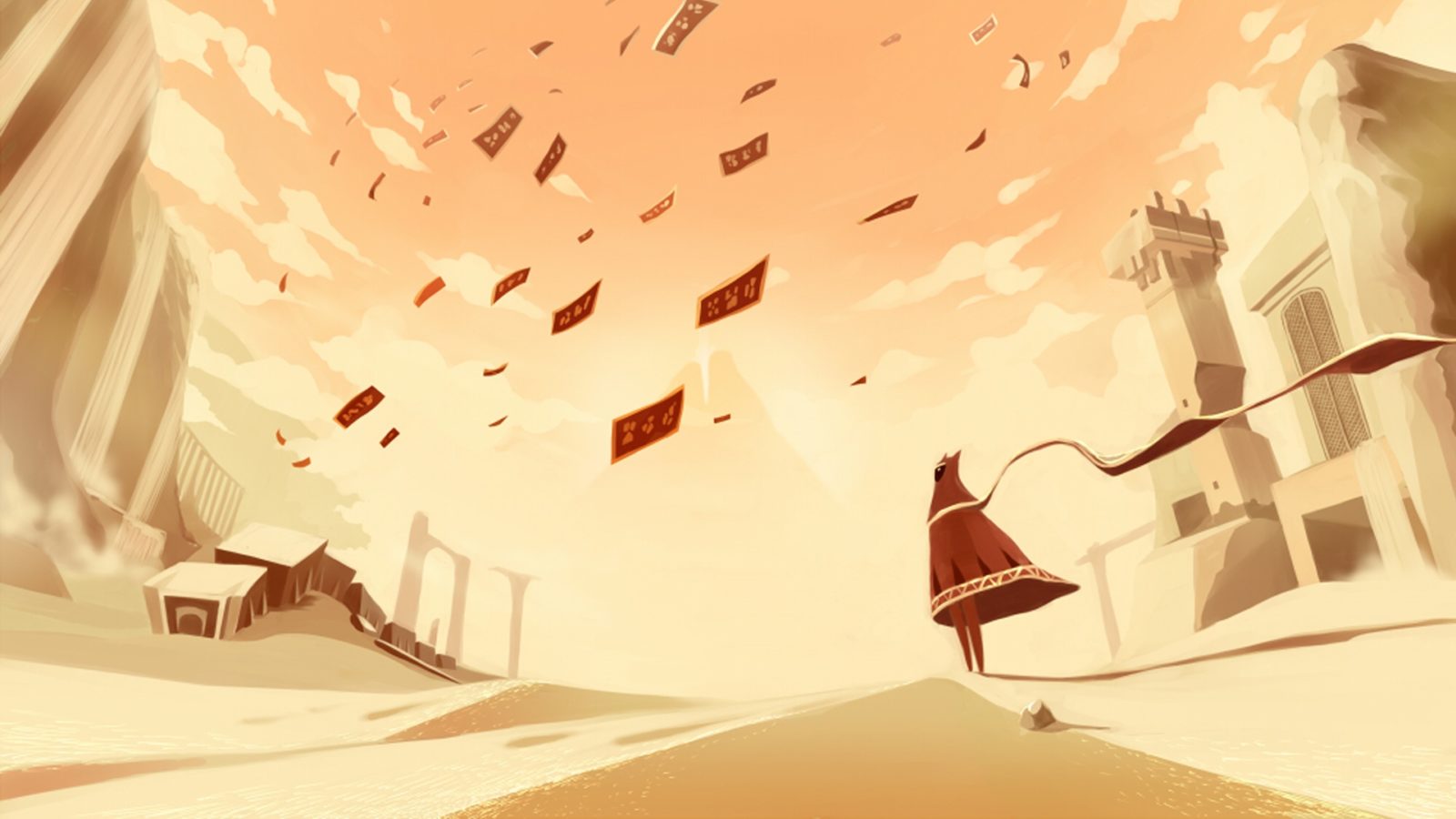
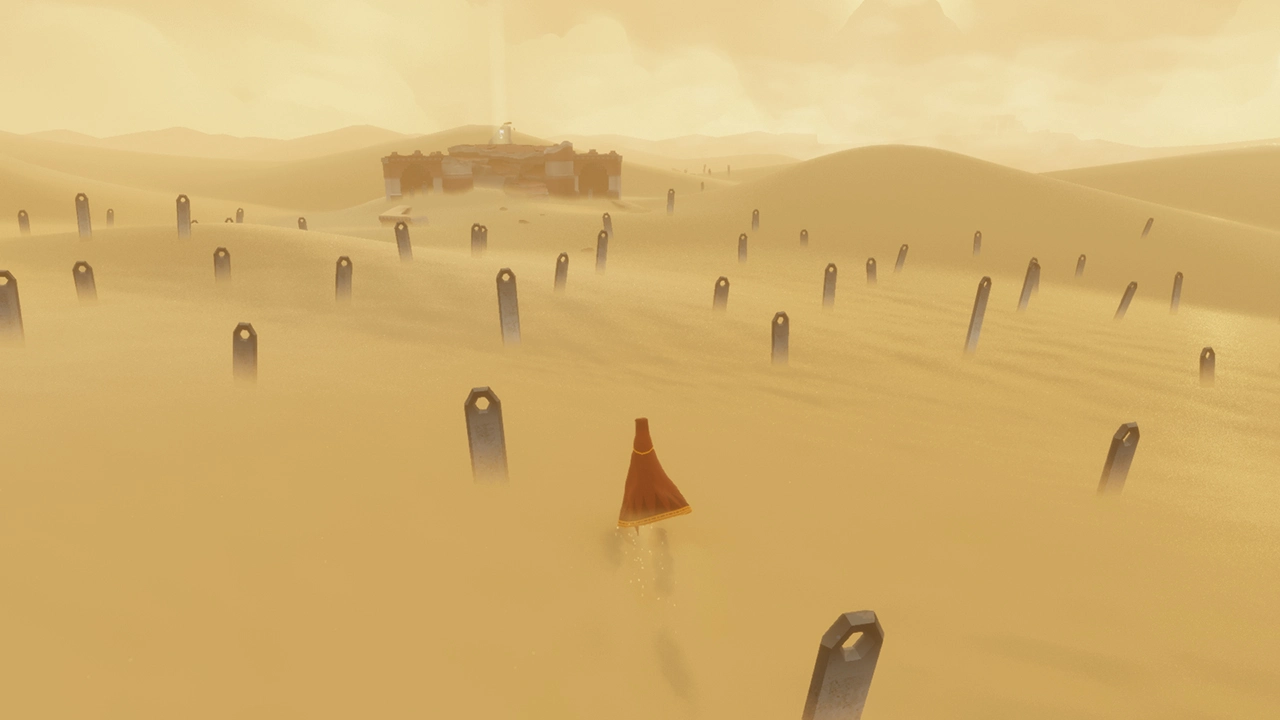
The game begins. Your character, apparently without a defined sex, is mired in the sands of an endless desert. A shooting star crosses the sky, and the only unusual thing we see is what appears to be a gravestone with a fluttering scarf. Having already realized that none of this is a normal game, we walk to the great dune that seems to be calling us and encounter the game's title above a massive mountain shining intensely, all to the sound of Journey's fantastic soundtrack. If you found this introduction vague and short on explanations, do not worry: that is the purpose of this masterpiece, which leaves us with far more questions than answers.
Journey is an indie adventure game originally released for PS3 on March 13, 2012, through PlayStation Network. Later, on August 28, 2012, it was rereleased on physical media in a special edition containing Thatgamecompany's previous titles and additional content. Finally, it received a remastered version with few changes for PS4 on July 21, 2015.
Below is the trailer for its PS3 release.
The journey's instinctive objective is the glowing summit of the enormous mountain mentioned earlier, but we have no idea why we are going there because of the singular way the plot is conveyed. There is no form of communication during the game, whether through text, character dialogue, or narrators; everything must be interpreted as though we were looking at a work of abstract art without a guide to help us understand what is happening.
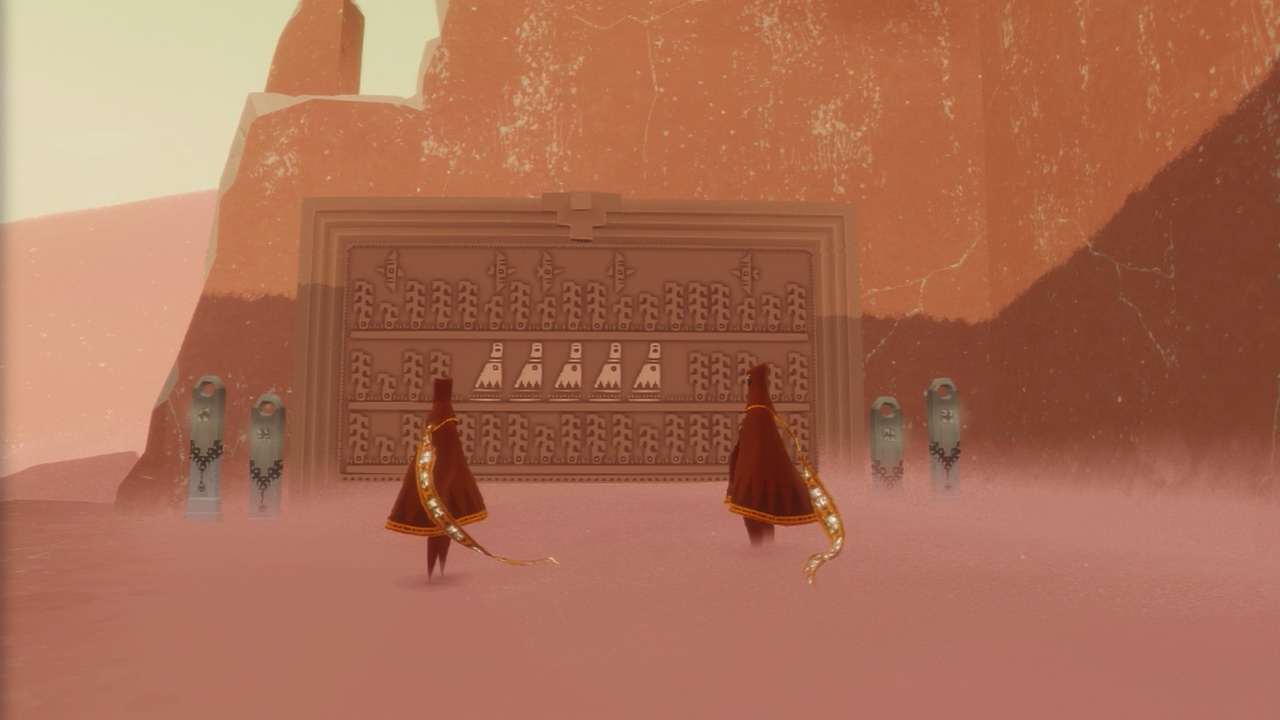
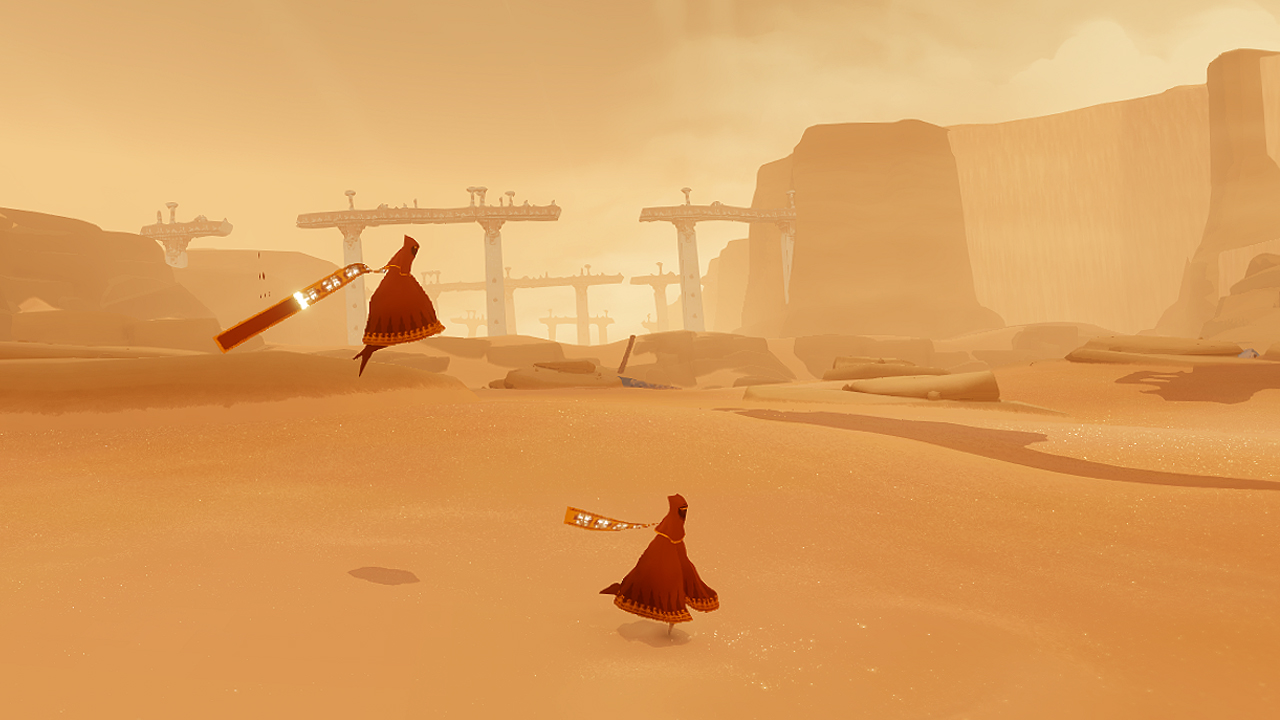
Wherever we go, we see the ruins of what was probably a wealthy civilization that once inhabited those lands before the sands took over everything. At the end of certain stretches, or even along the way, we find murals that try to give us clues about what happened and why the character is undergoing this ordeal. If you are playing online, you may encounter other players, but we have no way to communicate, apart from the simple musical note emitted by the sexless character.
It is up to each person to decide whether to follow a stranger or ignore them.
Tip: If you become lost, look for a high point in the environment, find the summit, and head toward it.
Below is the trailer for its PS4 rerelease. The trailer already shows how many awards Journey received.
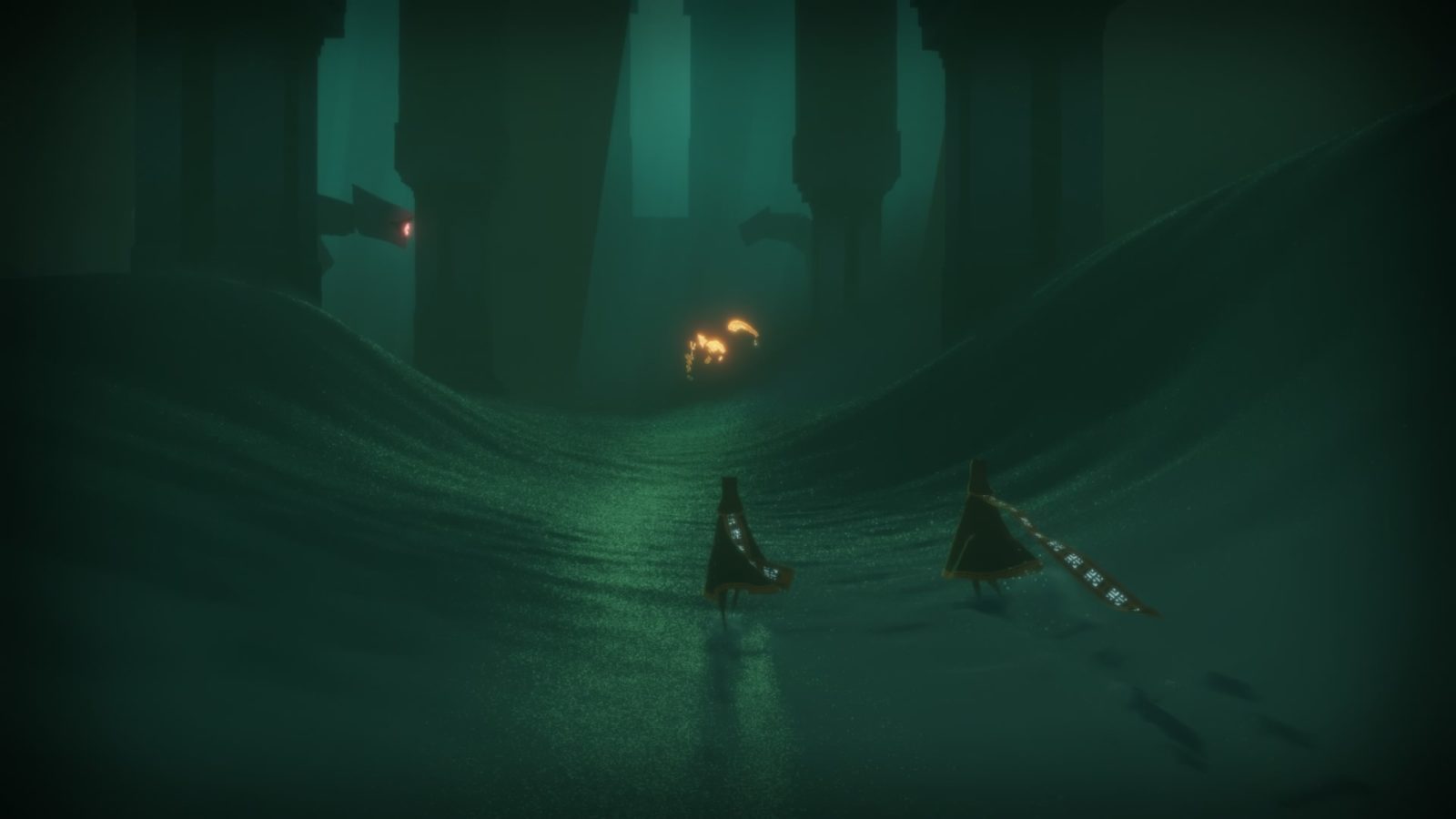
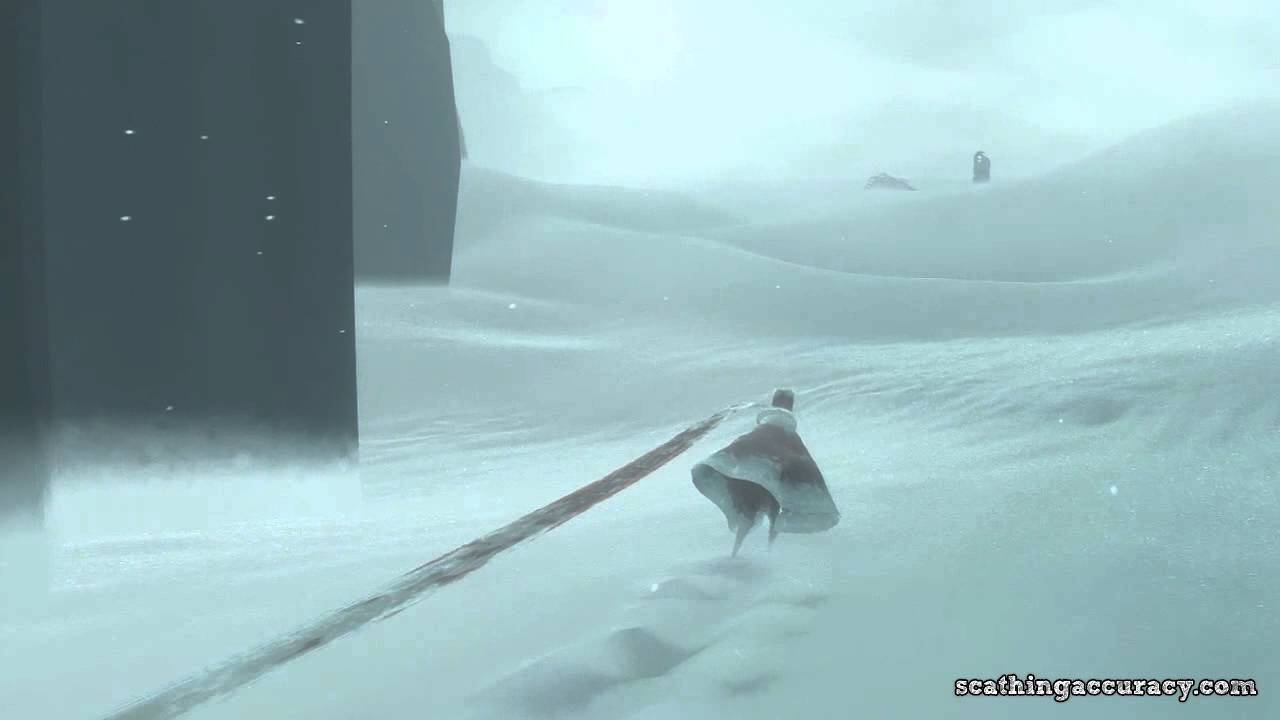
The game's atmosphere is one of desolation, with few animated beings and a great deal of silence, sometimes broken by the enormous guardians. This vast setting, with huge structures and little life, recalls Shadow of the Collossus, perhaps one of the few possible analogies with other games. The climate and landscapes change considerably over the course of the adventure. After leaving the desert, we see dungeons and even snow near the mountain's summit. The campaign lasts around three hours when played for the first time, but believe me, this is the ideal length for Journey. More extensive gameplay would probably make the game tiresome and harm the quality of the experience as a whole.
Everything about Journey described so far already reveals how original it is, and that made a tremendous difference at a time when the console market was experiencing a genuine wave of "50 shades of Call of Duty," a trend that is weaker but still present in the eighth console generation. A title so original and of such quality certainly gave the market room to breathe for new franchises that came later.
Fact 1: At the 2012 VGA, the Video Game Awards popularly known as the "Oscars of games," Journey competed for six statuettes, including Game of the Year, and won three: Best PS3 Game, Best Soundtrack, and Best Independent Game.
Behind the Scenes

Creative director Jenova Chen
The developer, Thatgamecompany, is a relatively recent content creator in the console market, and its hallmark is an intention to stir players' emotions while placing little emphasis on competition. The leading minds behind the company, Jenova Chen and Kellee Santiago, saw the digital distribution market as their best opportunity.
During the seventh console generation, Sony felt its dominance threatened for the first time, as Nintendo's Wii console was achieving incredible sales on every continent and its main competitor, Microsoft, already had a large installed base that would be difficult to match. In this context, Sony pursued exclusivity agreements to put its new console in the spotlight. Thatgamecompany was among the companies chosen to fulfill the mission of creating new classics. Its contract was for three games: Flow, Flower, and Journey.
Some critics do not consider Thatgamecompany's titles to be games at all, a complex and controversial definition. What about you? What do you think?
Technical Features
The gameplay in Journey is quite simple but functional. We can only emit a musical note that lets us interact with the environment in various ways, move the camera, and use a jump button that intensifies into a state of "near flight" after we increase the length of our scarf. This piece of cloth measures our flight energy and can be extended by finding the various runes scattered throughout the game's environments. At some points, there are faster scenes in which the character "surfs" over the sand, and at others, there is free flight; both are magnificent. The resistance conveyed by the sand and wind is also highly realistic and well executed. There are no deaths in Journey; the harshest punishments imposed by the experience are merely delays.
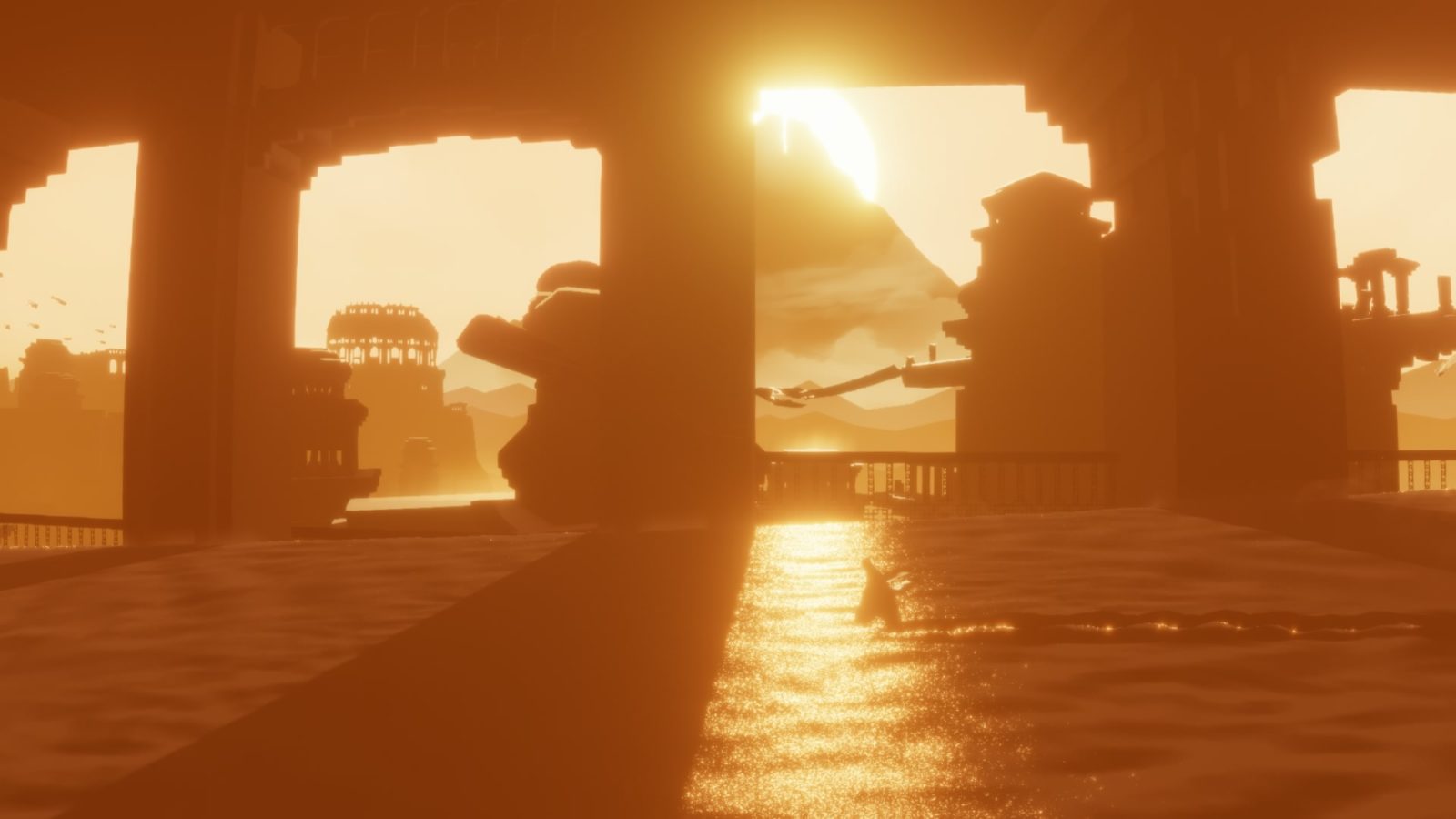
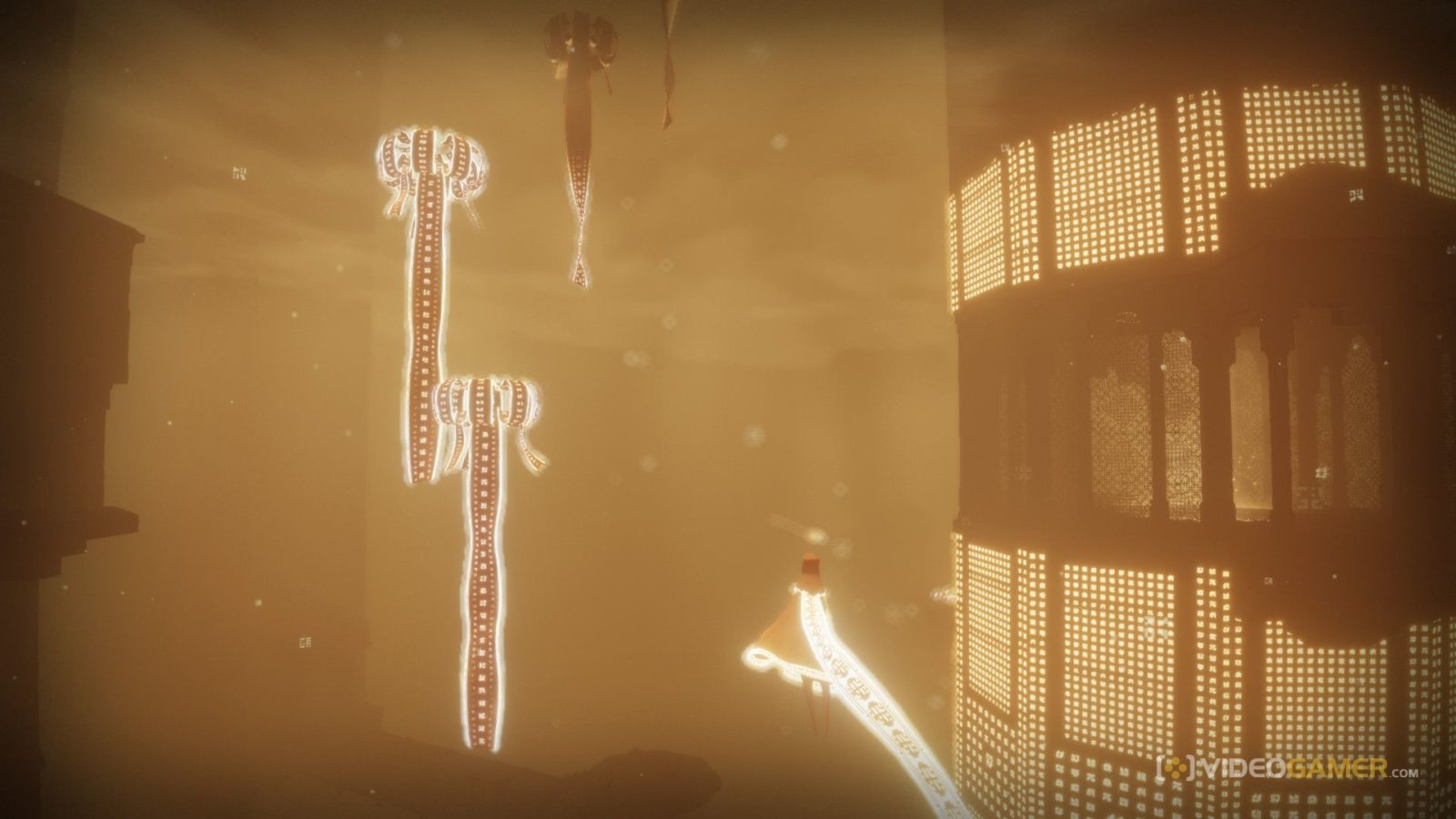
Journey's graphics will make you rethink what an independent game can be. Everything in it is beautiful, not only in its details but also in its visual art and level design. The moving sands and lighting effects are among the best ever presented in the game industry. In one of these high-speed moments, I even believe we may have the most beautiful artistic expression ever given to a single scene in the entire history of games.
The orchestral soundtrack deservedly won an award at the 2012 VGA and was composed by Austin Wintory. Everything in the music fits perfectly with the situations presented to us, contributing to Journey's intimate and contemplative atmosphere.
Fact 2: The music of Journey competed for a Grammy Award in the Best Score Soundtrack for Visual Media category. One detail: never before had a soundtrack made exclusively for a game competed for a statuette at this prestigious awards ceremony. Unfortunately, Austin did not take this award home.
Below is another demonstration of the game's high audio quality.
The technical points most likely to generate doubts among more demanding players are certainly the campaign's short length and its extremely low replay value. There are few apparent reasons to play Journey a second time apart from seeking trophies and hidden runes and appreciating all its beauty again. The absence of deadly enemies and greater penalties for mistakes does not encourage players to become skilled. Even so, I have completed this game several times and enjoy introducing it to other people who do not yet know it. Without a doubt, many more playthroughs of Journey await in the future.
The Bestiary
The Guardian: In my reviews, I like to give the game's enemies their due, but in Journey there is only one type: the guardian serpents that try to prevent us from reaching our objective. From the beginning of the game, it is interesting to see guardian remains scattered through the environments, as though they were deactivated or dead. They are monstrously large and have a glow in their eyes that works like a flashlight. When they spot us, the light changes color, and escape is difficult. Their presence enriches an atmosphere in which everything is enormous and makes us feel small. Since there are no deaths in Journey, if an enemy catches us, it removes a piece of our scarf.
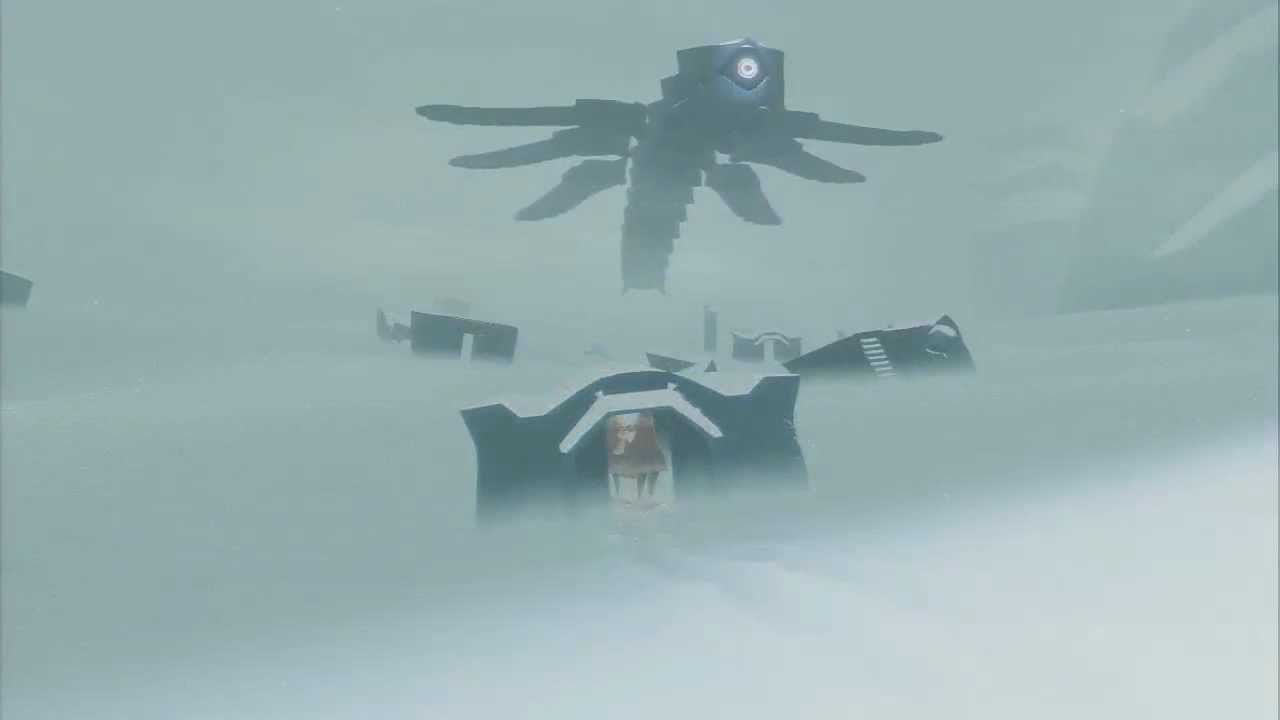 If you still have not seen the similarities with Shadow of the Collossus, I give up
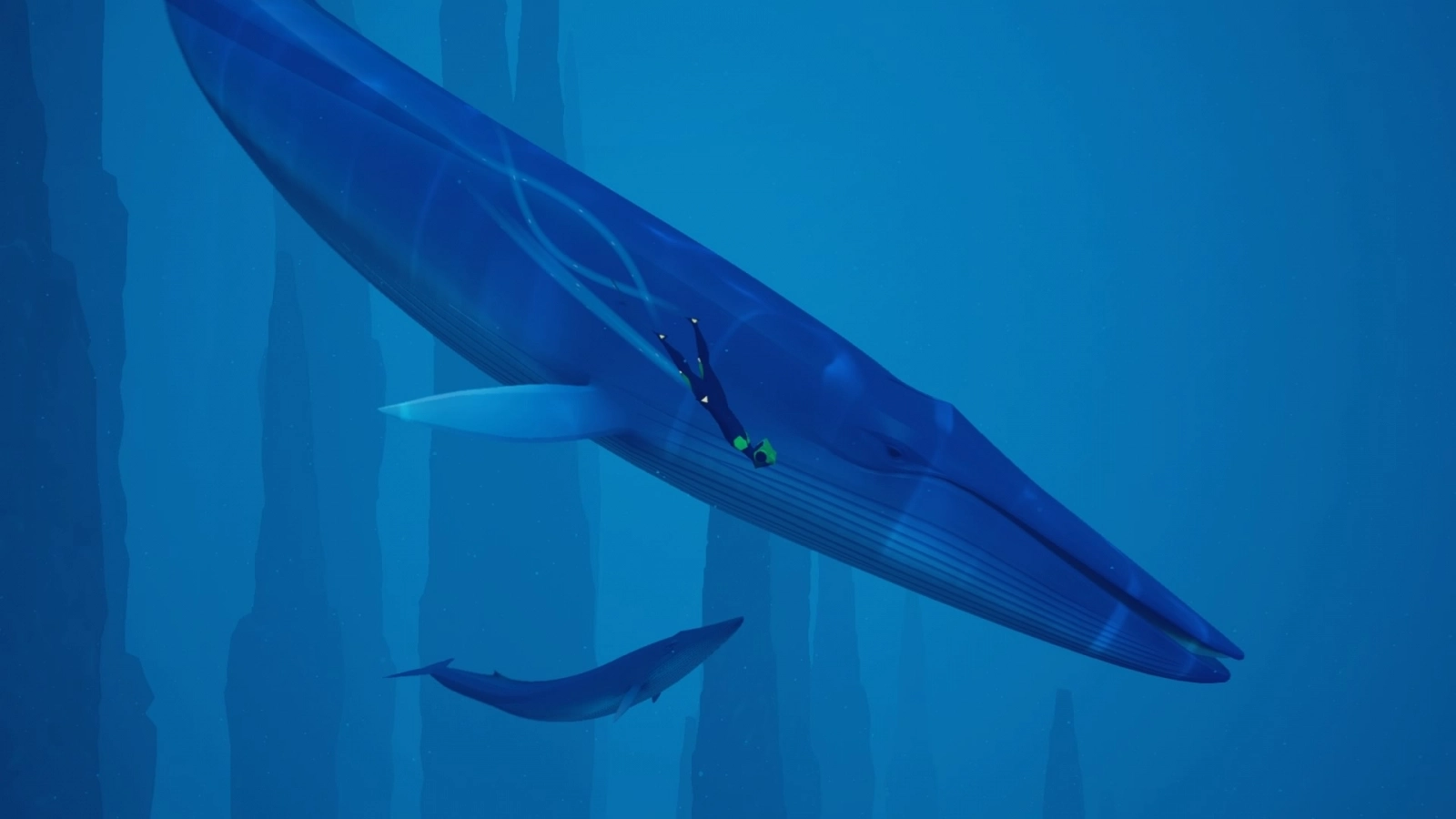
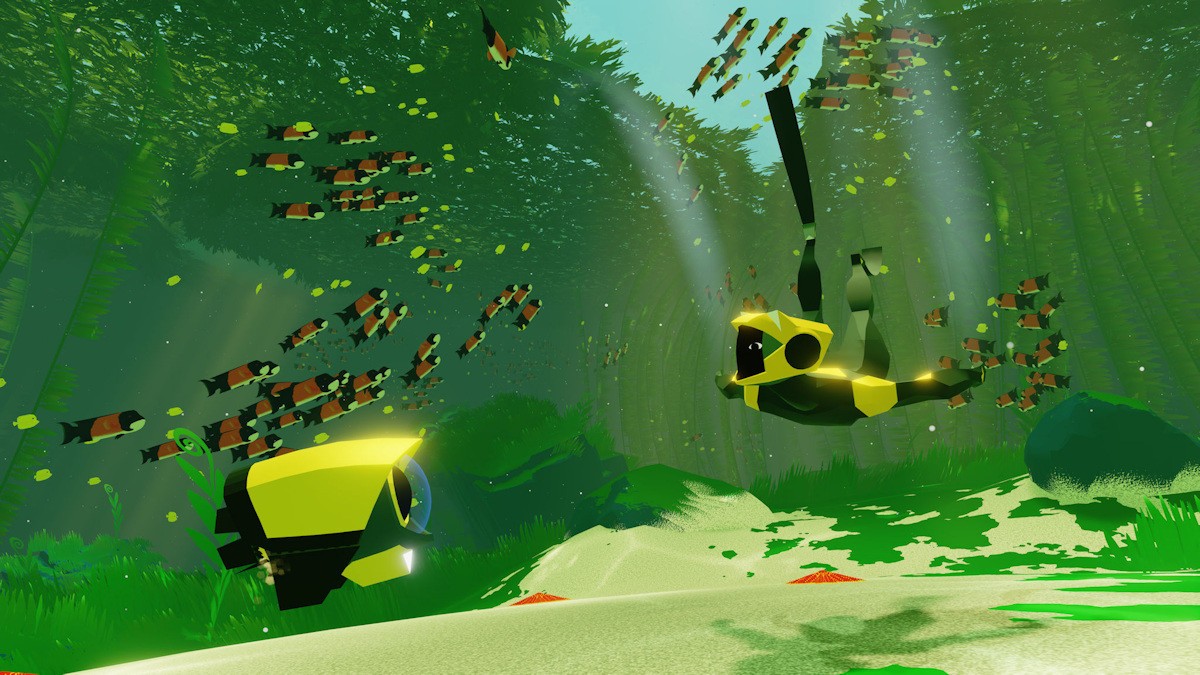
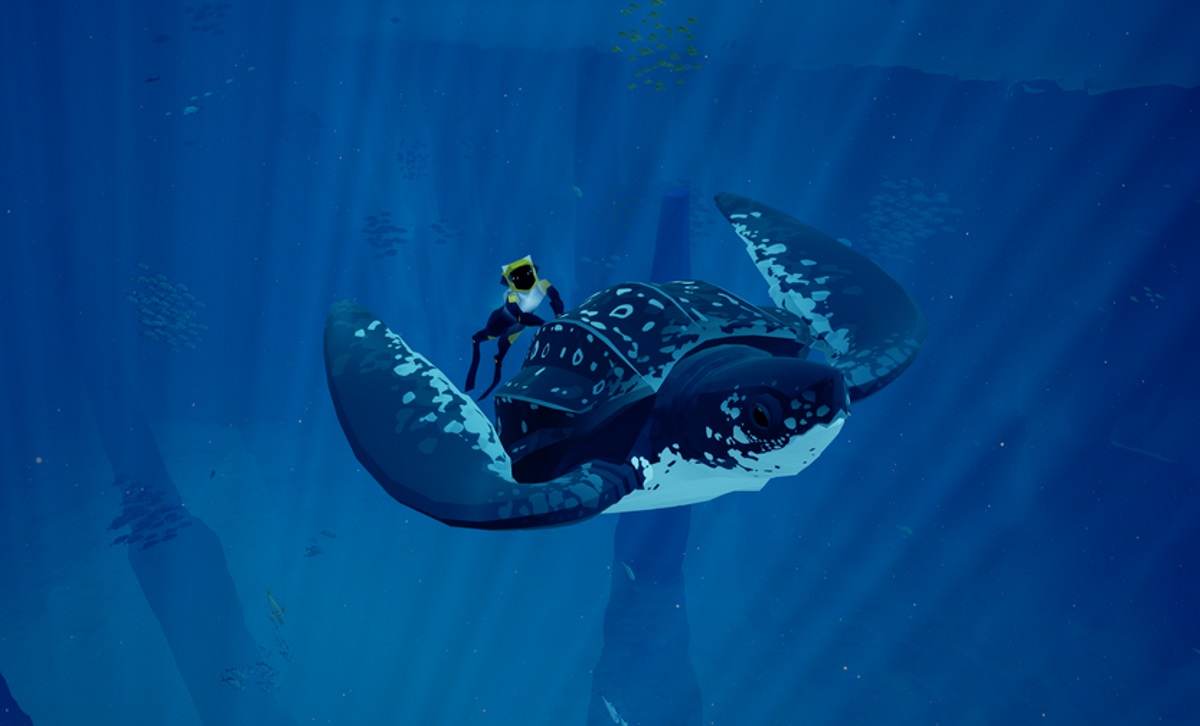
Fact 3: In August 2016, Abzû was released, a game made by former Thatgamecompany members who founded the Giant Squid studio. The game resembles Journey in every way and focuses on exploring the ocean floor. The title is excellent, and even its soundtrack was made by Austin Wintory, earning considerable critical praise. Many consider Abzû the spiritual successor to Journey, but that is a subject for another review.
In 2017, Thatgamecompany confirmed that it was making a new game with themes from Journey called Sky. Unfortunately, it will be released exclusively for Apple TV, iPhone, and iPad. We truly hope that decision will change in the not-too-distant future.
Below is the trailer for Sky:
Played on the PlayStation 3 version.