

A 31-year-old Japanese man used all of his grandmother's savings, equivalent to ¥40 million (approximately R$1.3 million), in a mobile MMORPG. The man transferred the money from his 82-year-old grandmother's account to his own and spent the entire amount on purchases in "Magic Sword Legend," developed by Spotlight Network Limited. The game is known for its gacha system, in which players use real money to try to win virtual items. Usually, the probability of obtaining the best items and characters—all virtual—is very low.
Desperate, the man's younger sister shared the situation through her profile on X (formerly Twitter), seeking advice on how to resolve the problem. She expressed frustration at her brother's lack of responsibility and said she was determined to get the money refunded as quickly as possible.
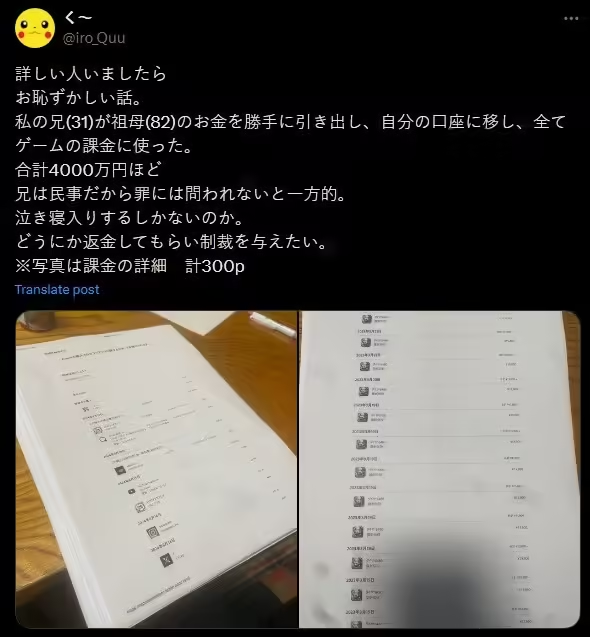
On X, the sister wrote: "If there is anyone who understands this subject, this is a shameful story. My brother (31) withdrew money from my grandmother (82) without permission, transferred it to his own account, and used it all on paid games, totaling about 40 million yen. My brother says it is a civil matter and that he cannot be accused of a crime. Do we have no choice but to cry and accept it? I want to recover the money somehow and impose a punishment."
She showed several pages detailing the expenses made by her older brother. According to her, the document contains about 300 pages.
What does Japanese law say about situations like this?
As the case continued to attract attention, Japanese website Livedoor News contacted Japanese lawyer Yasuo Sawai to explain the possible legal consequences. Sawai explained that an investigation must first determine how the man gained access to his grandmother's savings.
In an interview with Livedoor News, the lawyer explained: "If the older brother accessed online banking through a PC or smartphone and transferred money from his grandmother's account to his own, fraud cannot be investigated because he did not deceive bank employees. Since the money was not withdrawn and obtained, theft cannot be investigated.
However, since it can be said that a financial gain was obtained by providing false information to a computer used for administrative bank processing and creating data related to the acquisition or loss of property rights, the crime of computer fraud against the bank could carry a sentence of up to 10 years in prison (Article 246-2 of the Japanese Penal Code)."
Sawai also explains the possible civil consequences: "Regarding liability for civil damages, the criminal legislation has no provision similar to family theft. Therefore, if it is found that an unlawful act was committed, the older brother will be ordered to pay 40 million yen in compensation to his grandmother. If a judgment is handed down, the grandmother will seize the brother's account and receive the money using the judgment as a debt."