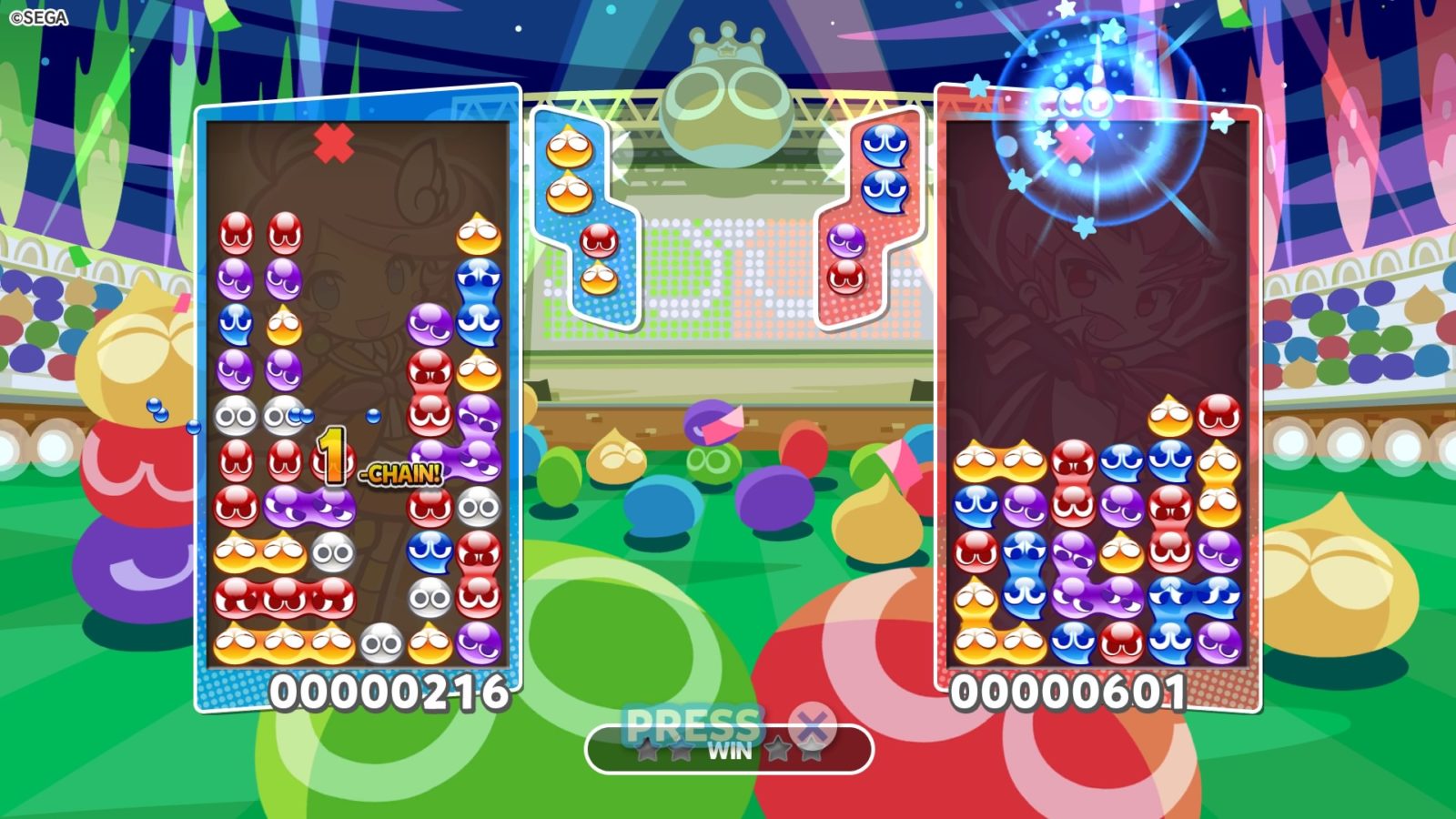
Puyo Puyo is a curious franchise. The puzzle series began as a spin-off of a dungeon crawler RPG series called Madou Monogatari, but eventually became more popular than the “main” franchise. The game consists of connecting four puyos, a kind of gelatinous ball with eyes, of the same color to make them disappear. Although it seems simple, the game's focus is on defeating your enemies, and to do so you must create “combos,” making sets of colors disappear in sequence like a chain reaction. This sends gray puyos to hinder your opponent.
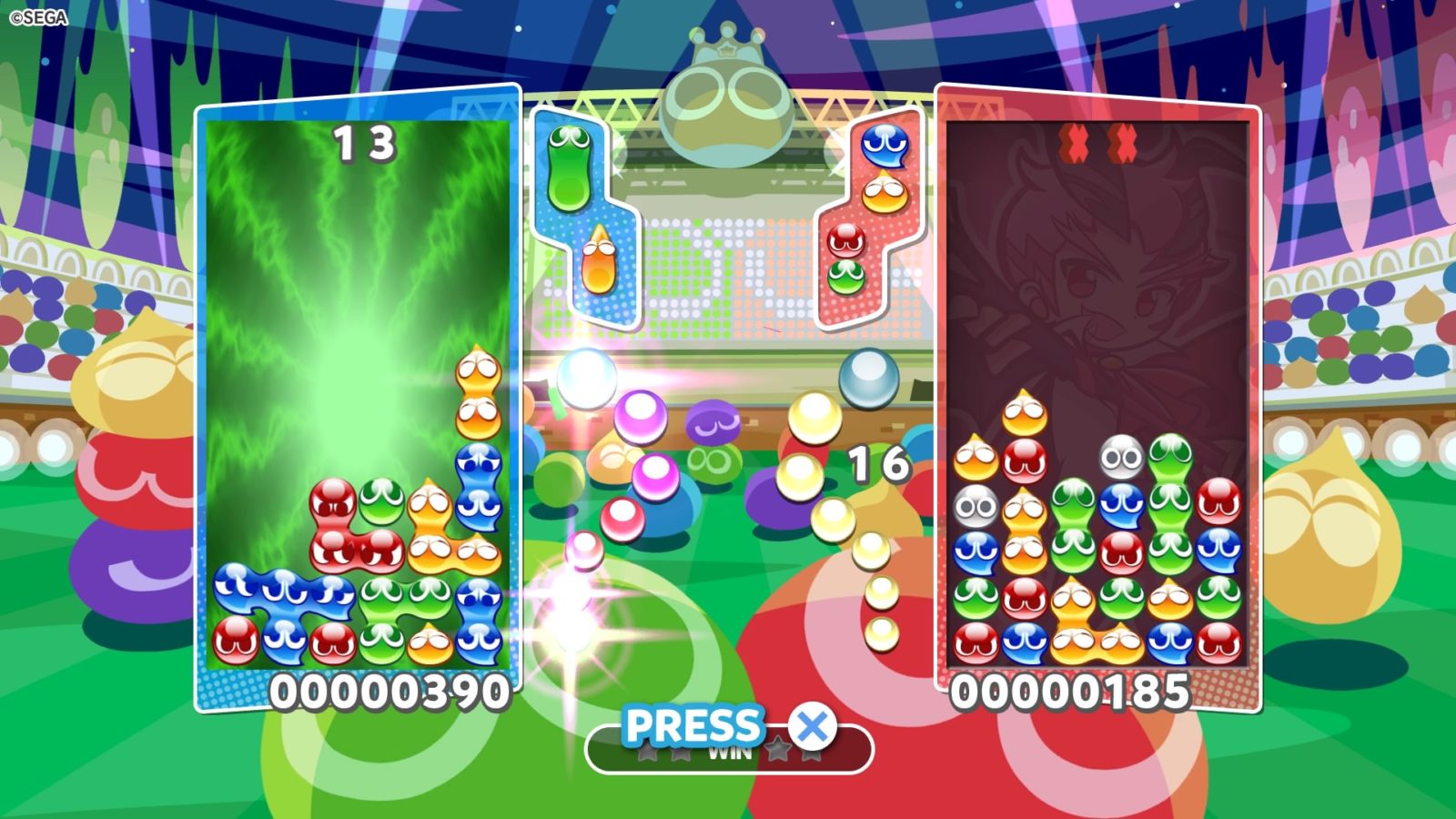 Notice that when the group of four blue puyos disappears, the red ones above will fall and form a new group, followed by the group of four green, four yellow and four blue puyos, for a combo totaling five.
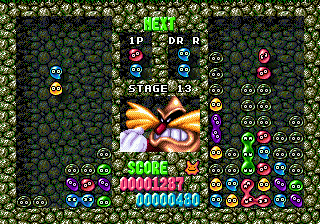
Extremely popular in Japan since its first game, the series never achieved the same level of popularity in the West. After its first arcade version, developed by Compile and published by SEGA, the game received console ports, including Mega Drive and Super Nintendo. When they went West, perhaps because Western players did not know Madou Monogatari or because of the anime-style characters, both versions were radically altered. The Mega Drive version became known as Dr. Robotnik's Mean Bean Machine, while the Super Nintendo game became Kirby's Avalanche. Each Western version rode the popularity of a different familiar franchise to make the game more appealing to Western audiences.
It was with Puyo Puyo 2 (PP2), however, that the game reached its peak popularity in Japan. The game now had a new mechanic known as offsetting. When players are about to receive gray puyos in their field, if they manage to make combos before that happens, they can not only reduce the number of gray puyos received but, depending on the combo, even cancel them and send them to the opponent.
This simple change made the game much more competitive and dynamic, becoming almost as popular in Japanese arcades as Street Fighter II. Unfortunately, neither PP2 nor the countless sequels the series received ever saw the light of day in the West, where the Western Mega Drive and Super Nintendo versions remained most Western players' point of reference for the series, despite being outdated in comparison with PP2's game mechanics.
Later, after Compile went bankrupt, SEGA acquired the franchise and produced a new Game Boy Advance title with the original characters in 2001, known as Puyo Pop. In 2004, the series received a kind of reboot with Puyo Puyo Fever, called Puyo Pop Fever in the West, featuring a new cast of characters. Although it was released for every platform of its era, Dreamcast, PlayStation 2, GameCube, Xbox, Game Boy Advance, Nintendo DS and PSP, the Dreamcast version was released only in Japan. In America, Nintendo wanted the title as an exclusive, so the non-Nintendo console versions were released only in Japan and Europe, which may have hurt the series' reach because the GameCube did not come close to selling as many units as the PlayStation 2, for example.
In Japan, the series continued to receive several games, but none were localized for the West. Franchise fans became accustomed to playing the games in Japanese and even created the Puyo Nexus website, containing information about every game in the series entirely in English and supported by a highly dedicated fan community.
Things did not begin to change until 2017, when SEGA announced that it would release Puyo Puyo Tetris (PPT) in the West. The game was originally released in Japan in February 2014 for PS3, PS Vita, Wii U and 3DS, followed at the end of the same year by PS4 and Xbox One definitive versions containing all the DLC. When Nintendo announced the launch of its new console, Switch, SEGA of Japan prepared a version of the game for it. Perhaps unwilling to miss the opportunity to have a game available for the console's launch, SEGA of America finally announced a Western release for April 2017, though only on Switch and PS4, followed by a PC version in February 2018.
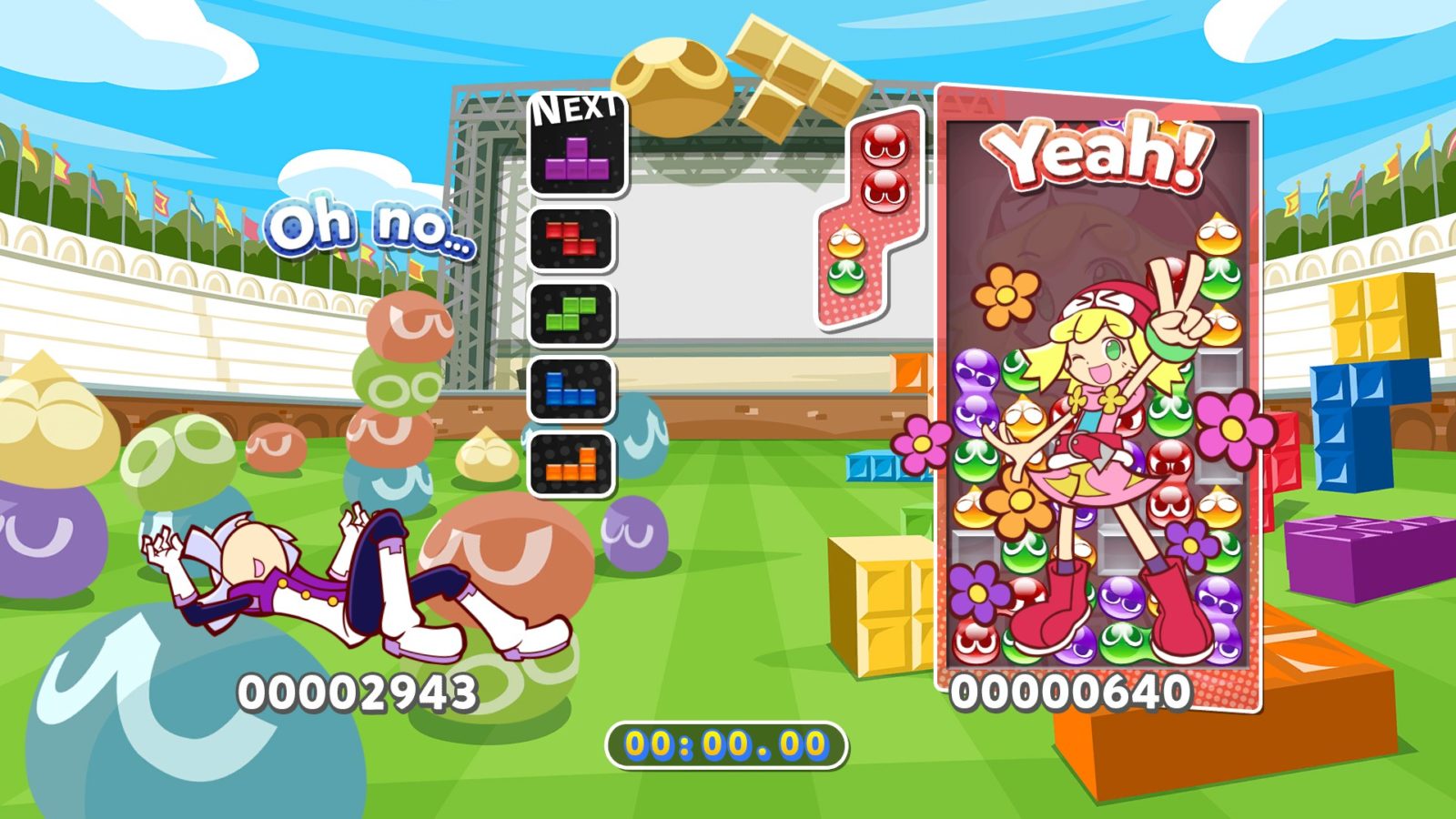
Fans were certainly happy to see a new Puyo Puyo finally localized after 13 years without a Western release, but PPT still left some uncertainty. Had SEGA localized the game only because it was betting that mixing Puyo Puyo with Tetris, which happens to be the world's best-selling game franchise, would make it sell? Or would the company finally begin genuinely investing in the franchise? Despite being an excellent game, PPT also suffered from some balancing differences because it contained two different games. In its online modes, moreover, you could not choose whether you would face a Puyo Puyo or Tetris player, something some fans did not particularly like.
Then, in October 2018, SEGA released a new game in Japan called Puyo Puyo eSports, focused on competitive play, for PlayStation 4 and Switch. It was a kind of simplified version of PPT, but obviously without Tetris. Fans quickly began asking for the game to be localized, until at the end of April, just two weeks before launch, SEGA announced that it would reach the West under the name Puyo Puyo Champions (PPC) on May 7, 2019. In addition to PlayStation 4 and Switch, it would also receive PC and Xbox One versions. A new “pure” Puyo Puyo, this time without relying on another franchise's popularity, was finally being released in the West.
But what is Puyo Puyo Champions? Merely Puyo Puyo Tetris without Tetris? Just an enhanced version of the game we had known since Dr. Robotnik's Mean Bean Machine? Not exactly.
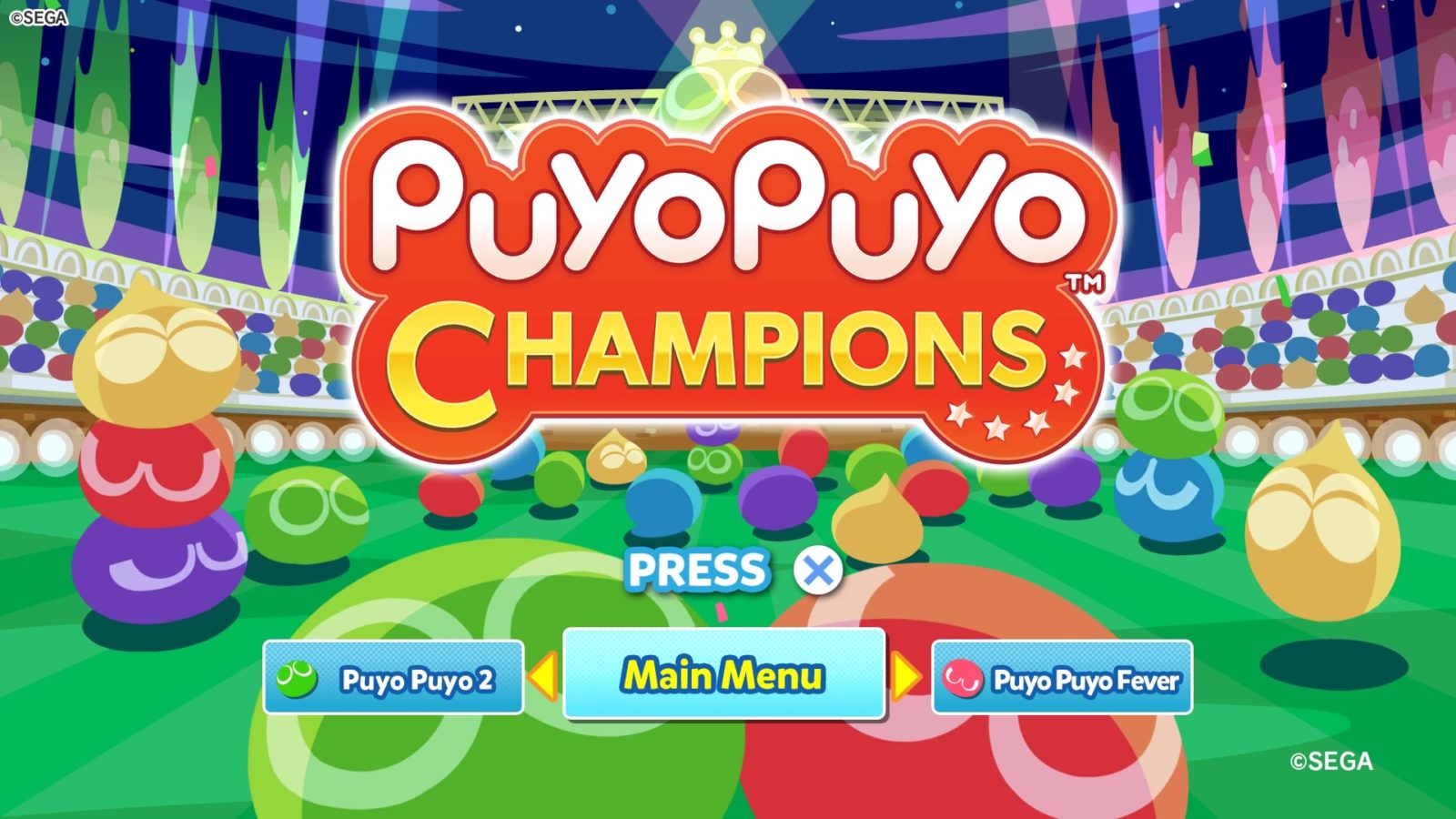
Yes, Tetris was removed and much of PPC's content is reused from PPT, but PPC is not merely a “stripped-down” version of PPT. PPC was intended as a game focused on competitive modes, meaning it does not have a story mode and has fewer game modes than PPT. At the same time, however, the game was released for only US$9.99, one third of PPT's original price.
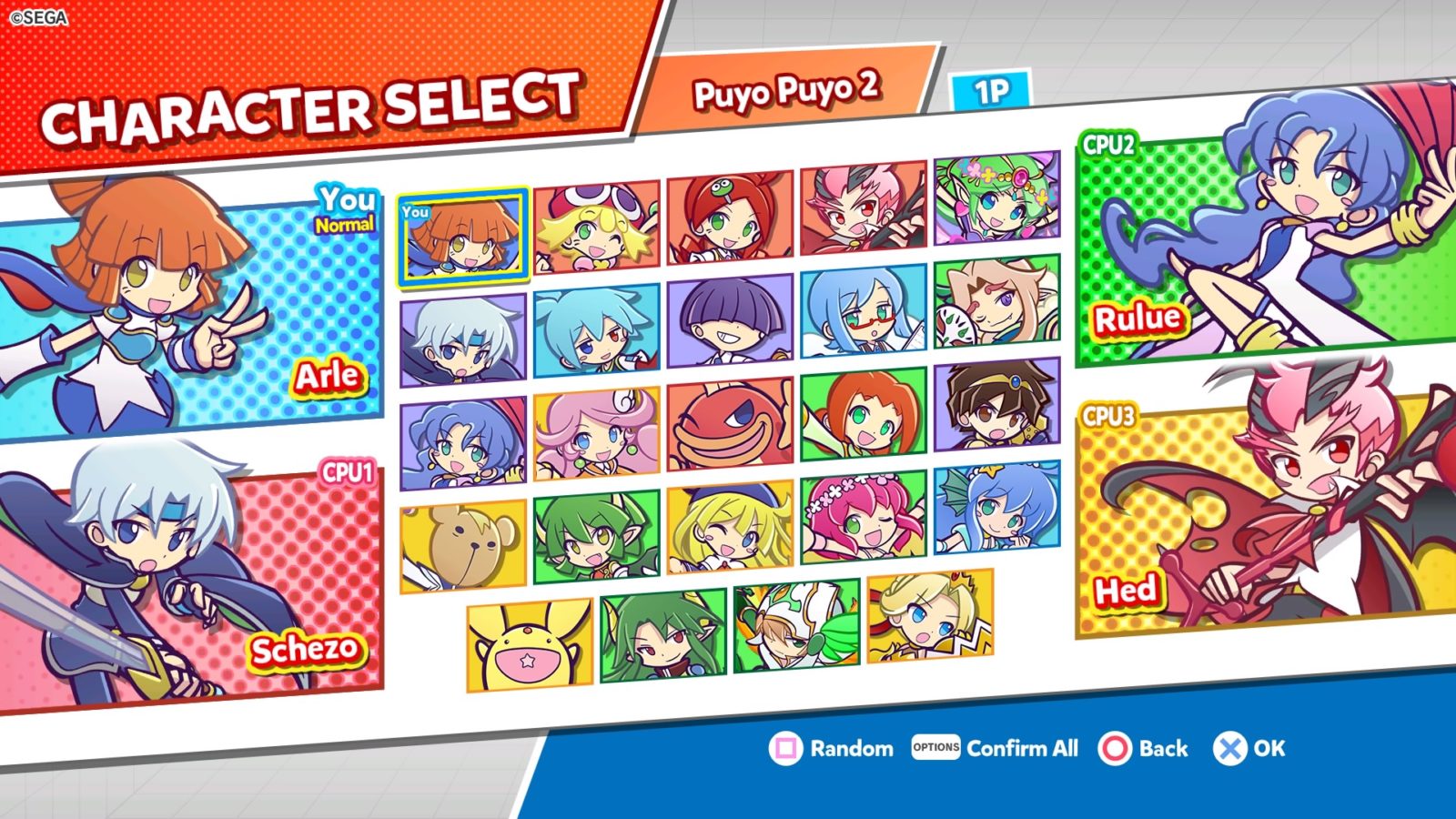
If you are only a Tetris fan and do not care about Puyo Puyo, PPC is not for you. But for people who like Puyo Puyo, enjoy its mechanics and want to learn more, PPC offers advantages over PPT. Besides the PP2 rules, which are standard in the series, it is also possible to play using PP Fever rules, something that was not possible in PPT. The game also includes some new characters originating in Puyo Puyo Quest, a very popular smartphone game in the series that, you guessed it, was also released only in Japan.
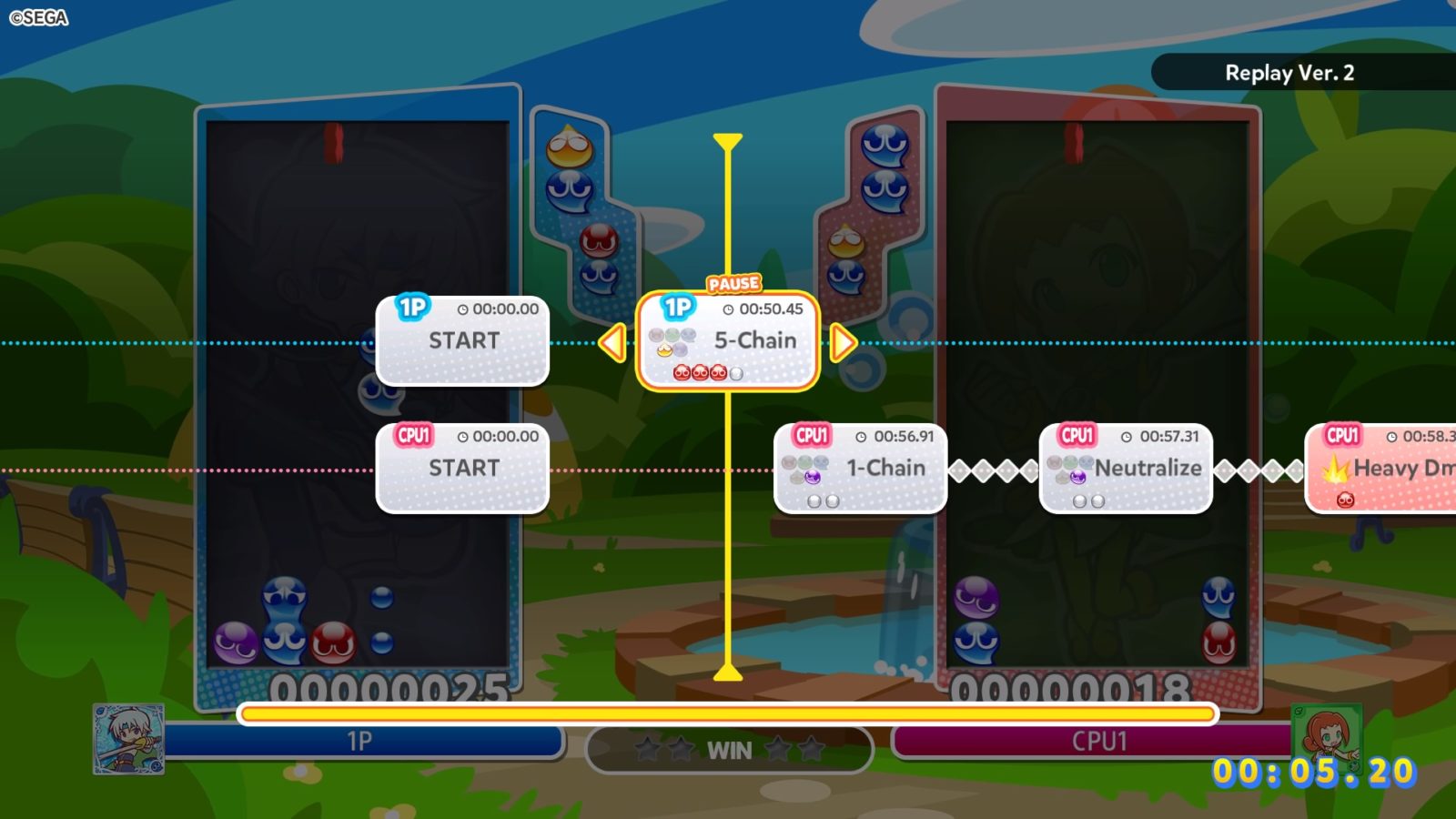
Replays are now saved automatically, though this can be disabled, and were greatly improved. In PPT, you could only change replay speed and nothing else. In PPC, each replay is marked by a timeline showing every event in the match, letting you see everything that happened in detail. It is also possible to go backward and pause, allowing you to genuinely “study” the match.
The options menu also lets you customize your “avatar,” choosing your favorite character, a background and a frame. Interestingly, several non-playable characters can be used as avatars, including many from Puyo Puyo Quest, the smartphone game mentioned earlier. There are also several other customizations, including 41 environments, 46 songs and even different puyo types, ranging from the classic Mega Drive style to the modern, MSX and Game Gear styles, Sonic character heads and more.
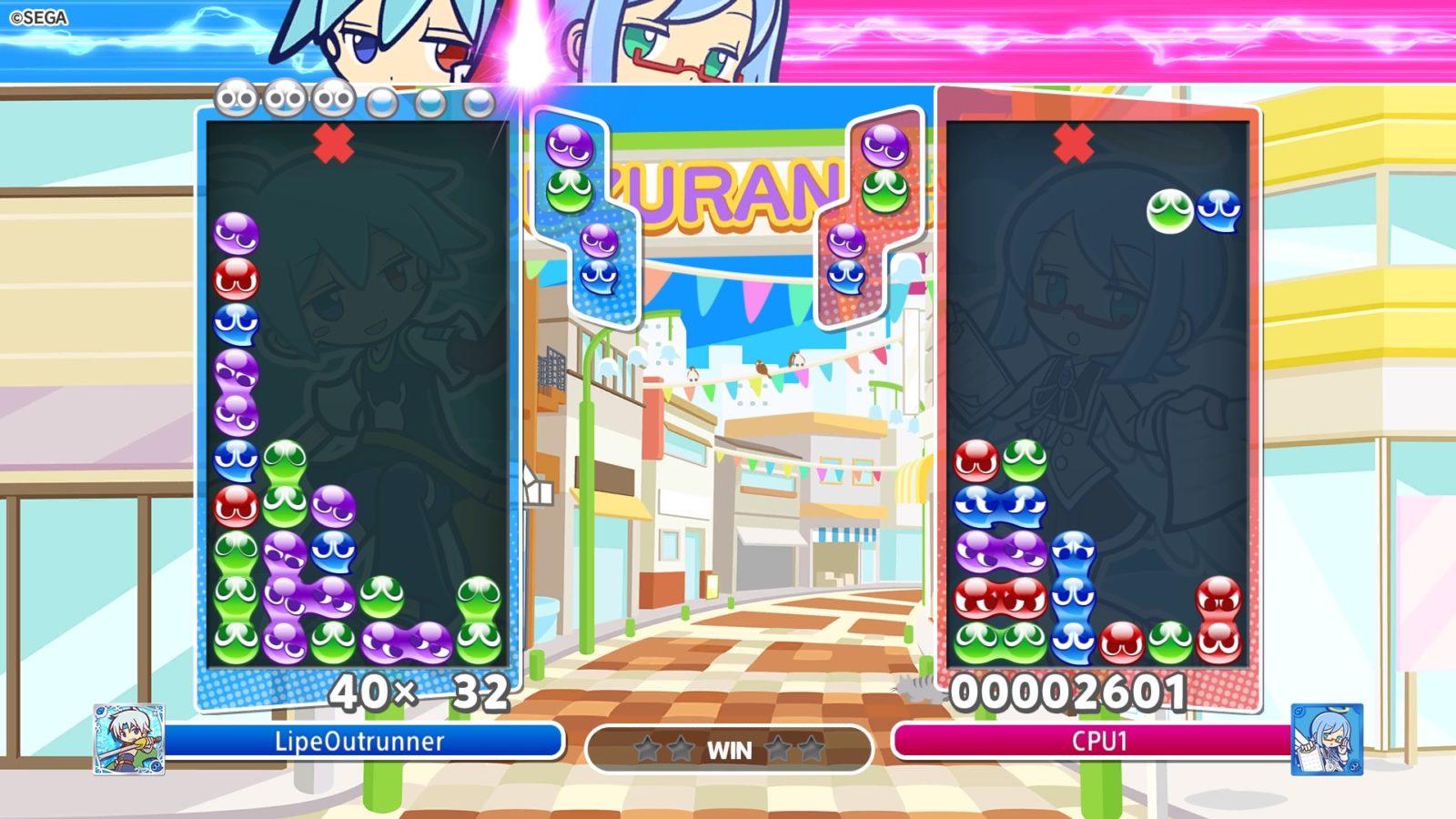
The game runs at 1080p and 60 fps, which is unsurprising given the simple nature of its graphics. We tested the PlayStation 4 version, but believe there is no difference between the Xbox One, Switch and PC editions, just as there are probably no improvements for PlayStation 4 Pro and Xbox One X. Although basically identical to PPT, the graphics show new environments and character artwork, as well as an introduction to matches displaying that art. In addition, if players begin creating large combos to counterattack each other, the game shows a bar at the top of the screen with the characters facing one another, indicating who has the advantage.
The audio also received improvements. In addition to various songs from earlier games, with themes that will sound familiar to anyone who has played other entries in the series presented in new versions, there are also new arrangements, including some by Jun Senoue, the guitarist known for his music in Sonic games. The game also offers English and Japanese voice acting, whereas the Western version of PPT did not let players choose the original Japanese voices, something that bothered some fans; that feature appeared only in the PC version.
One interesting change from other games in the series is that, when creating combos, the characters used to say the names of different spells. “Spells”? Yes, because Puyo Puyo comes from an RPG series, as we said earlier. PPC, however, changed this aspect and made the characters count. If you make a combo of five, for example, they will say “1, 2, 3, 4,” followed by a spell on the fifth, instead of different spells for every number. This may feel strange to anyone who played earlier games, but I believe the change was made because of the game's focus on competitive modes, since it makes it easier to understand what your enemy is trying to send at you and vice versa.
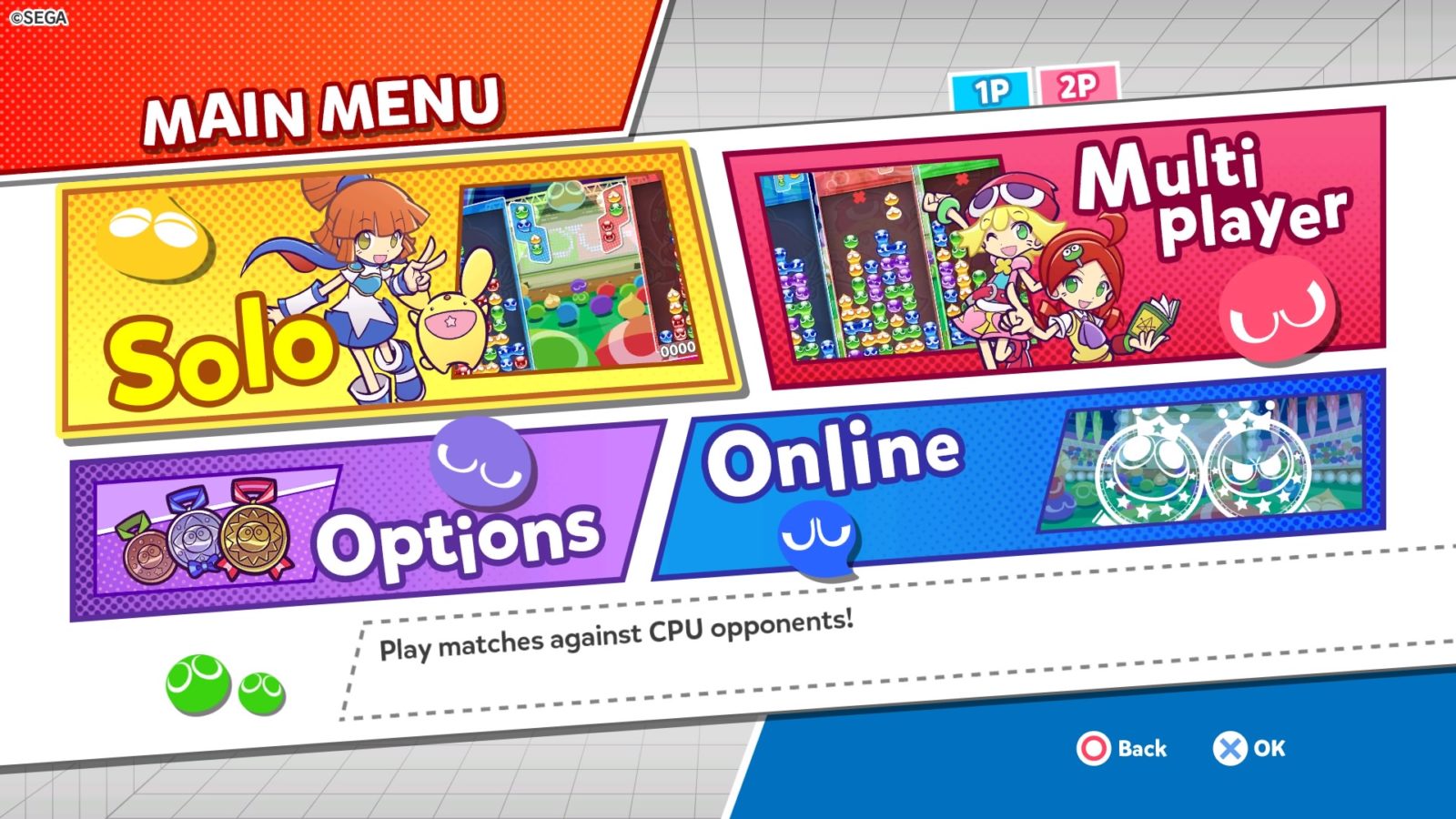
The game also offers an offline single-player mode in which players can take part in ordinary matches or a “survival” mode, defeating as many enemies in succession as they can. Although it is a relatively simple mode without a story, remembering that the game has a different premise and was released at a much lower than normal price, nearly every trophy and achievement can be earned while playing alone offline if the player wishes.
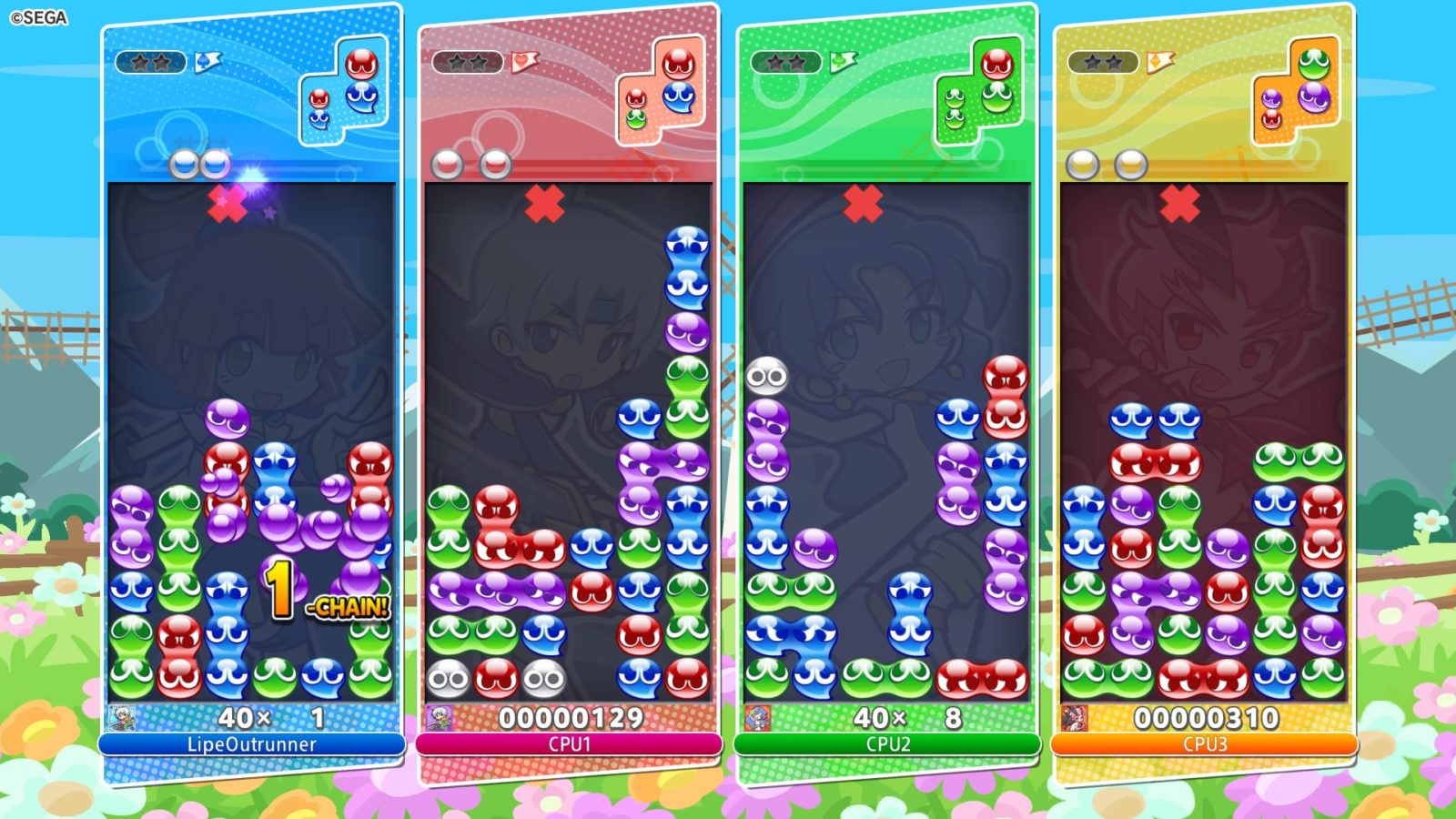
Every character is unlocked from the beginning and, although there is no difference between them in PP2 mode, they have different dropsets in PP Fever mode. The game's difficulty is also based on the character you challenge. In other words, the game has no difficulty levels to choose because that depends on the character you decide to face. It is worth remembering that even in single-player mode, it is possible to battle three computer-controlled opponents at the same time.
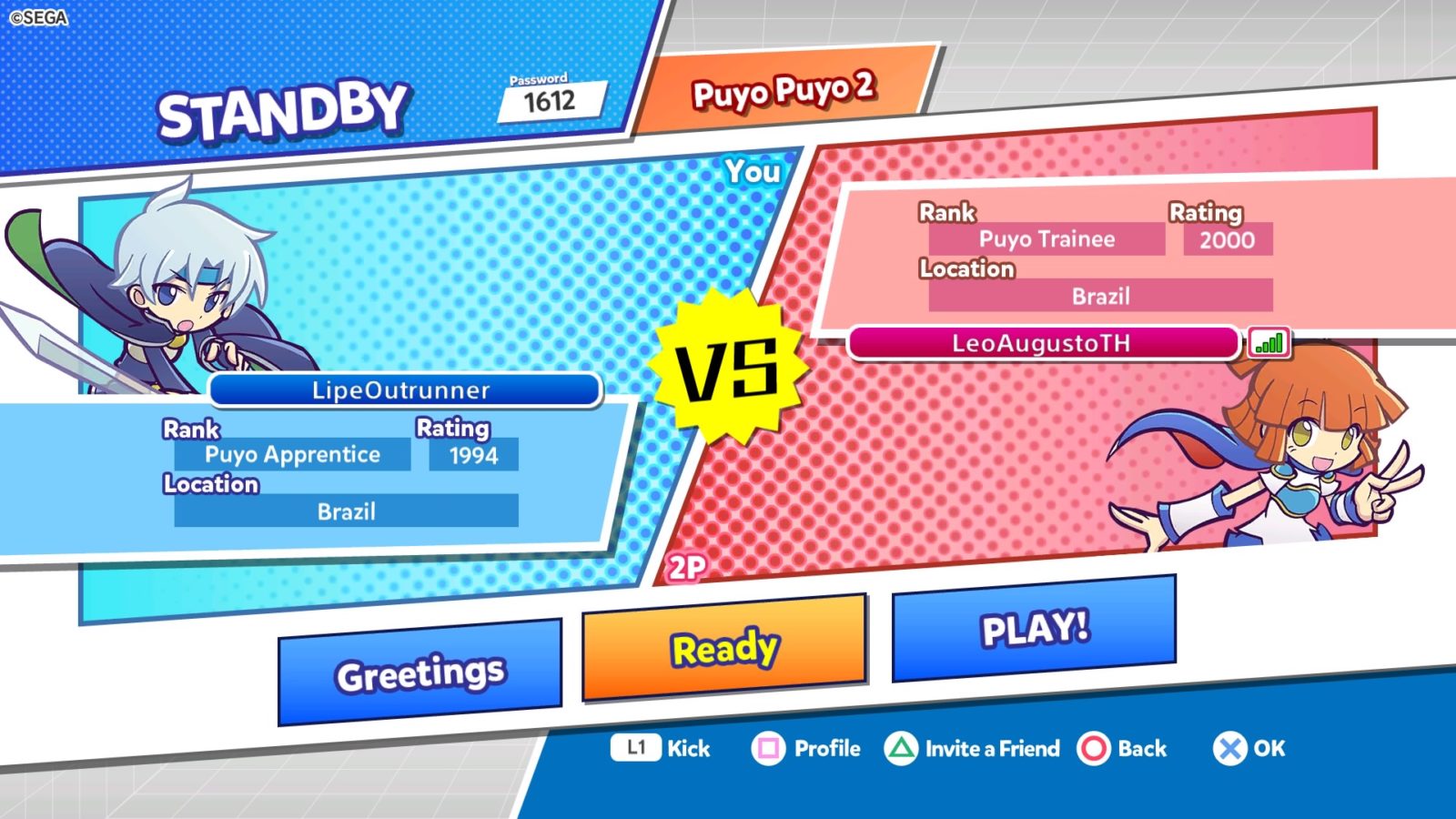
Online mode was also improved. In PPT's ranked matches, even after losing several times, the game could still place you against people with ten times your score, and you could not choose whether the other player would use Puyo Puyo or Tetris. PPC, on the other hand, tries to match you with people at approximately your level and separates game styles into PP2 and PP Fever, meaning you will play only against your preferred style. Although I had no problems finding online players on PlayStation 4, it appears most players are on the Switch version, while Xbox One's online mode seems emptier than those on other platforms. You may want to consider this when choosing which version to buy.
In local multiplayer, four people can also play simultaneously, with up to two controlled by the computer. There is also a new tournament mode for up to eight people. You can play with eight different people, two people against six computer-controlled characters, or even two players controlling four different characters; everything depends on your preference, and only two controllers are required because they can be passed among the players. Although it is the kind of game that most people look at without thinking it is anything special, it can be extremely entertaining when played with a friend beside you, especially if you have roughly the same skill level.
A new version of the game in Japan also adds Challenge mode, where you can play a Time Attack and see how many points you can earn in a given period, as well as a Race mode to see how quickly you can reach a certain score. These modes come with leaderboards as well. In addition, a new update is on the way that will add a lessons mode. Although PPT had lessons that acted as a kind of tutorial, the game taught only the basics and expected you to discover the rest yourself, while other entries in the series released only in Japan had highly detailed tutorials that taught players to master the game's mechanics. PPC will receive a mode with many lessons, making it much more accessible to beginners.
Although we still do not know when these updates will reach the Western version, it should not take long. Even in its current state, however, PPC is an excellent, inexpensive and accessible puzzle game, and it is where the online community is playing now. If you enjoy a good puzzle game, we strongly recommend it. SEGA is genuinely trying to grow the franchise in the West by making several posts on its social networks, including Facebook and Twitter, releasing tutorial videos on its official YouTube channel, and recently even creating new franchise products and merchandise for its official store, SEGA Shop.