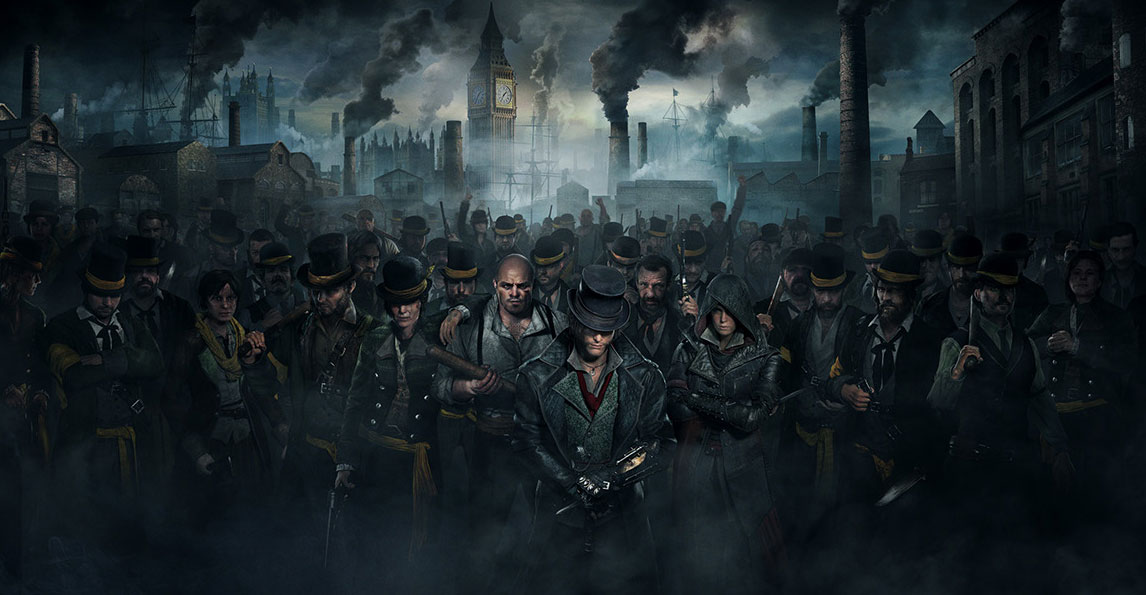
“Another Assassin's Creed?” The year had not even ended, people had barely finished Assassin's Creed Unity, from 2014, and Ubisoft had already announced the next one: Assassin's Creed Syndicate. And so comes the question everyone wants answered: is this a good Assassin's Creed, to the delight of fans and disappointment of those who hate the series, or a bad Assassin's Creed, to the delight of those who hate the series and disappointment of its fans?
The Troublemaker and the Assassin
Ubisoft decided that this time we would control not one but two Assassins: Jacob and Evie Frye, twin siblings who already belong to the Assassin Brotherhood at the beginning of the game. That is a positive point, since I believe many people are already somewhat tired of seeing a main character's origin story in every game and completing missions before becoming an Assassin each time.
This introductory choice already dictates the tone of the entire game: a faster, more dynamic story without much fuss, yet one that remains well constructed. Unlike Unity, a game with a heavier plot that tried to be more serious, Syndicate has a much lighter, more adventurous atmosphere, due in large part to the Frye siblings.
Jacob and Evie have opposite temperaments. While he is explosive, she is cool and calculating. From this, we can already see the main difference between their mechanics: the brother is strong in battle, while the sister is more skilled at stealth.
Fortunately, Jacob can remain unnoticed when he wants, and Evie can kill groups of enemies. There are no restrictions here, only greater possibilities for different approaches between the two, including combat abilities unique to Jacob and stealth abilities unique to Evie.
Switching characters at any time is an interesting idea, but it is somewhat underused and creates busywork for players: there are two characters for whom abilities must be purchased and levels raised, and two characters who must be equipped with weapons and gear. Even so, it is fairly uncomplicated because the experience earned is shared between them. I would not want this trend to continue through the rest of the series, however, despite both characters being well constructed.
Liberate London
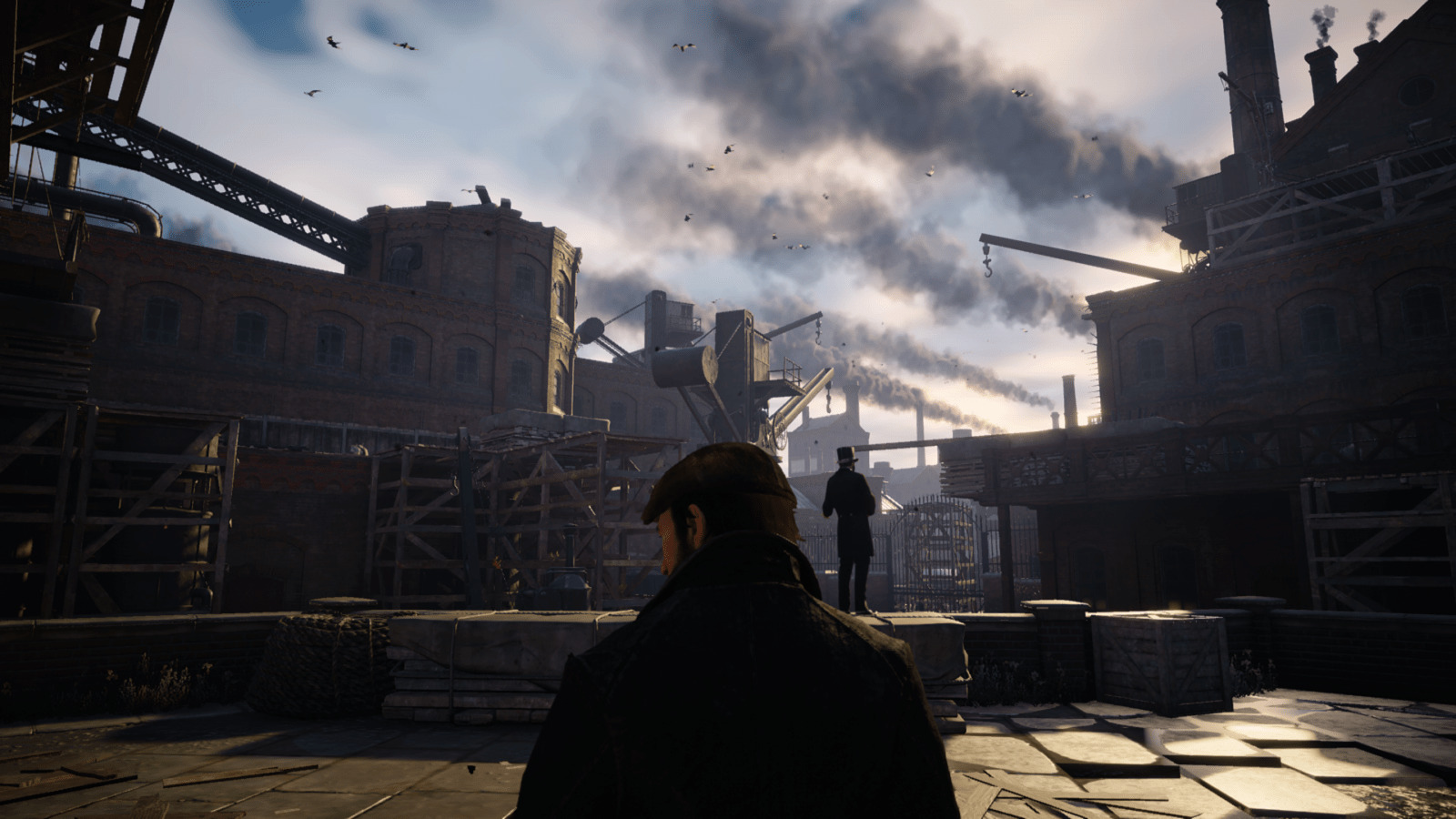
Assassin's Creed Syndicate takes place entirely within England and primarily in London. And it is an enormous London! The developers said it is about 30% larger than the already sizeable Paris in Assassin's Creed Unity.

Assassin's Creed Syndicate
But what should be done with such a huge map? Fill it with collectibles, so many that it becomes nearly impossible to navigate the map and choose exactly where to place a marker?
Fortunately, Ubisoft Quebec was smarter and less megalomaniacal, filling the map with activities for taking control of London. You see, when Jacob and Evie arrive in London, it is completely under Templar control, with villain Crawford Starrick at the top, and they must take the city back.
Each borough is controlled by a boss from the Templar-controlled Blighters gang, and Jacob has the idea of forming his own gang, the Rooks. Evie initially mocks it, since her objective is to recover the Piece of Eden before the Templars.
There are several types of missions for liberating the boroughs: Templar hunts, gang stronghold invasions, child liberation and bounty hunts. Each uses a different type of approach, but all are best completed with stealth. Still, nothing prevents you from simply beating everyone up, especially once the Rooks have grown enough for Jacob and Evie to conduct violent raids against the Templars. The more a borough is liberated, the more Rooks appear on the sidewalks, giving the siblings easy access to help within sight or earshot: simply enter combat and, if they are nearby, they will promptly join in.
The mechanic is somewhat reminiscent of what we saw in Assassin's Creed Brotherhood, but with greater freedom. In the 2010 game, the Brotherhood was called in for small, quick raids, while Jacob and Evie can walk freely through the city with up to five Rook henchmen, ready to attack and cause an uproar.
Assassin's Creed Syndicate
At first, the Rooks do not seem particularly useful. Later, it becomes clear that they serve mainly as a distraction, allowing the objective to be achieved stealthily. Creating chaos is essential, and the mechanic becomes entertaining.
Liberating London carries considerable symbolic meaning. Templar control represents the oppression imposed on the city's people. We are in the middle of the Second Industrial Revolution, in what was then Europe's most industrialized city. Anyone who did not skip history class, or at least read about it, knows what was happening in that era: brutal child labor, exhausting workdays, poverty... Jacob and Evie fight against this, and there is a strong movement by the Assassins against the inhumane conditions imposed on workers throughout the game, culminating in Karl Marx's controversial participation as an ally in the Assassins' struggle. I will not enter those discussions, however, because they do not influence appreciation of the game and even make sense within the period's context.
A Smaller Arsenal, but More Punches
Since Assassin's Creed II, the Assassins' arsenal had been expansive: swords, spears, axes, cleavers and weapons of every kind. Syndicate takes another approach, with only three weapon types: kukris, small, curved long knives; sword canes, very British and full of class; and brass knuckles. This makes combat less strategic and more brutal. Whereas it was previously a game of waiting and counterattacking, Syndicate operates almost like a melee action game and sometimes even resembles the Batman: Arkham series, though with far less depth. There is even a combo counter now.
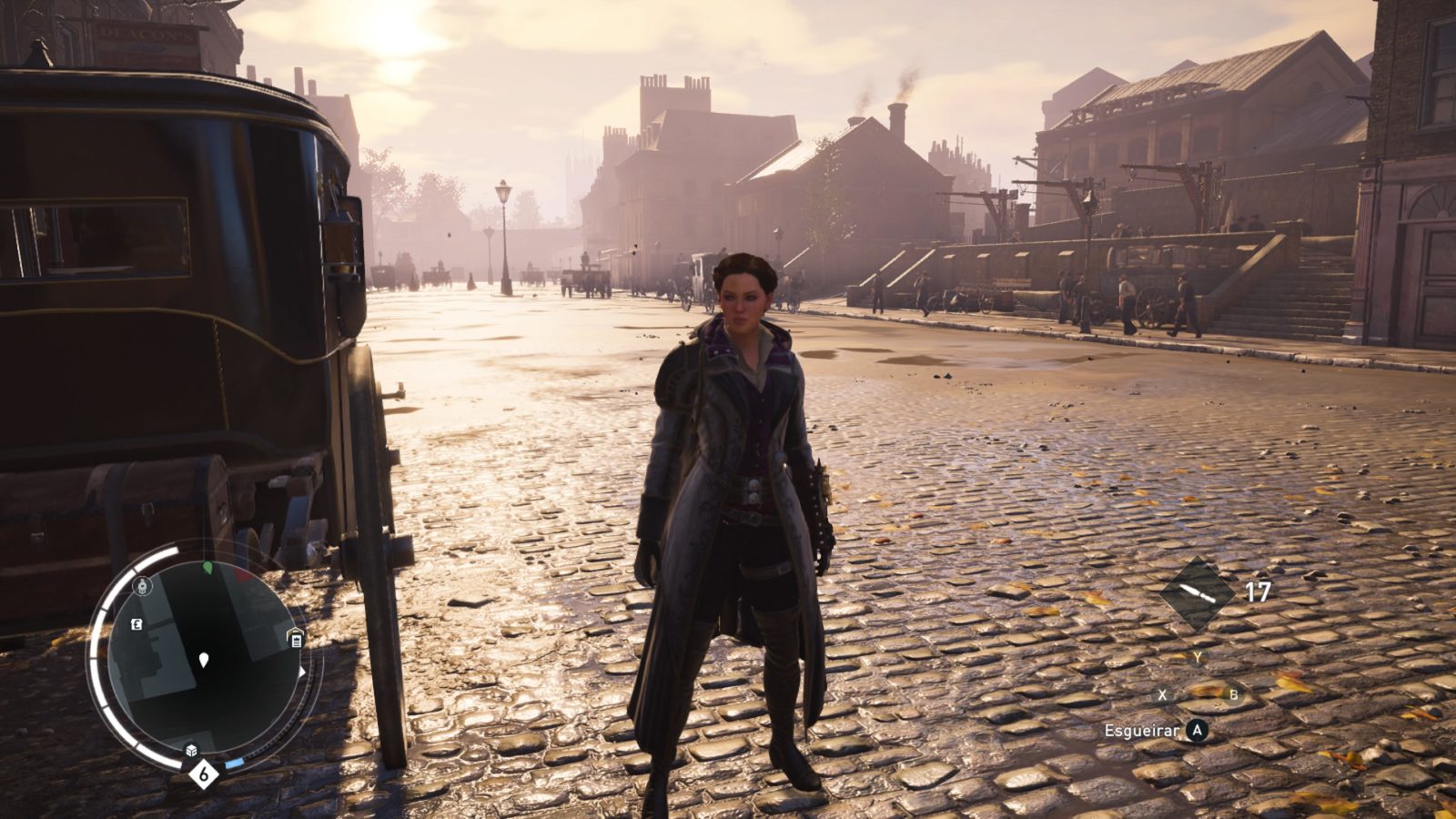
Building upon the character-level development and unlocking of new abilities introduced in Assassin's Creed Unity, earning experience points is essential for advancing through the game, and nearly everything you do can grant experience, as well as money, which enables the development and purchase of weapons and gear and the acquisition of gang upgrades. Interestingly, everything available to do is appealing. It is difficult even to walk through the streets, be provoked by the Blighters and ignore them; you want to go settle the score, especially if some Rooks are walking with Jacob or Evie.
Assassin's Creed Syndicate
This fluid movement from one mission to the next is very good for the series. While London is not yet entirely under the player's control, there is always a mission nearby, whether it involves conquest, helping allies or the main story. Since London is enormous, a vast range of missions can be expected.
But London is huge, and traveling through it would be tiring without two good additions to the series: carriages and the rope launcher.
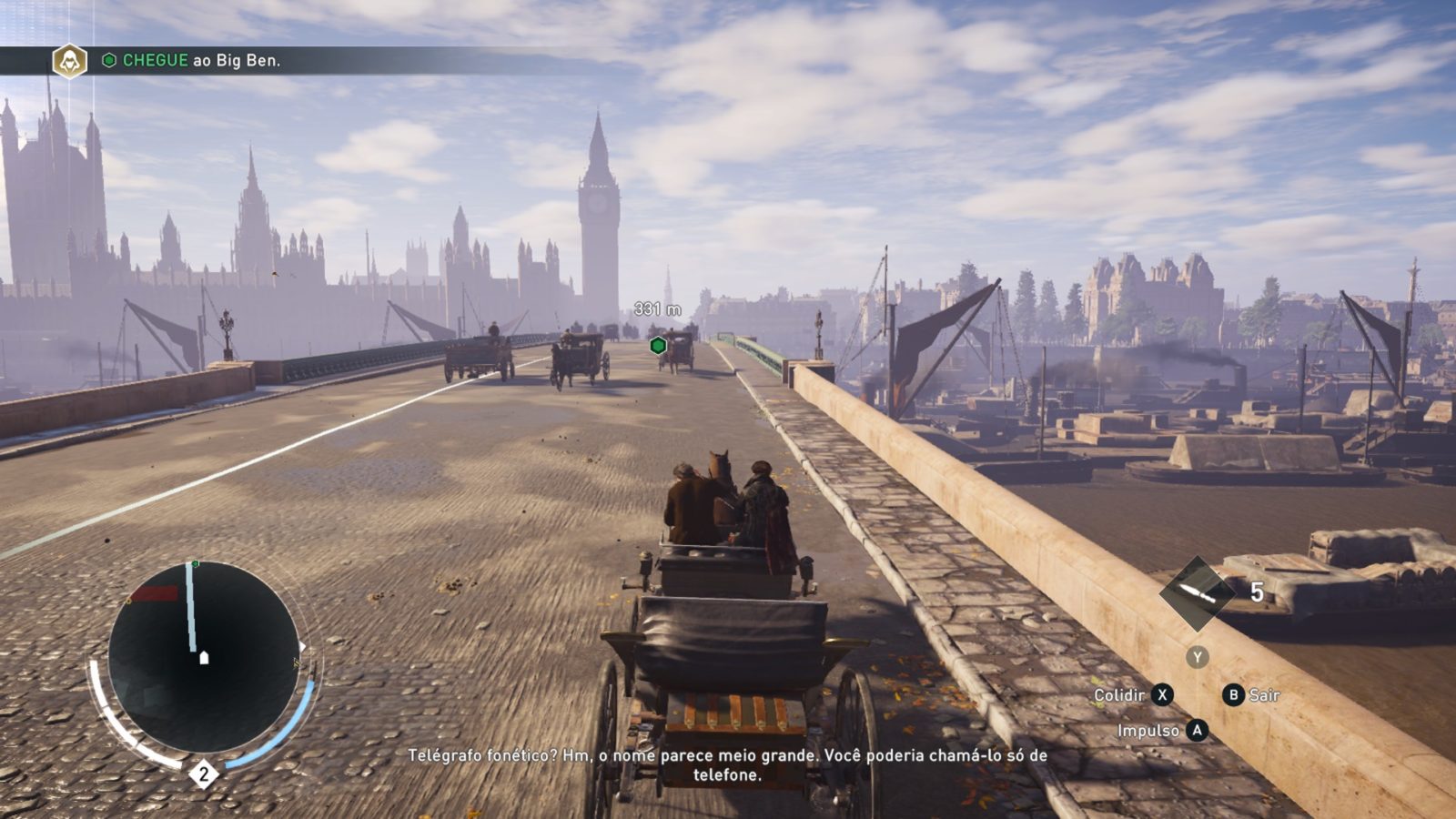
Carts and carriages are like cars, and nothing like boats, and there is a tremendous amount of them in London traffic. Players can steal any one at any time, like in Grand Theft Auto, and set out for their destination, terrorizing the Blighters and stealing their cargo. It is even possible to climb onto the carriage roof while the horse continues running, fight enemies or jump to another carriage and take it.
These moments are excellent, and many main missions allow this approach during their stages. More broadly, the missions in Assassin's Creed Syndicate give players enormous freedom in how to complete them, which is an extremely positive point: there is practically no straight line for finishing missions. Granted, we already had carts in Assassin's Creed Revelations, but only during certain missions, and they were very different from what we have here.
The rope launcher is another mechanic borrowed and adapted from the Batman: Arkham series. Jacob and Evie obtain it in the game's first missions, and it makes moving through the enormous, tall city of London easier. The buildings are very high, and climbing them manually can become tiresome, making the rope launcher, or grappling hook, extremely useful. It does not only go upward: it also forms ziplines between buildings, which are spaced much farther apart across the streets than in earlier games, especially because those streets are wider to let carts and carriages pass.
Assassin's Creed Syndicate
Friends and Gifts

Charles Darwin
Jacob and Evie have several friends, or associates, around London, including illustrious figures such as the famous Charles Darwin, Charles Dickens, Alexander “Aleck” Graham Bell and Karl Marx, as well as the lesser-known police chief Frederick Abberline and fictional characters such as Assassin Henry Green. Their missions award loyalty points with each person, and the more missions we complete, the more rewards we earn. These rewards come in the form of unique materials and new weapons and gear at increasingly high levels.
It is interesting to have several missions for each associate because this gives them depth and lets us learn more about their ideas, even if they are sometimes simplified. You see, Assassin's Creed has never taught History in the strict sense, and this time is no different. But it gives us an idea. Darwin, for example, is a prominent scientist who suffered defamation at the time because of his Theory of Evolution by Natural Selection, and his missions deal with this and show us a little of the character. But the game should never be taken literally.
Although the series offers fantastic historical reconstruction, that is precisely what it is: a reconstruction, an adaptation, with everything serving the Assassins' plot. At most, it should act as a trigger that encourages the player to conduct further research. In this regard, Syndicate deserves praise: London is extremely well realized, as are its historical characters.
Visuals and Sound
You only need to look at the images to see it: Syndicate is one, or several, steps behind Unity. While Unity offered completely next-generation graphics, at the cost of poor optimization on every platform released, bugs, glitches and a flood of problems, Syndicate's visuals are more reminiscent of Assassin's Creed III and Assassin's Creed IV Black Flag. Even so, its appearance is not enough to convince me that the game has only last-generation visuals.
Although it does not impress, the game has very beautiful moments, with particles across the environments, on a small scale, and several puddles reflecting light on London's ground. Moreover, the city is gigantic and the game has good art. There is also a fog that reduces the draw distance, the distance at which the game renders graphics for the player, justified by the presence of fog in real London itself.
Even so, it is difficult to hide the disappointment of seeing an Assassin's Creed that looks inferior to its predecessor. But all this is forgiven because of the extremely small number of bugs and glitches throughout the game, as well as its good frame rate, with only minor, brief drops. In this respect, it is more fluid than Unity, which suffered dramatic performance drops. I hope a future Assassin's Creed will once again use Unity's improved engine, this time with all its fixes. Unity itself is much more playable today than it was at launch, five updates later.
As for sound, we have good music that appears more often than it did in the previous game in the series. That is good, but there still is no truly memorable track. Honestly, I do not think we will ever again hear a challenger to Venice Rooftops (Assassin's Creed II), The Brotherhood Escapes (Assassin's Creed Brotherhood) or Freedom Fighter (Assassin's Creed III). Still, Syndicate's music gives the game a good English character, with tracks that evoke pubs, especially during escapes.

The twins
London Creed
Assassin's Creed Syndicate casts aside several pieces of the series' busywork, such as a long introduction and the delay before starting the game as an Assassin, and gives players an entire London to explore. Fluid, cohesive missions keep fans rooted to the spot until they have liberated all of London and helped every associate to the end.
With a story removed from Jacob and Evie's private lives yet still featuring good character development, Assassin's Creed Syndicate revolves much more around the city and its historical moment than Unity did. This is an extremely positive point for a series that has always delivered excellent historical reconstructions, both in their settings and in the actions taken. In this regard, Jacob and Evie become completely involved with London and its people, and that is what makes them legitimate members of the Assassin Brotherhood.
Rating: 8
Tested on a standard Xbox One.