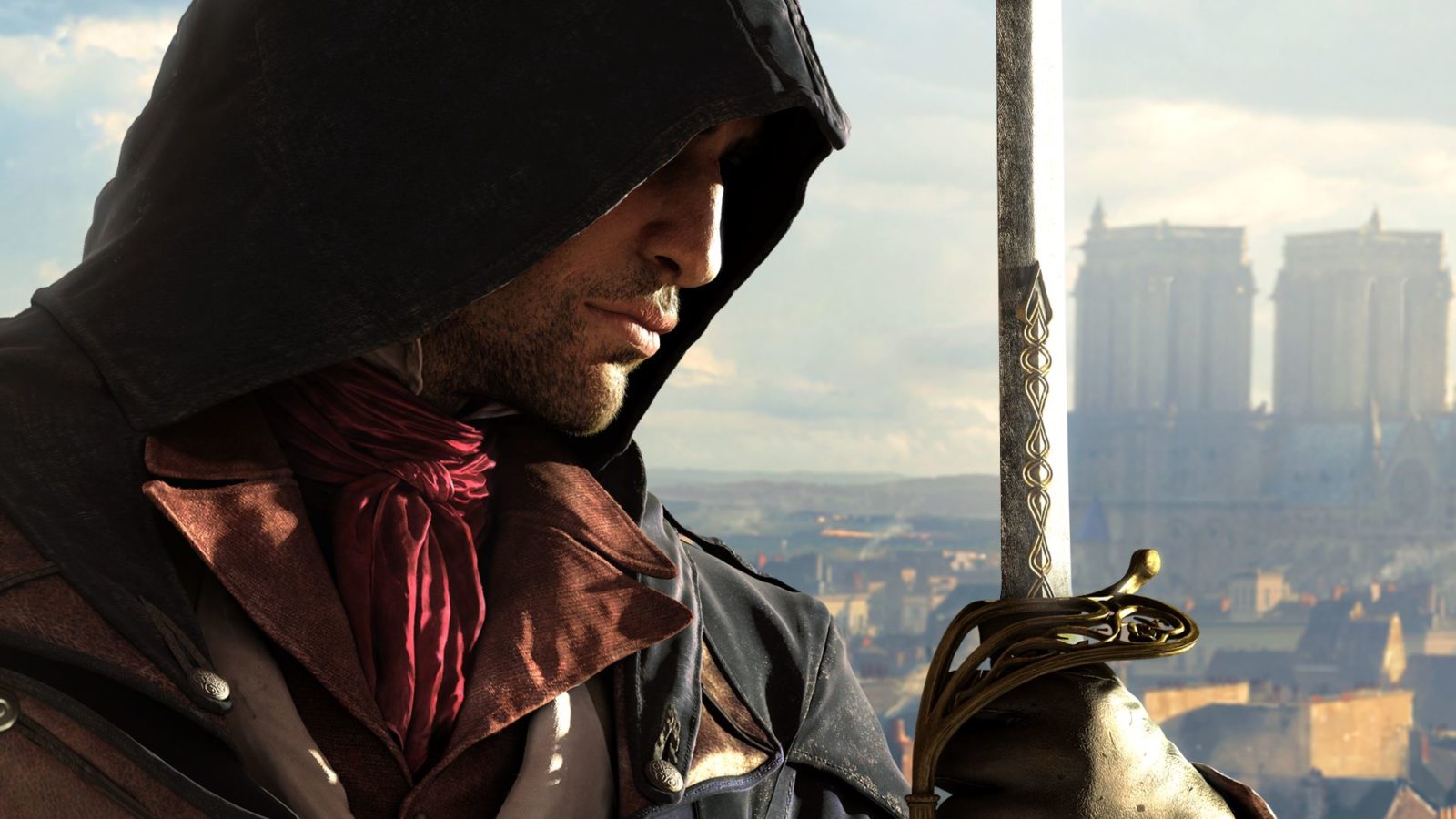
As tradition now dictates, every year's end brings a new Assassin's Creed. Can you believe that, with Unity, we have seven Assassin's Creed games exclusive to home consoles, with an eighth, Rogue, released in the year of this article for PlayStation 3 and Xbox 360? Did the number seven, so mystical, so symbolic and filled with meanings, therefore come for the series' good or ill?
Égalité!
Assassin's Creed Unity takes place entirely in France, most of the time during periods of the French Revolution, especially the Reign of Terror.
It is difficult to imagine another moment more ideal than this for an Assassin's Creed. The Crusades are fascinating, as is the Renaissance; the American Revolution is extremely important to the course of History; and the golden age of piracy is compelling... but the weight of the French Revolution is enormous. Think about it: the consensus among several historiographical schools is that the French Revolution marks the end of the Modern Era, Ezio's time, and the beginning of the Contemporary Era, Desmond's time — in other words, ours.
With such a powerful historical component, one would expect Ubisoft, which has always created extremely interesting historical reconstructions that can easily encourage disinterested young people to begin researching the periods portrayed in Assassin's Creed, to do a good job in this area, especially because the developer itself is French. Unfortunately, that is not what happened.
All that weight, that historical backdrop, was somewhat pushed aside. Yes, it is very interesting to walk through the streets and see protests, signs and people singing hymns and songs, but honestly, the game fails to show why any of it is happening.
Assassin's Creed Unity
We embody Arno Dorian, a member of the local nobility who, after his father's death when he was young, was raised by another nobleman. The game itself, after we play a section in medieval France involving Jacques de Molay and then a short part with Arno as a child, begins without showing much of what France was like on the verge of revolution.
We rarely hear the words “hunger” or “bread,” so heavily emphasized in history books. In this regard, the game almost feels like a reinterpretation of History itself, omitting many things until the Revolution actually begins and its participants end up looking like a group of troublemakers without a cause. The Assassins' position in supporting the monarchy of the era is also very strange, since it is known that while the people starved, the monarchy feasted in luxurious palaces.
This is not to say that the excessive violence symbolized by guillotines severing heads across Paris should at any point have been praised by the game. But here, Ubisoft clearly and strangely decided to support the monarchy of the era.
The game ends up focusing too heavily on Arno's life and his involvement with Elise, his romantic and martial counterpart. Their story is practically Romeo and Juliet, a forbidden and extremely clichéd romance. I will confess that I have never found the central character plots in Assassin's Creed particularly impressive, with the exception of Assassin's Creed III and Assassin's Creed IV Black Flag, which have fascinating stories. Perhaps for that reason, I developed a habit of always looking at the historical background masterfully woven by Ubisoft and somewhat ignoring the twists and turns in the characters' destinies, turning a blind eye to them.
Unfortunately, in Unity this is reversed, and we have a poorly explained, poorly told Revolution that leans to one side. Compared with Assassin's Creed III, which to me is the best example of a fantastic historical reconstruction of its period, Arno barely seems involved in the Revolution, while Connor practically makes his happen. Both have stories of revenge, but the Native American's is completely intertwined with the historical events portrayed, the American Revolution, while Arno hardly seems to know what he is doing there and thinks only of his personal vendetta.
Screen for the new assassination missions.
It is very interesting to once again see the Assassin clan well organized and prominent after Assassin's Creed III, where we basically had only Achilles and Connor, and Black Flag, where the Creed was not even particularly important. Still, they ultimately seem somewhat apathetic, perhaps because of how little they actually engage with the Revolution itself.
The databases covering events, historical figures and locations are naturally highly informative, but I greatly missed seeing history happen in motion. We have the Fall of the Bastille, one very famous beheading and several other events, but everything feels so distant and so focused on Arno's revenge that it represents a tremendous waste of an important historical moment.
Liberté!
Assassin's Creed Unity is clearly an advance in mechanics for the series, however. For a franchise with one game per year, I always emphasize that the titles have many innovations and changes between them, in part because the production period for each game is longer than a single year, as Ubisoft itself has said on several occasions.
Now, for example, we have an Arno who crouches. This alone would be an enormous addition to the series, since stealth gameplay has always been one of its foundations and it was quite strange for no Assassin to have a command for crouching and moving quietly. Unity finally gives players this freedom, making this type of strategy more authentic.
One reason for this may be the absence of the bushes present since III, where Connor and Edward crouched and remained hidden. Since we can now also enter many buildings and several missions involve doing so, level design is based more on objects such as sofas, tables and others scattered around. Arno even has a cover button for moving between obstacles.
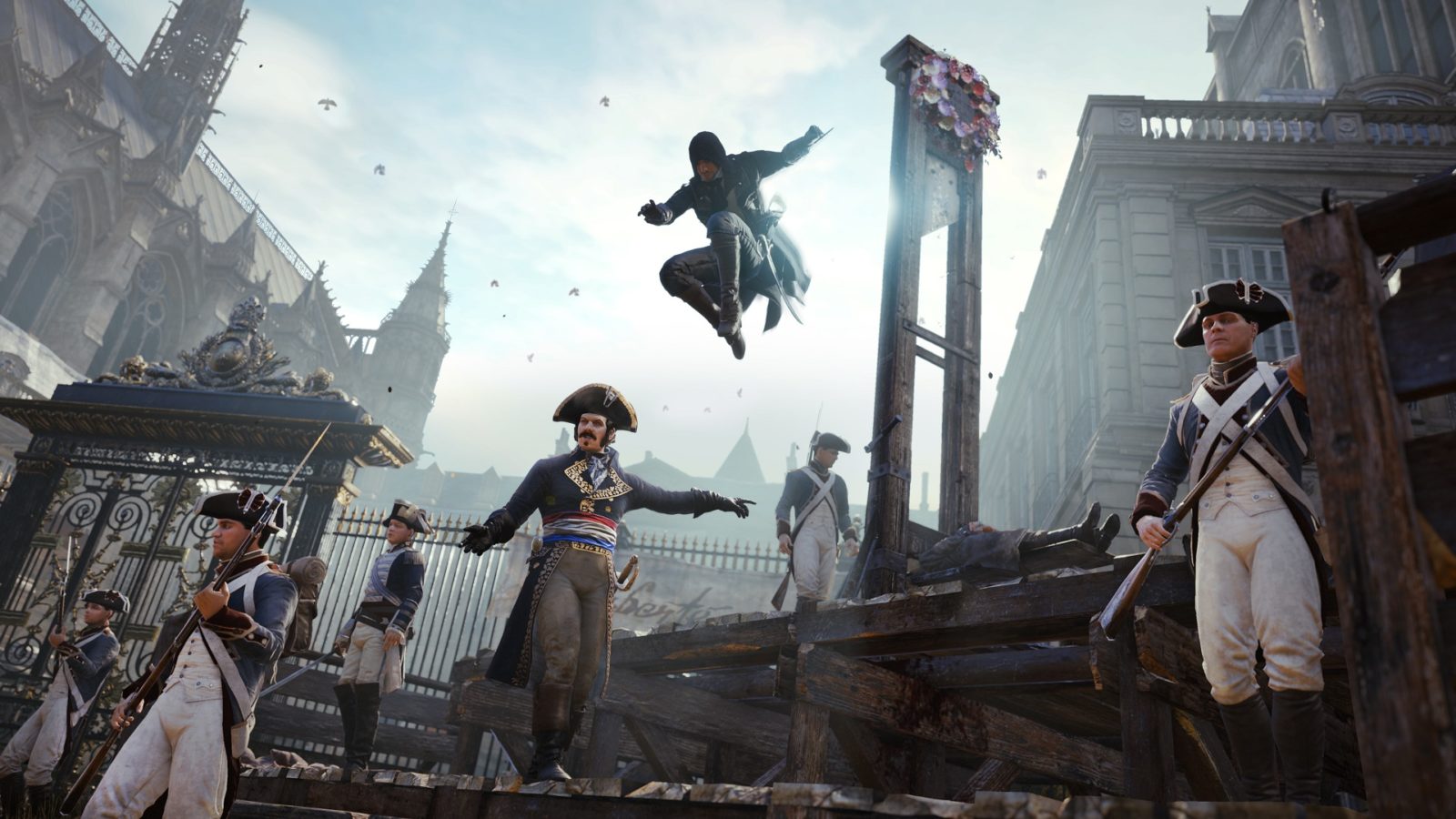
Assassin's Creed Unity
Another excellent evolution is that we now have one button for climbing up and another for climbing down, making it easier for the character to understand what we actually want to do. There are still some movement problems, but far fewer than before.
Adding an “RPG element” to the game, there is also meaningful customization of character equipment, leveling up, a broad selection of weapons, “Assassin” ranks earned by completing missions masterfully and more. This is interesting because it adds reasons to obtain more money, complete side and cooperative missions and seek collectibles.
Since money is the subject, it is best to say it now: yes, there are microtransactions in Assassin's Creed Unity. Once again, as in earlier entries, purchasing them is entirely unnecessary. They offer Helix Credits, which work like in-game money for obtaining anything.
It is extremely easy to earn money in the game, so once again microtransactions are for either millionaires with nowhere else to put their money or people who do not want to earn it because they are too lazy to explore the map or purchase clubs, which add money to the safe at Arno's Café Théâtre over time and also return a great deal of funding to players who renovate it. Is it a bad tactic for video games?
Yes, it is, but you can easily complete 100% of the game without even thinking about spending a cent on microtransactions.
This customization and leveling proves extremely necessary because this time, at last, battles offer some challenge. Arno is highly susceptible to enemy attacks, and this time it is extremely difficult to survive facing groups larger than three or four. The enemy variety is not great, but the intensity of duels has improved. Most of the time, being stealthy, and running away if caught, is the best option. But the stronger he becomes, the more comfortably Arno can face his enemies and the greater his resistance.
There are also many abilities to acquire using experience points earned as we progress and complete cooperative missions. I find it somewhat silly, however, to have to buy an ability to “kill two enemies by falling onto them,” which had been standard from the beginning since Ezio's Assassin's Creed II and his paired hidden blades.
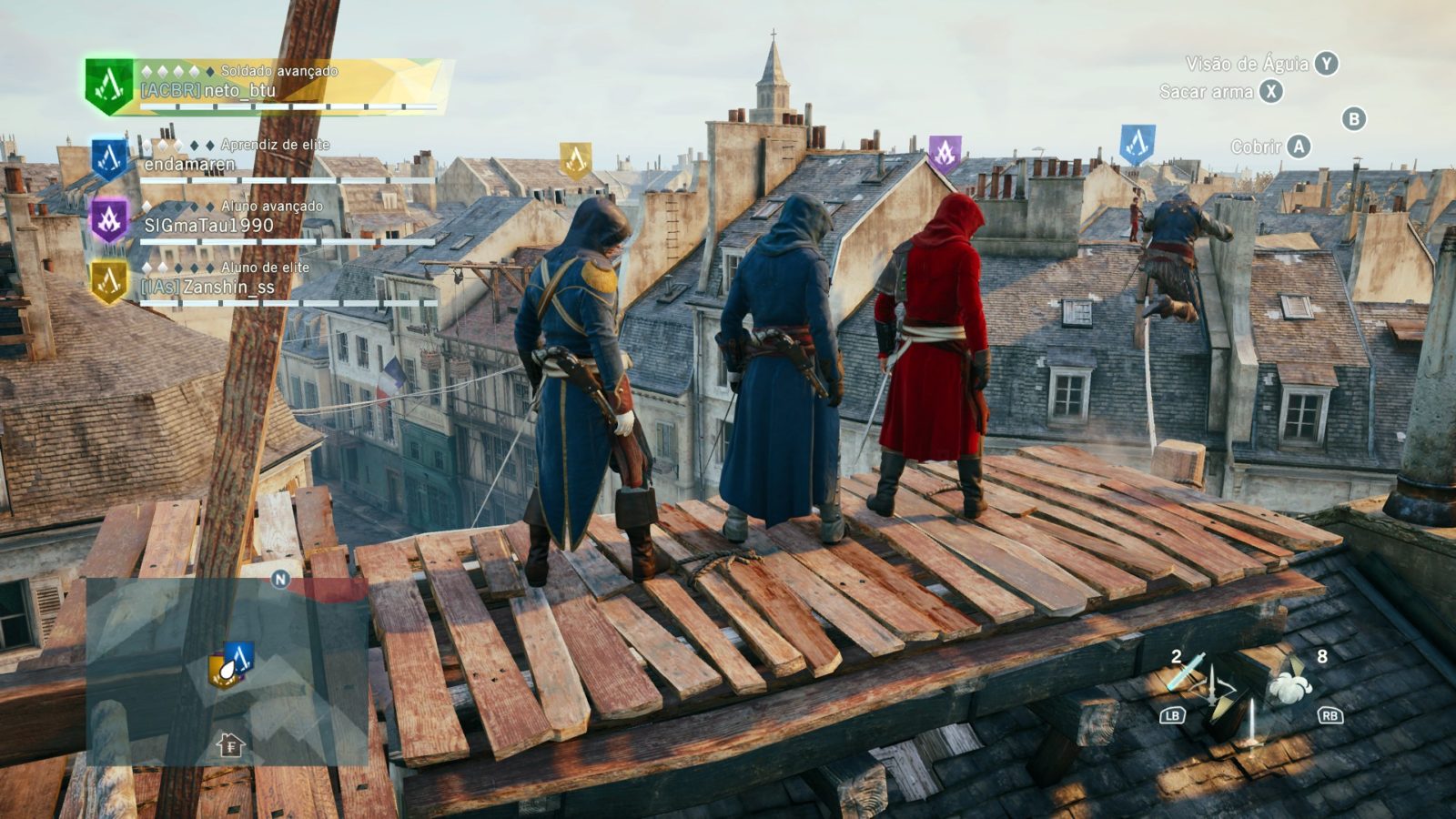
Online Multiplayer
Speaking of hidden blades, Arno has a weapon different from the others: the Phantom Blade, a kind of miniature crossbow attached to the Assassins' original hidden blade that shoots blades at high speed for a clean, silent kill from a distance, or poisons enemies and makes them attack their companions like the berserk darts in Assassin's Creed IV Black Flag. It is an interesting addition, and replenishing these blades is quite expensive at first, but Arno becomes extremely rich and generates a great deal of funds over time, making them inexpensive.
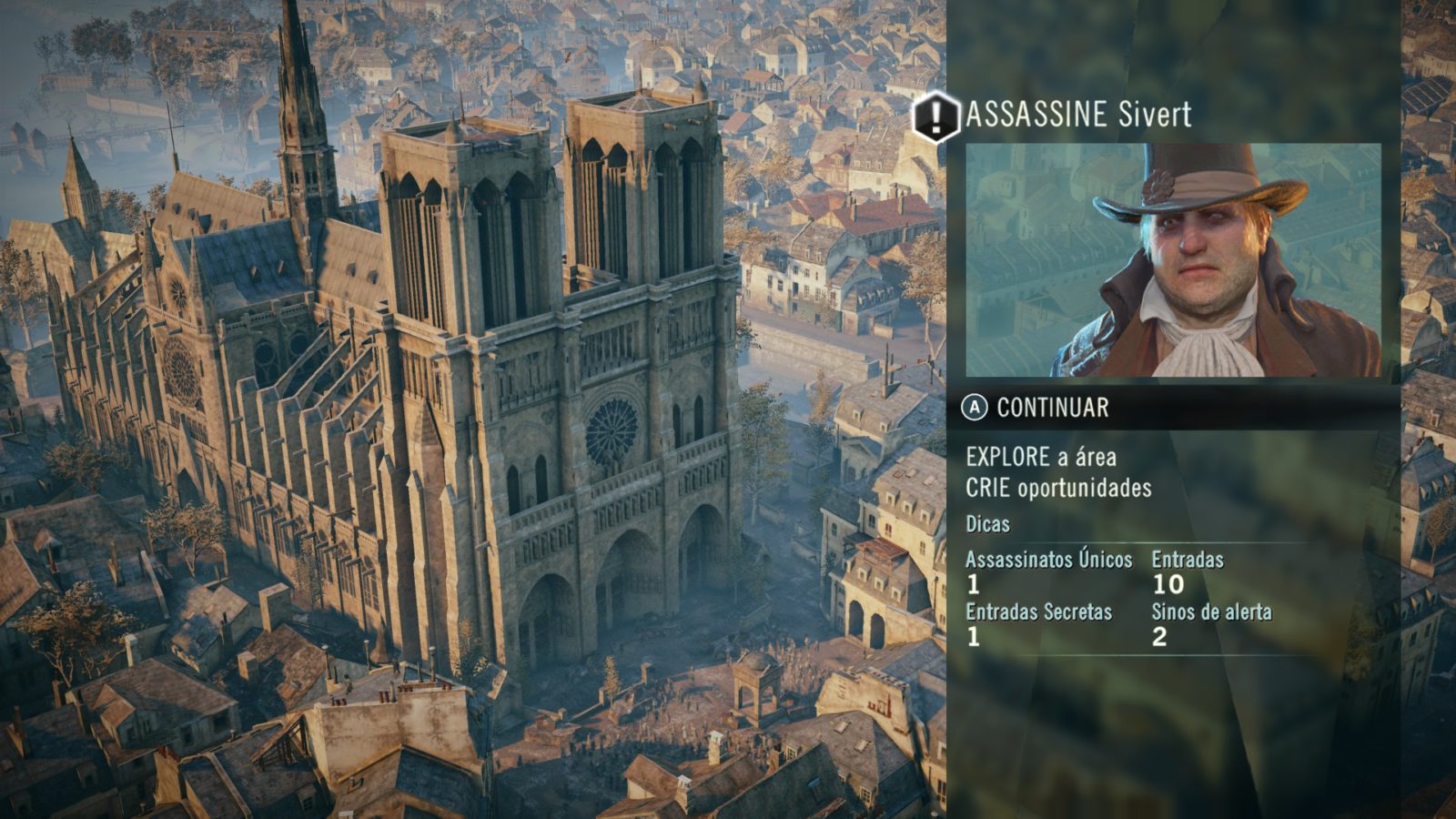
The greatest evolution, however, lies in the main assassination missions. All the freedom we have always wanted in Assassin's Creed is here. Missions change according to your actions; there is no longer desynchronization because you were spotted during an assassination mission, for example, although some other missions have penalties and conditions that must be followed. There are several entrances to hideouts and various possible strategies. This is the legacy Assassin's Creed Unity will leave for future games in the series, which should now refine this freedom even further.
There are several side missions, some new things to do on the map and various series traditions, such as climbing viewpoints to synchronize the map. Unity is far more traditional in its Assassin's Creed structure than Black Flag, which was too focused on being a pirate rather than an Assassin, even though it remains my favorite game in the series.
I am not a great fan of excessive customization, especially because I have always liked each Assassin in the series to have a unique robe. Unity handles it well but ends up setting that aesthetic aspect aside, despite the clothing and accessories being extremely well made and detailed. Only at the end did I discover that even after modifying them, I could use Arno's “official” outfit without losing the attributes gained by purchasing and equipping other clothing parts!
One of Ubisoft's greatest focuses during the game's advertising was its online component. Several cooperative missions are scattered around, and all are very good to play... with friends. Honestly, when I played with people I did not know and with whom I was not speaking and jointly planning strategies, I did not find it particularly enjoyable, because it becomes a mess, every player for themselves, rather than better-defined cooperation. It is indeed very good, but perhaps a future entry could better structure public matches in cooperative mode. It is nevertheless certainly a good start for another way to play Assassin's Creed, and I want competitive mode back — it was so good!
Fraternité!
Technically, Assassin's Creed Unity was a disaster and remains one at the time this review is being written. Playing on a PC with the recommended specifications, especially a GeForce graphics card, I confess that I had no frame-rate problems and encountered only three bugs that forced me to restart the game or fast travel elsewhere on the map. But the game's community, which suffered through all of this, cannot be ignored.
Ubisoft released the first new-generation Assassin's Creed with horrific problems on every platform and today, more than a month after launch, it has already released four corrective patches, practically one each week. There is still a long road ahead before the game is at 100%, and I confess that I believe Assassin's Creed Unity will never achieve technical excellence, regardless of how many patches arrive.
Countless times I read articles that began with “So-and-so from Ubisoft apologizes for Assassin's Creed Unity's problems.” This is harmful to the series, and the game is permanently stained by it. I do not know the reasons, but it appears the game's enormous size, its many characters with lives of their own and a launch deadline caused it to be released like a bomb, with many people unable to play. I especially note players with AMD graphics cards, who suffered, and must still be suffering, to play. But I no longer think that is even a compatibility problem, but rather some embargo by Nvidia, Ubisoft's partner on its latest games — though that is merely my conspiracy theory.
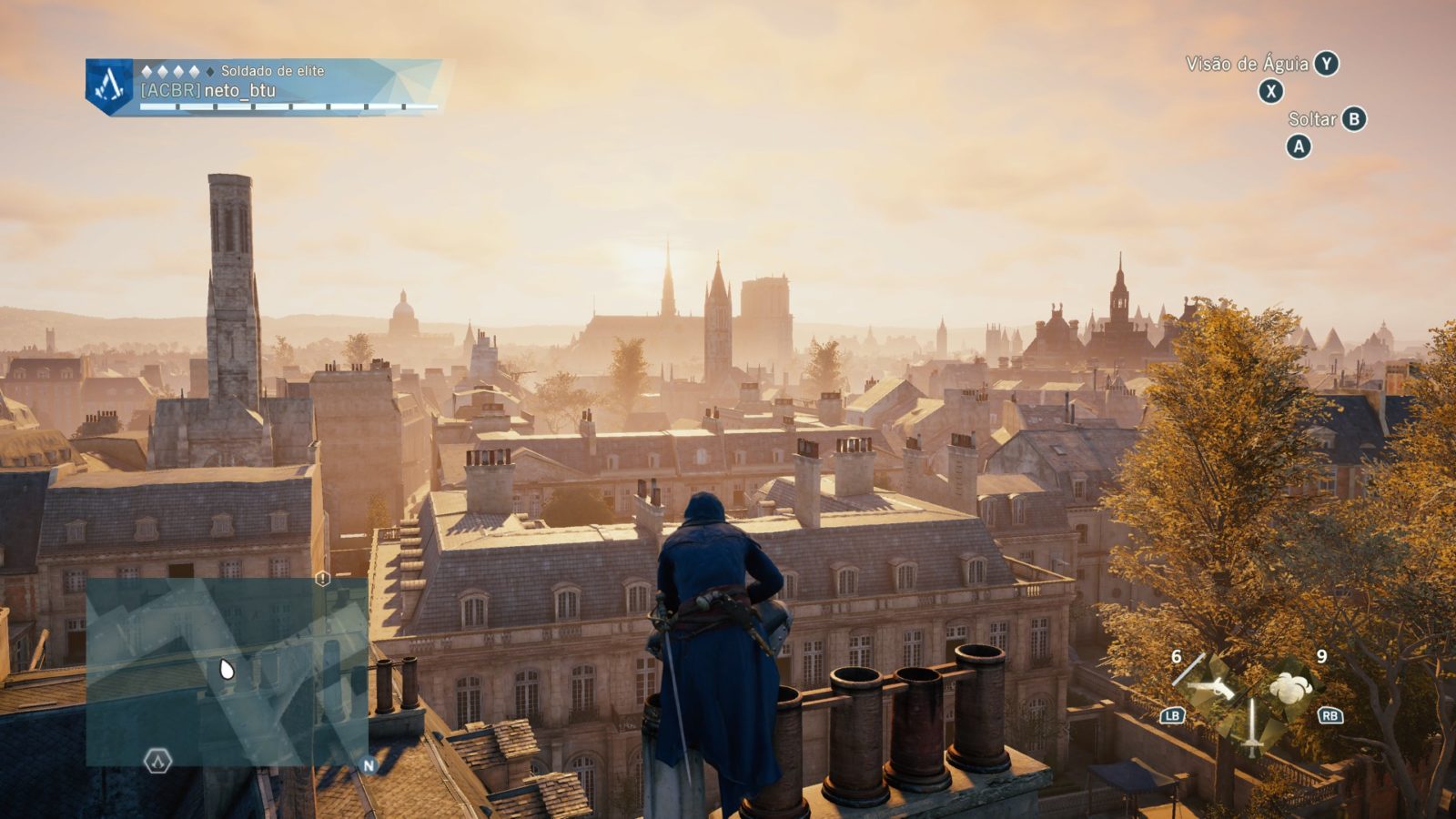
Nevertheless, Assassin's Creed Unity is beautiful and wonderful. With lush graphics, highly detailed architecture, excellent facial expressions and eye-catching textures, it is difficult to believe the game's production lacked care. Everything visible in Unity is beautiful and detailed, from the fluttering of Arno's clothes, and how fluidly this character moves, with so many different motions, especially when jumping from building to building, to the details of a pillar at Notre-Dame. All this is crowned by wonderful lighting, especially at sunset, when everything seems even more alive.
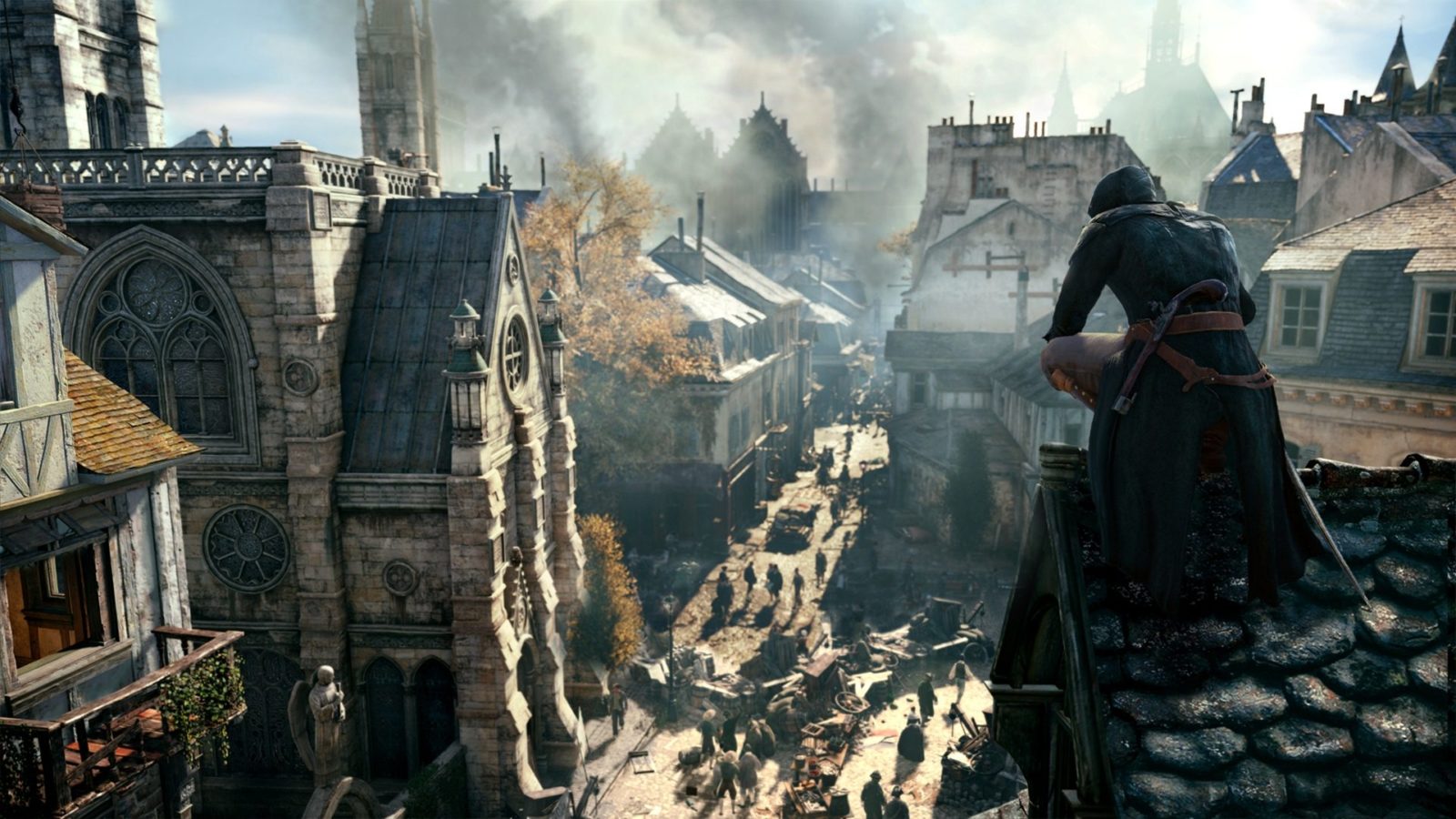
Assassin's Creed Unity
In terms of sound, there is a good but extremely restrained soundtrack, the most restrained in any game. It is a problem to be corrected and a pattern several games are adopting, setting aside prominent music in favor of supposed “immersion,” which would occur far more naturally and impressively with a background score.
“La liberté ou la mort!”
It is very strange to like a game as problematic as Assassin's Creed Unity so much. Ubisoft did terribly by releasing it completely broken and patching it afterward, though at least it is patching, or trying. The stain on the game will be remembered forever, and this fact drives potential new players away from the franchise.
There are many problems, but considerable evolution can be seen in movement, mission structure and combat. Returning to Europe after two games focused on the Americas is extremely good, and the entire game has the air of the Ezio Trilogy. Arno is a good character, but completely wasted in a silly plot with little interaction with the historical events the game tries to address.
Tested on PC.