In recent days, Ubisoft has returned to the spotlight not because of a new game, but because of a controversy involving the terms of use for its products. According to reporting by IGN Brasil, the company requires that if a player wishes to terminate a game's license agreement—or if that game is discontinued—they must delete all installed copies and destroy every available physical or digital version. This kind of clause appears in several EULAs (End-User License Agreements), and although many people never read these documents, their content has generated outrage.
Although legally questionable in several jurisdictions—since EULAs do not have the force of law by themselves—these clauses represent an attempt to maintain complete control over how a product is used, even after its sale. They demonstrate how major developers see games more as temporary services than as purchased goods. In this context, the player never truly “owns” what they bought.
Ubisoft Is Not Alone
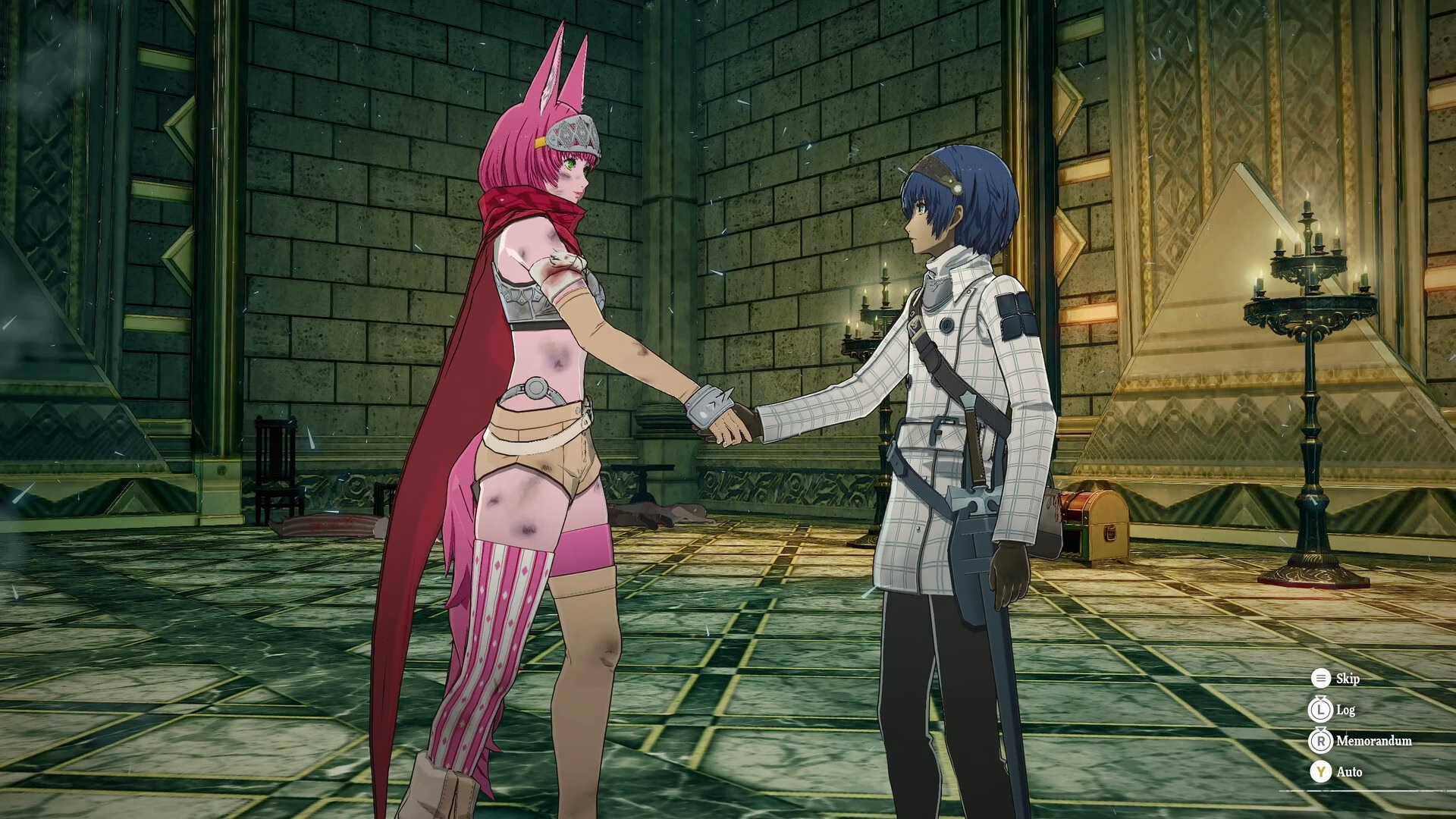
The Ubisoft case sounded an alarm, but it is far from isolated. Several companies include similar clauses in their contracts, requiring users to delete and destroy their game copies if the license is terminated. Titles such as Death Stranding, TES IV: Oblivion, Call of Duty, Elden Ring, and No Man’s Sky follow the same logic. What is more, studios and publishers such as Square Enix—with Final Fantasy XIV—SEGA, including Persona, Yakuza, and Metaphor: ReFantazio, Activision, and even mobile games such as Genshin Impact also adopt this clause in their EULAs.
Some companies go beyond a simple legal warning in their terms of use. SEGA, for example, applies the same clause across all its games—such as Yakuza, Persona, and Metaphor: ReFantazio—requiring players to destroy all physical or digital copies if the license is terminated. This reflects a rigid stance that treats games as temporary licenses even when they were purchased permanently.
Larian Studios, the developer of Baldur’s Gate 3, adopts a different model: the clause applies only if the player personally terminates the agreement, which requires formal notification to the company. Until that happens, the agreement remains valid and the destruction requirement has no effect. The difference between these approaches shows how some developers still leave the user a degree of control, while others impose more automatic rules—even though the legal validity of these clauses remains debatable.
What Does This Mean for Players?
Although these clauses rarely have broad legal validity, they reveal a troubling trend: consumers losing control over something they purchased. In practice, a company can discontinue a game, remove its servers, and still require players to delete all their copies, including physical ones. This confronts the traditional idea of ownership, especially when a financial investment is involved.
This scenario reinforces a change in the game-consumption model: games stop being products and become services with an indefinite lifespan, subject to unilateral rules. The EULA for CD Projekt Red's Cyberpunk 2077 illustrates this well with confusing text that is even comical in places—showing that many of these agreements function more as tools for concentrating power in developers' hands than as fair agreements with users.
#StopKillingGames
The imposition of clauses requiring the destruction of discontinued games is directly connected to the #StopKillingGames movement. Created by players and supported by independent developers, the campaign defends the right to continue accessing titles even after official support ends and has more than 1.2 million signatures worldwide. The proposal is clear: if the servers are shut down, the game should at least work offline or be maintainable through community servers.
The movement emerged in response to the closure of still-popular games whose servers were shut down despite an active player base. Faced with terms of use that treat consumers only as temporary users, #StopKillingGames raises a crucial question: if you paid for a game, why can you not continue playing it when the company decides to abandon it?
More than an isolated complaint, the campaign strengthens the debate about game preservation, genuine ownership of what we buy digitally, and the limits of the control companies should have over products already sold.