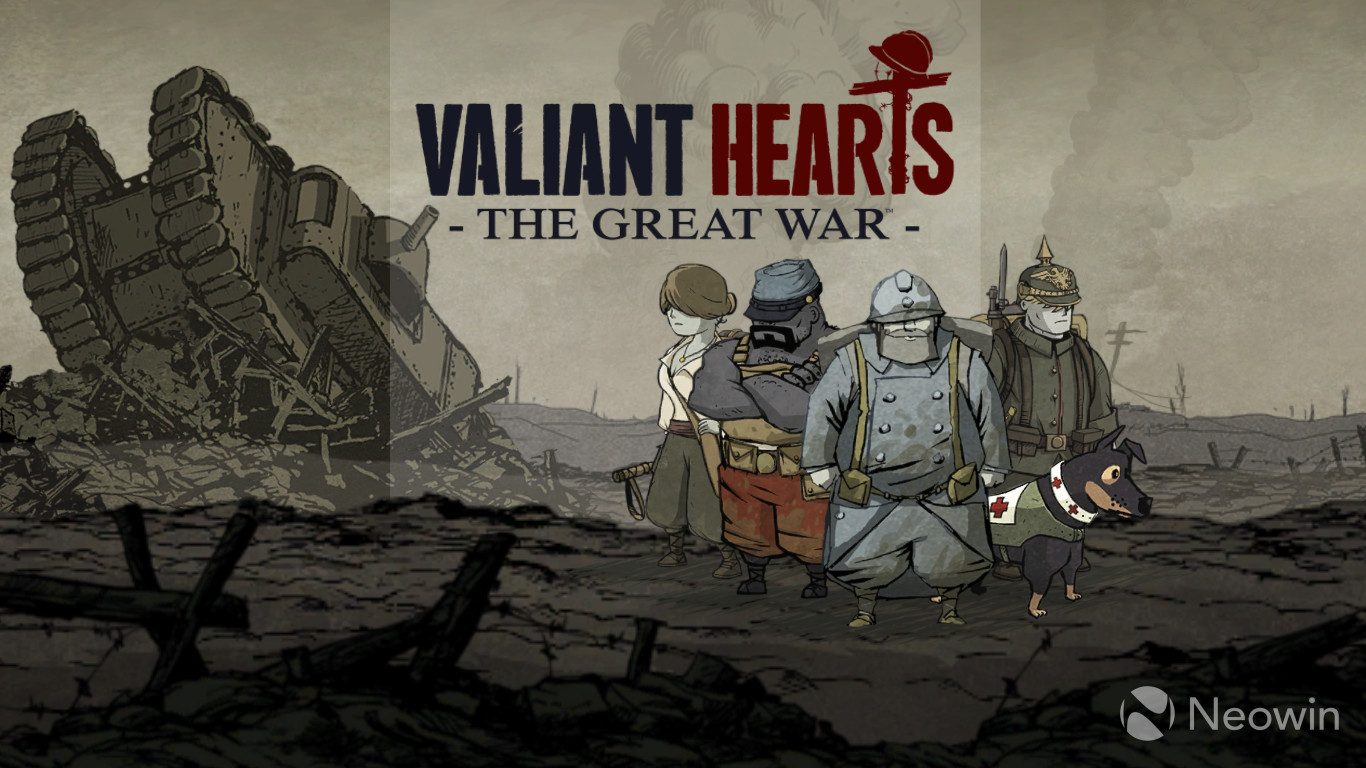
Cinema and games often ignore the First World War. Perhaps because of the scale, events, or icons of the Second World War, the latter receives far more attention. Ubisoft decided to go against this tide and delivered another of those games worthy of being called a work of art. By teaching history in a cartoon-like and emotional way, it reminded us that video games stopped being compared with toys many years ago.
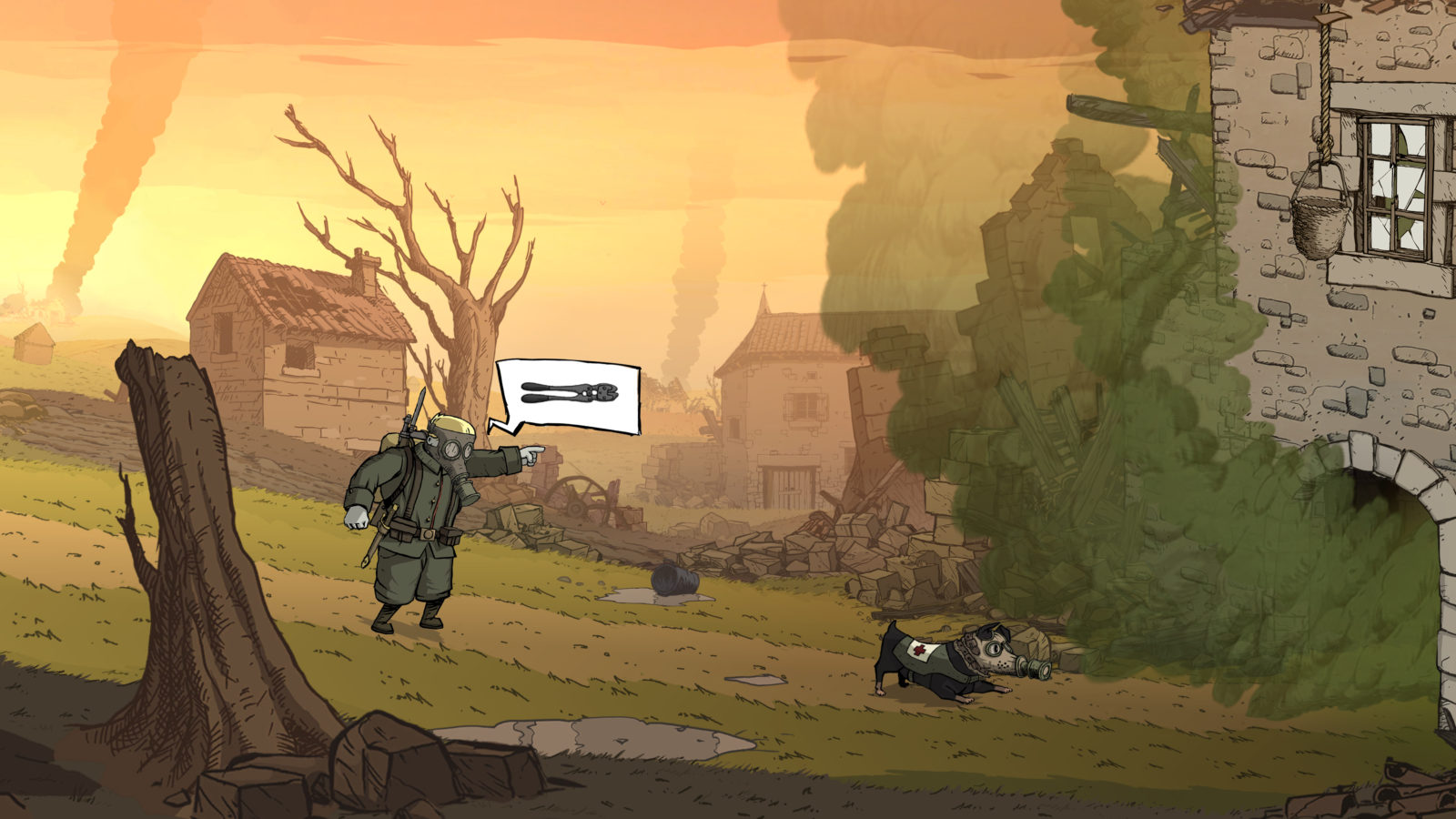
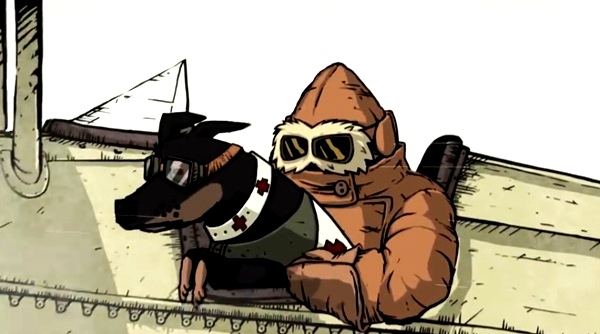
The dog constantly helps us at various moments during the campaign.
Valiant Hearts: The Great War is a 2D puzzle adventure developed by Ubisoft Montpellier and published by Ubisoft. Initially released for Windows, PlayStation 3, PlayStation 4, Xbox 360, and Xbox One in June 2014, it was ported to Android and iOS that same year. Finally, more recently, it received a Switch version in November 2018.
Below is the subtitled trailer for Valiant Hearts.
Behind the Scenes of Valiant Hearts

Valiant Hearts director Yoan Fanise.
After creating Assassin's Creed III, Yoan Fanise began working on a project he had wanted to make for some time. It was something smaller, made by a small team whose members he could contact constantly, and based on real events.
Choosing the First World War was not particularly difficult, because members of his production team had family stories they believed would fit well in a "work of art" style game like the one they wanted to create. Everything began from there: a true story intended to move those who played it, with a major focus on love, friendship, and family.
During the game, we gain access to real letters from the period that soldiers sent to reassure their families. They even include letters from Yoan Fanise's great-grandfather, Felix Chazal, who was wounded twice during the war and returned home without either of his legs.
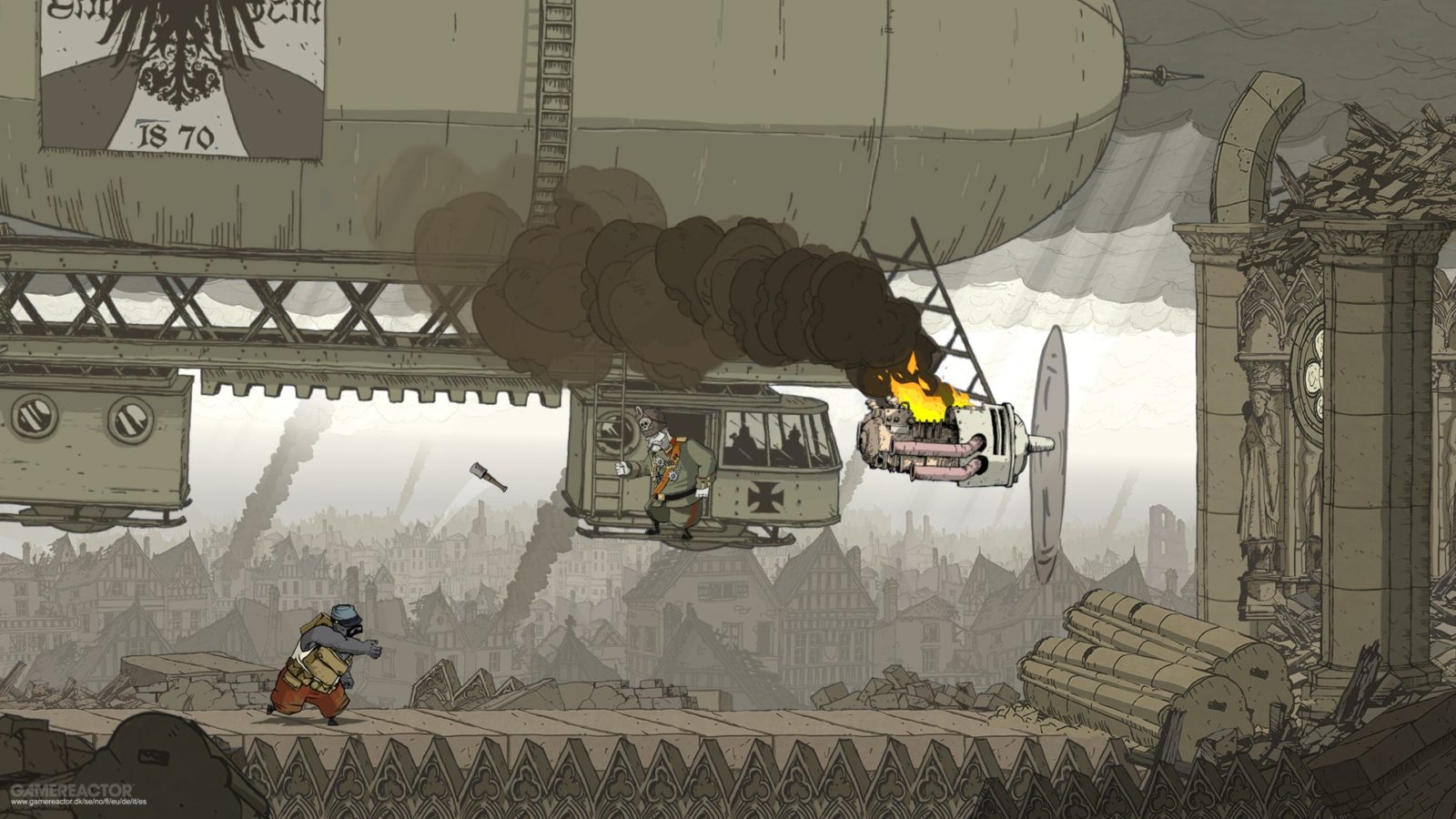
Although they require more reasoning than skill, bosses are present in the game.
Original battlefield photographs and objects from the trenches were among the production's greatest highlights. These were even heavily criticized by parts of the press, which considered them intrusive. The programmers, on the other hand, believed these details motivated people to read and learn history. According to Yoan, the response was highly positive: "People understood that this greatly enriched the game. Many people even told us they learned more about the First World War from Valiant Hearts than in their schools."
Background to the Events and the First World War (1914–1918)
It is often difficult to explain why we like something; feeling is easier than speaking. In the case of Valiant Hearts, however, I believe one reason I admired the work is my love of history. For that reason, I will include a brief introduction here, believing that it will better prepare those who have not yet played this marvel to enjoy the experience, since the following events form the setting in which the game takes place.
Between 1871 and 1914, humanity experienced one of its greatest periods of prosperity and technological and cultural development. Inventions such as the telephone, automobile, airplane, commercially viable incandescent light bulb, and even the Titanic entered our society during this period, known as the belle époque. A climate of uncertainty hung in the air, with this wealth distributed terribly, countries dissatisfied at being excluded from major decisions, and old tensions among nations. Everyone wondered what the next war would be like, because if all these innovations were available to civilians, imagine what the military was creating for destruction. Just as people form friendships when they feel threatened, countries formed alliances.
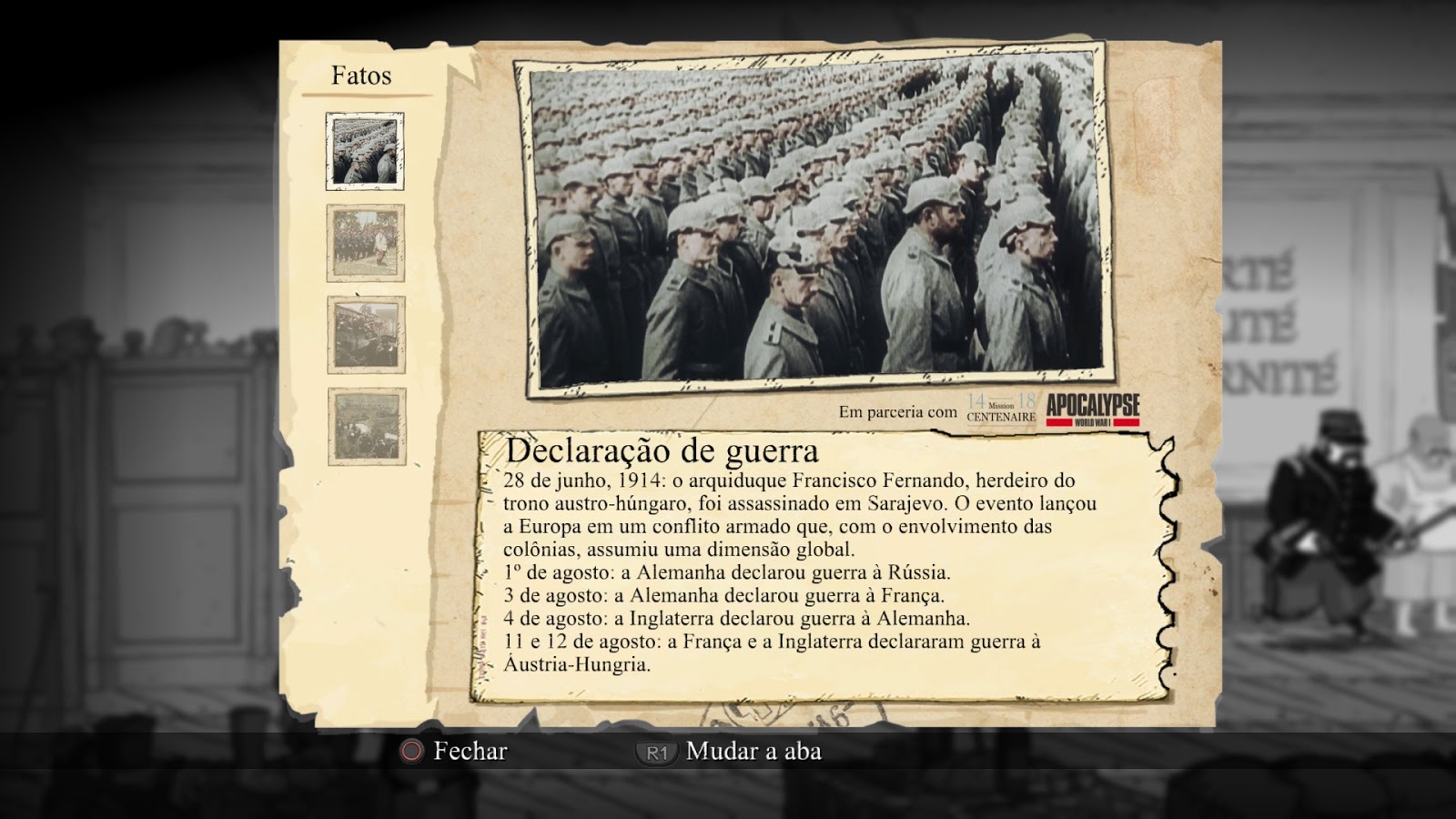
Historical facts are available so we can fully understand the context of the story.
On one side was the Triple Alliance, formed in 1882 by Germany, the Austro-Hungarian Empire, and Italy, all dissatisfied with their opponents' economic and colonial expansion. On the other was the Triple Entente, formed in 1907 by Russia, the United Kingdom, and France, countries that wanted to continue their global dominance and had recent disputes with the Alliance's members.
With everything ready for war, all that was missing was a single spark to ignite the powder keg the European continent had become. The conflict began when a Serbian student shot and killed Archduke Franz Ferdinand, heir to the Austrian throne, on June 28, 1914. Austria consequently blamed Serbia, which had Russia's support. Germany declared war on Russia because of its alliance with Austria. Germany then declared war on France and invaded Belgian territory. The violation of Belgian neutrality became the reason England entered the conflict, which would later assume global proportions with the participation of countries such as the United States, Brazil, and Japan.
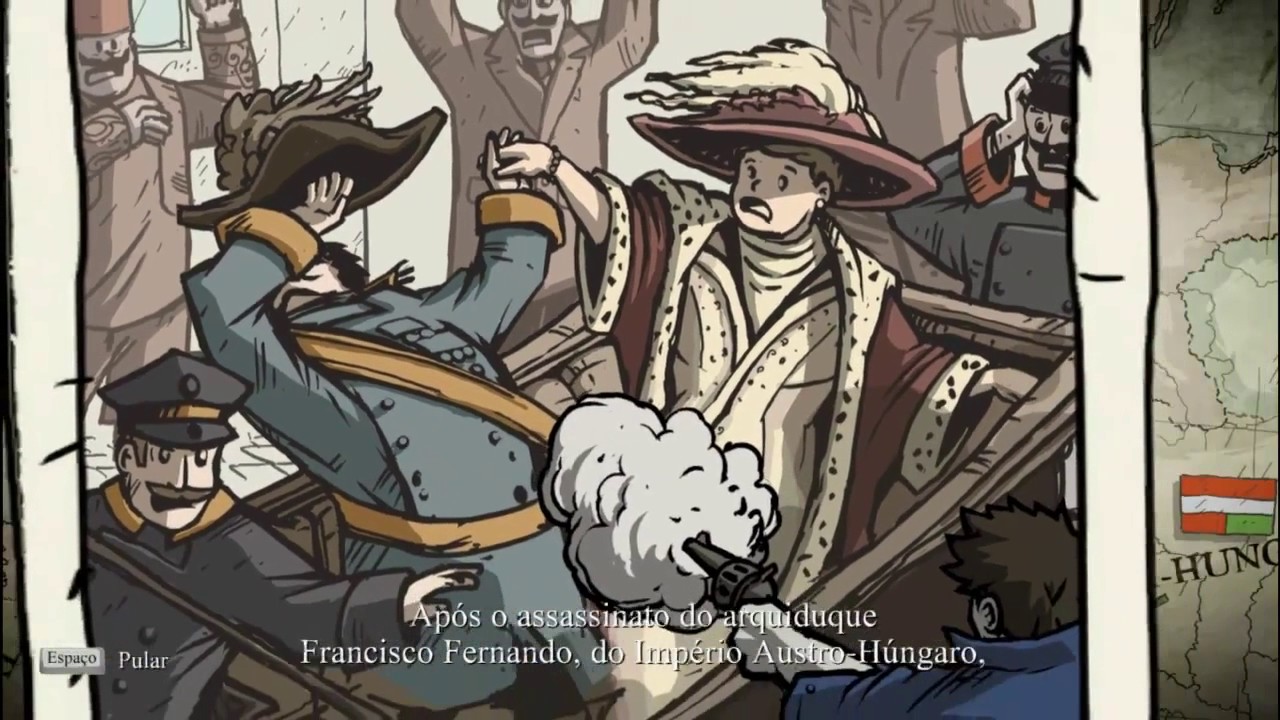 Francisco Ferdinando is often translated as Francisco Fernando. Both forms are correct.
The German government's goal was to defeat France quickly so it could focus on the battle against Russia. Germany's advance was stopped at the Battle of the Marne in 1914, however, by the French trenches. These defensive structures were shelters dug into the ground and protected with barbed wire, practically impossible for ordinary infantry to cross. This setting effectively created the symbol of what the Great War would become.
This form of warfare, with troops fixed on the ground, continued until 1916, when tanks and airplanes began to be used on a large scale on the battlefield and could easily overcome these defenses, allowing infantry to invade enemy territory.
The year 1917 brought major changes to the conflict, including Russia's departure because of internal conflicts and the entry of the United States. Because of a series of unsuccessful campaigns and the great misery endured by the German people, Germany surrendered in 1918, bringing the war to an end. These final events are not depicted in Valiant Hearts.
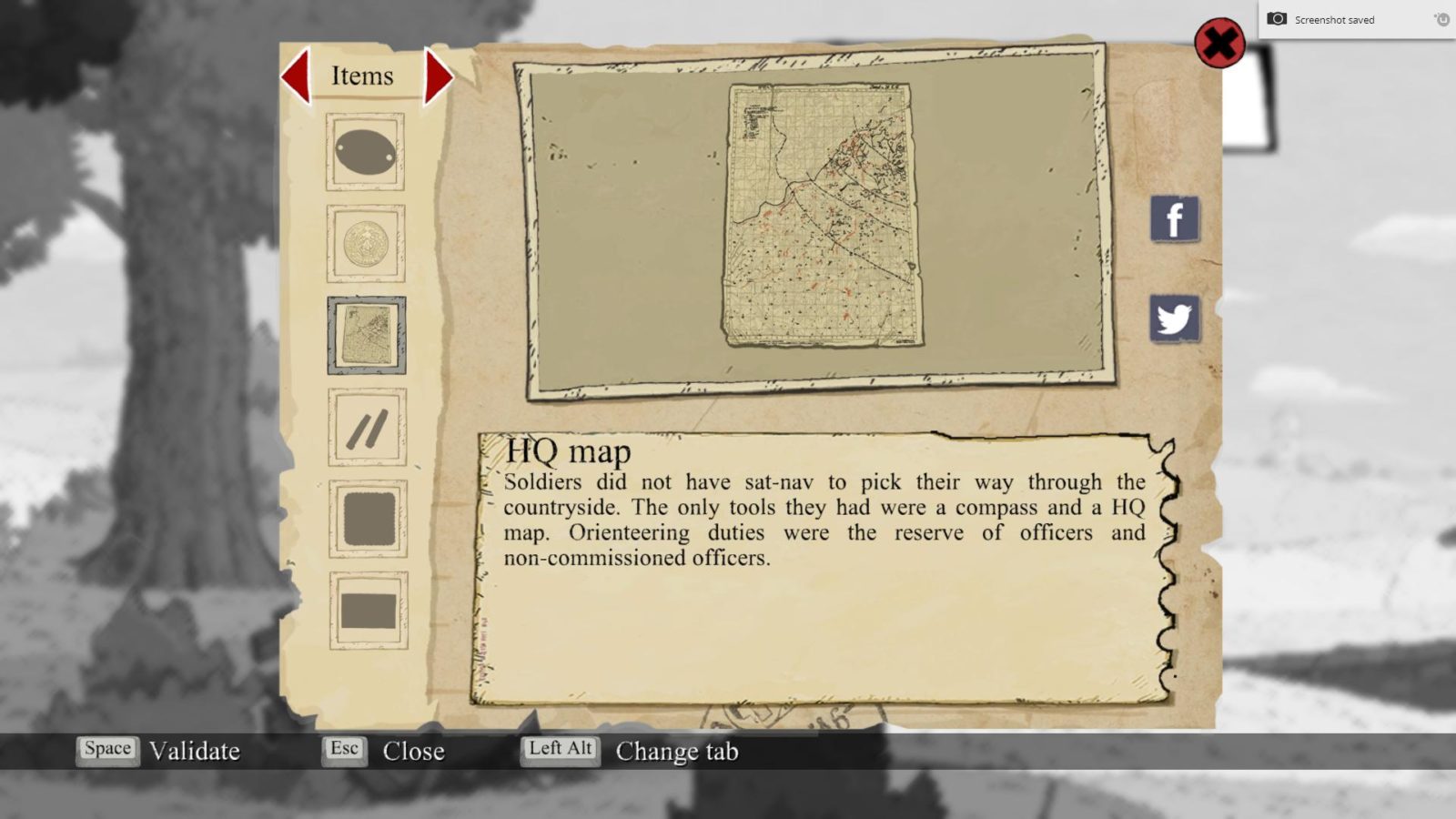
Real objects from the period are found as collectibles during the game.
Known at the time simply as the Great War, as in the game's subtitle, it was said that a conflict of such proportions would become "the war to end all wars." Unfortunately, as we know, events did not unfold as people imagined, and an even greater conflict would begin 25 years later. That, however, is the subject of another game and another review.
Below are images of the trenches, symbols of the First World War.
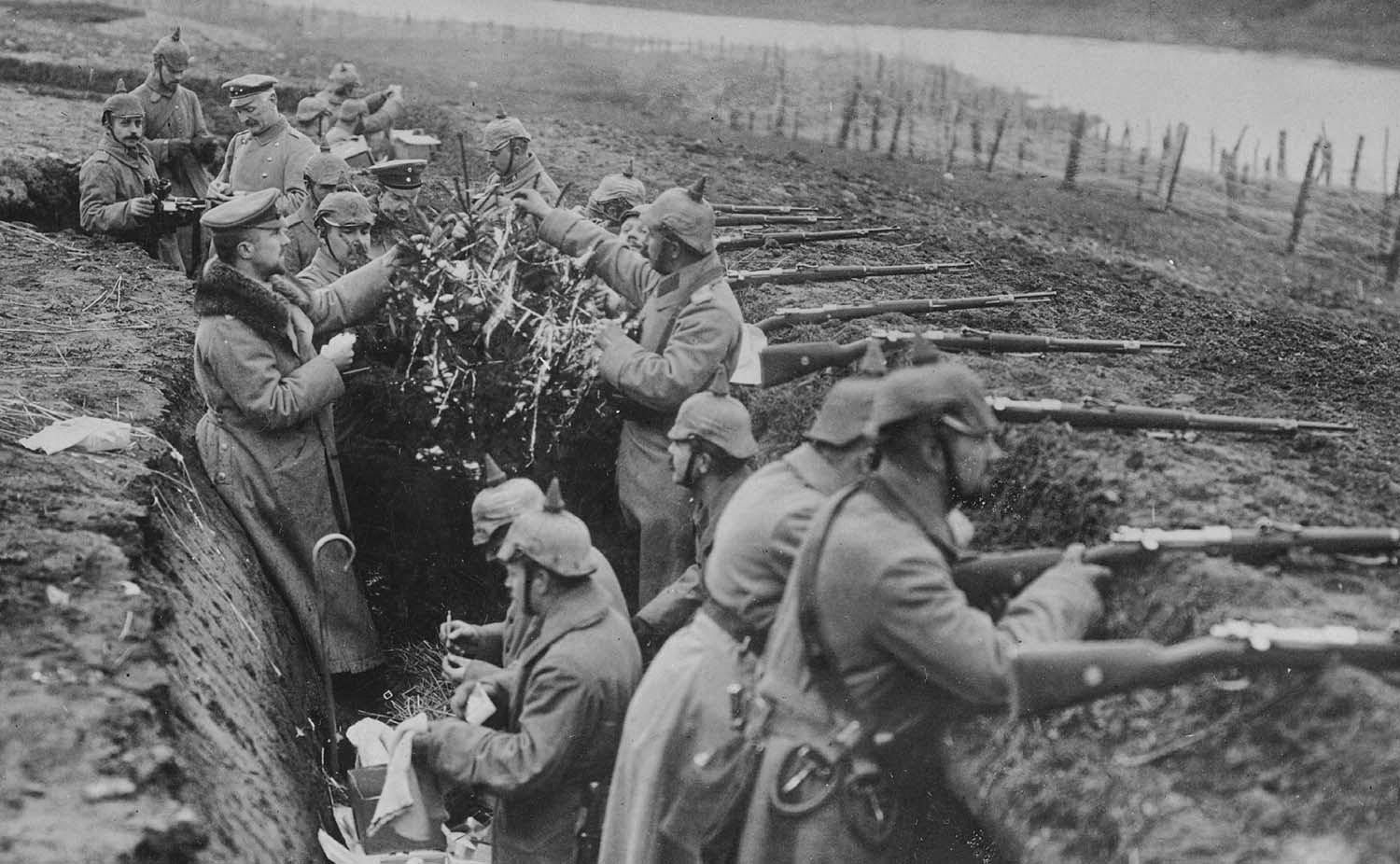
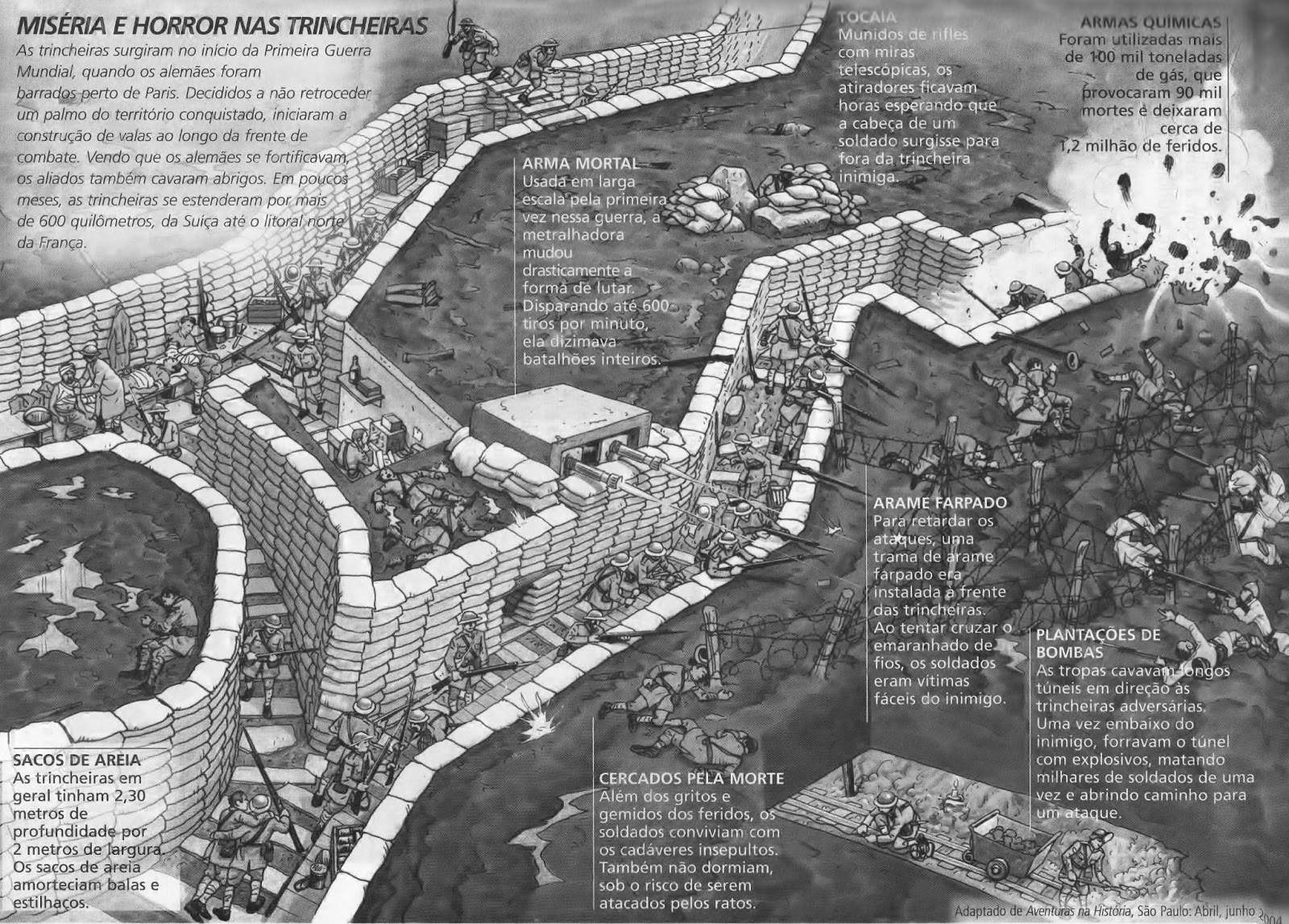
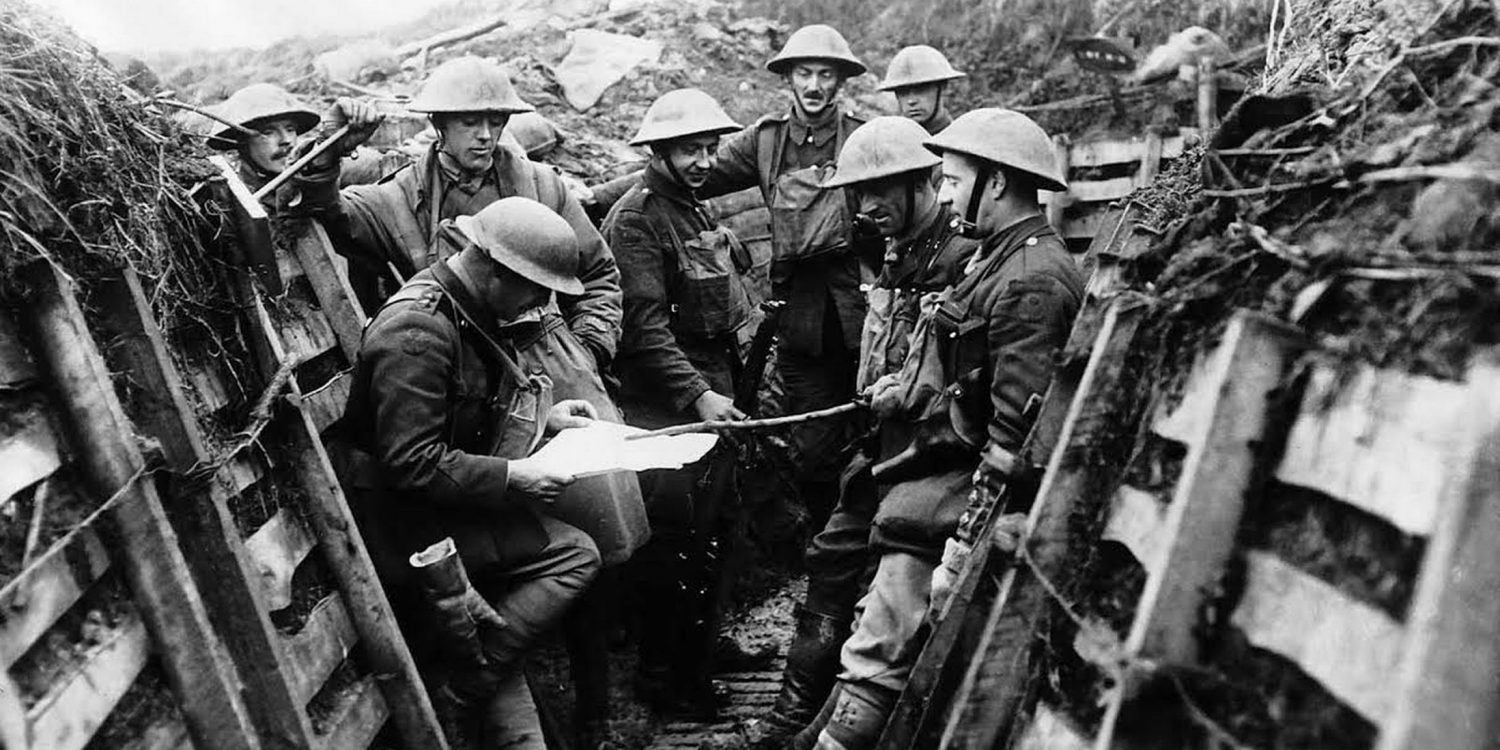
To give an idea of daily life in a trench, I will quote the words of a First World War veteran: "The battlefield is terrible. There is a sour, heavy, and penetrating smell of corpses. Men who were killed last October are half sunk in the marsh and growing turnip fields. The legs of an English soldier, still wrapped in gaiters, protrude from a trench; the body is piled with others, and one soldier rests his rifle on them.
A small stream of water runs through the trench, and everyone uses the water for drinking and washing; it is the only water available. In the Langemark cemetery, the remains of a slaughter were piled up, and the dead rose above ground level. German shells falling on the cemetery caused a horrible resurrection. At one point, I saw 22 dead horses, still wearing their harnesses. Cattle and pigs lay on top, half rotted." (Source: Rudolf Binding, A Fatalist at War, São Paulo ed., 1994, p. 119).
Fun fact 1: In addition to translating the game into Brazilian Portuguese, Ubisoft Brazil added text explaining our country's participation in the conflict and the consequences the war produced here, including economic and social impacts.
The Story and Narrative of Valiant Hearts
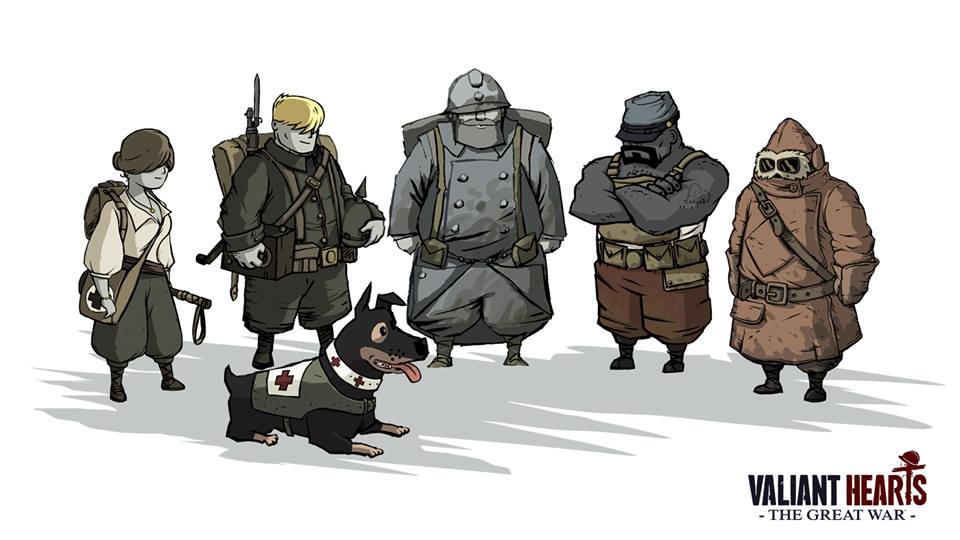
In Valiant Hearts, we control four main characters who occupy different positions in the war. Anna is a Belgian volunteer nurse in the field with the sole objective of saving lives regardless of where the wounded person comes from. Freddie is an American volunteer in the French army who sees the battles as an opportunity to resolve a problem from his past. Karl is a German immigrant living in France with his wife and newborn son who is summoned by his home country and forced to fight against the land where the people he loves live. Finally, we have Emile, Karl's father-in-law, who serves in the French army.
With no spoken dialogue apart from the narrator, the narrative used comic-strip images to provide a universal language for every character. This contributed to the simple, cold atmosphere of war and heightened the emotion of the scenes.
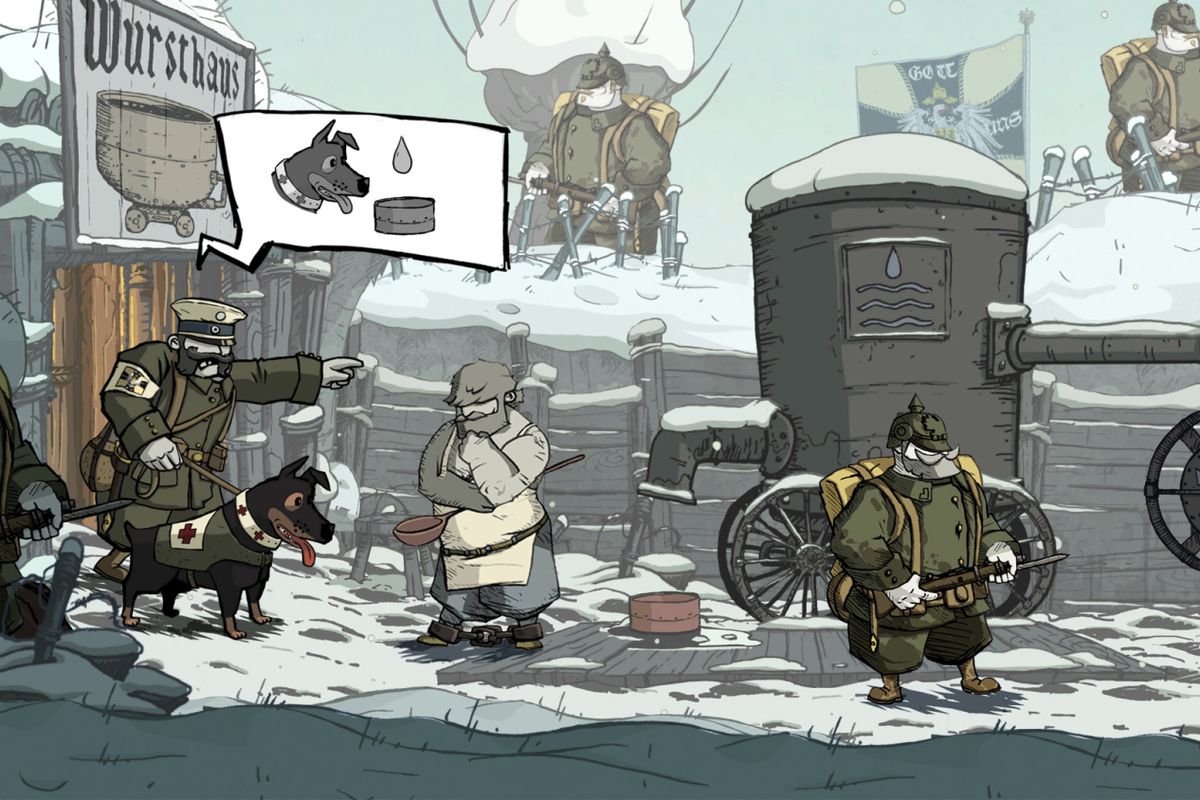
The wordless narrative through speech bubbles was very good.
In addition to the protagonists' individual stories, we also gain access to collectible items found in the environments. These real objects total more than 100 and, like the letters, are now considered trench art by many. Creating them was encouraged to maintain troop morale and even to sell when soldiers reached towns.
At the beginning of each chapter, new diary pages and historical facts are added for us to read. Although they are not mandatory, I highly recommend them, not only for a better understanding of the story but also for greater immersion in the gameplay. Thus, if at the beginning of a stage we "study" that the Germans first used flamethrowers or gas at a particular moment, we can already know what awaits us in that level.
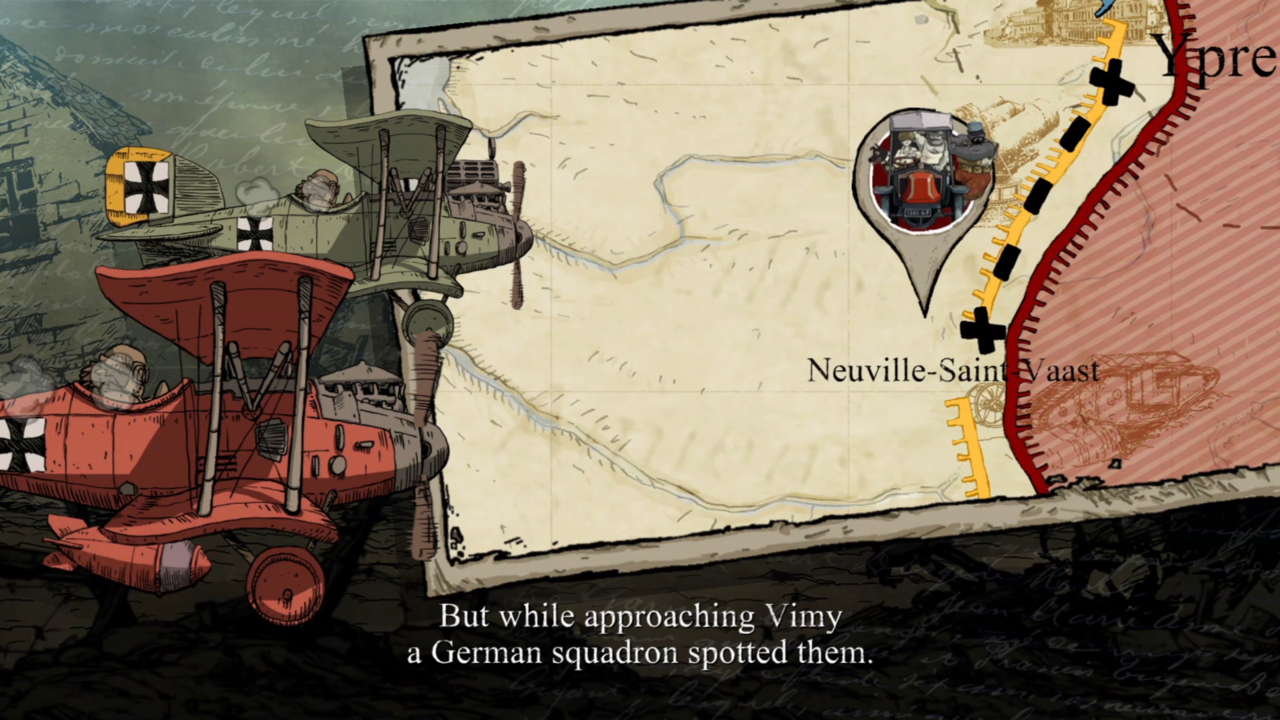
Could this be a reference to the famous German pilot the Red Baron? Probably.
We never kill enemies with any of the characters. Even so, we constantly encounter corpses and severely wounded people. All of this helps us think that there is no good or bad side among the combatants, only the desire for the war to end and for everyone to return home as soon as possible.
Fun fact 2: Originally, Valiant Hearts would not have had only four protagonists, but five. The fifth character was to be an English aviator named George, who would have needed to lie to gain access to the battlefield.
Technical Review of Valiant Hearts
Valiant Hearts' gameplay is quite simple, combining a little platforming and stealth with a great deal of puzzle-solving. Most puzzles are very easy, and if you still have significant difficulty, a hint prompt appears so we can access help and avoid becoming "stuck" during the campaign. Across the game's four chapters, there are stages in which we drive cars and must avoid as many obstacles as possible to keep our vehicle from exploding. At these moments, the soundtracks are wonderful, and the obstacles appear in time with the song. Simply brilliant.
The game also has a few bosses, but in practice, they are disguised puzzles that we simply need to solve before dying and demand minimal skill from the player. Checkpoints are close together throughout the game, which also prevents frustration.
While playing as nurse Anna, we experience quick-time events in which commands are presented in a particular order so that everything proceeds perfectly, creating a kind of "medical Guitar Hero." This is entertaining and adds to the game's atmosphere. Emile's distinctive feature is a shovel, which he uses to dig through parts of the environment. Freddie's gameplay is defined by cutting barbed wire, while Karl has a few brief stealth moments. We cannot forget the dog Walt, who often helps us solve puzzles and does not judge the people he rescues by the uniform they wear.
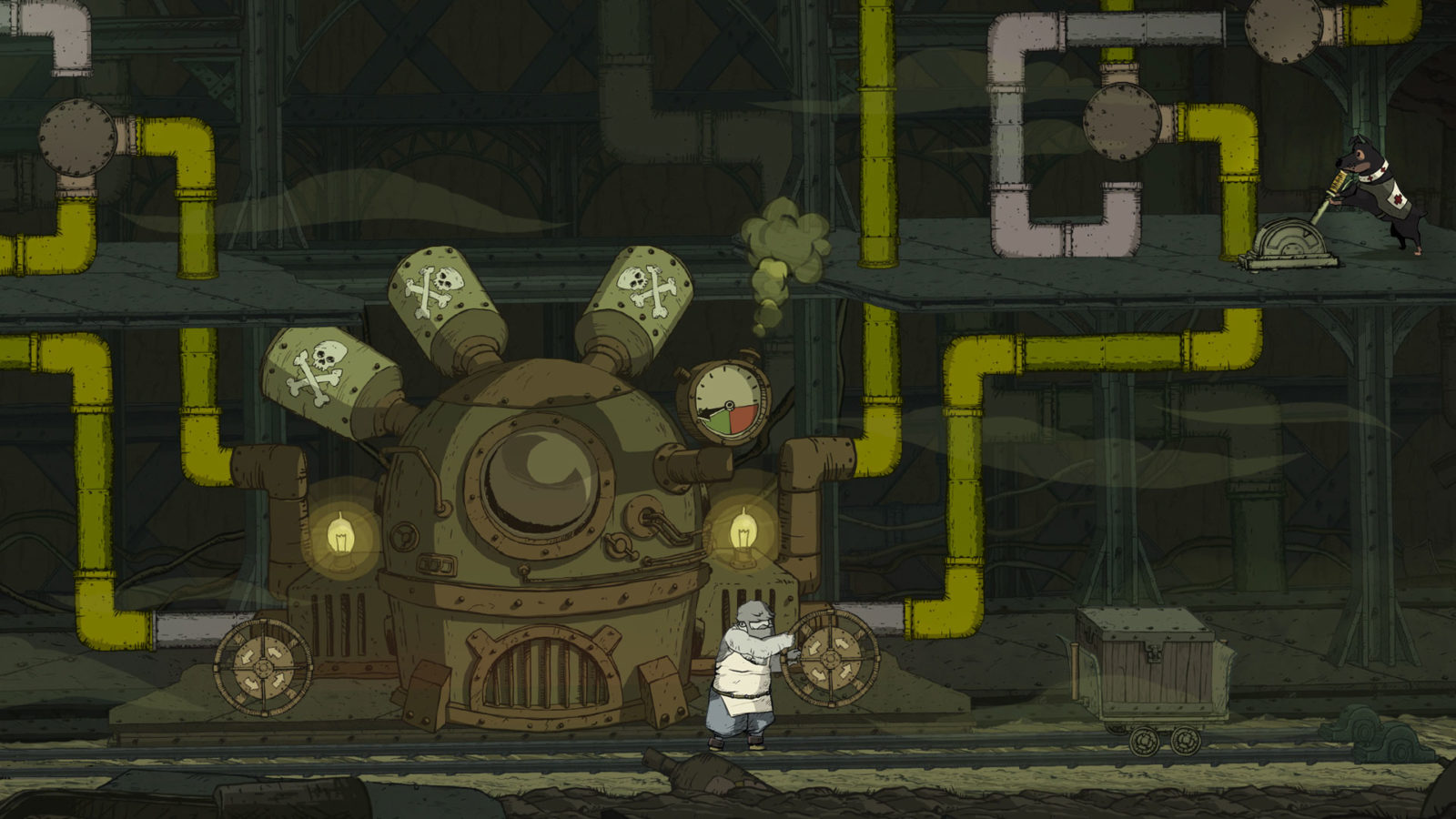
Puzzles are undoubtedly the main feature of Valiant Hearts' gameplay.
The game's campaign is quite short, consisting of four chapters and taking less than five hours to reach the end on a first playthrough. This is extended slightly if we want to find the collectibles in the environments. The difficulty is very easy, even by the standards of today's games. Everything we must do is quite intuitive, and if we still have trouble, hints begin appearing to help us.
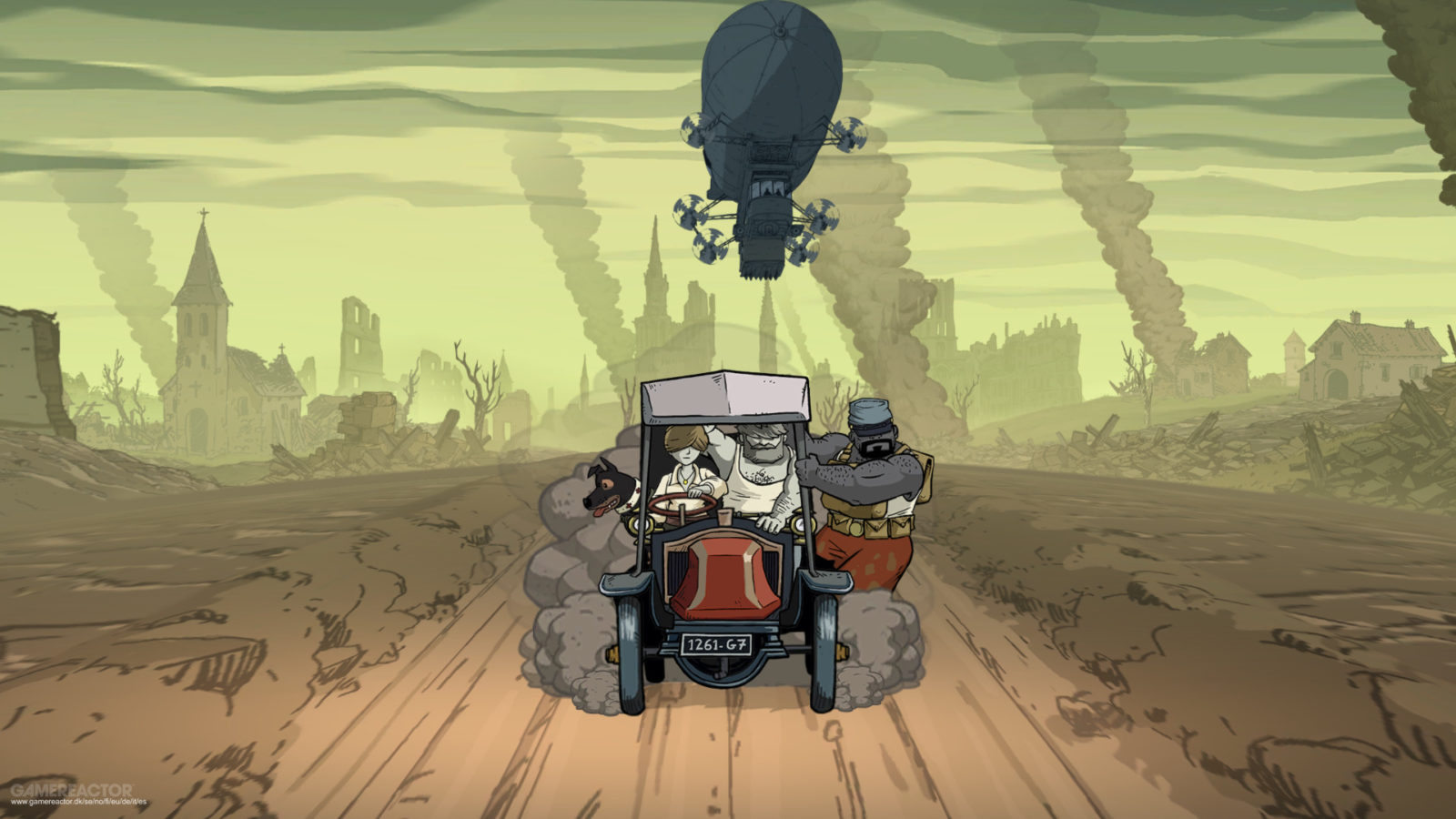
The taxi moments have the most action and excellent soundtracks.
Despite being a Ubisoft game, the entire visual presentation follows a simple cartoon style. Although it works perfectly well and helps establish the game's atmosphere, it does not match the eighth generation's potential. In a way, this also helped children access this "heavy" information in a "light" form. At one point, for example, Anna performs an amputation. Although we all know what was happening and how traumatic such a procedure can be, the game portrayed it in a way that let younger players see only that the wounded person was being healed.
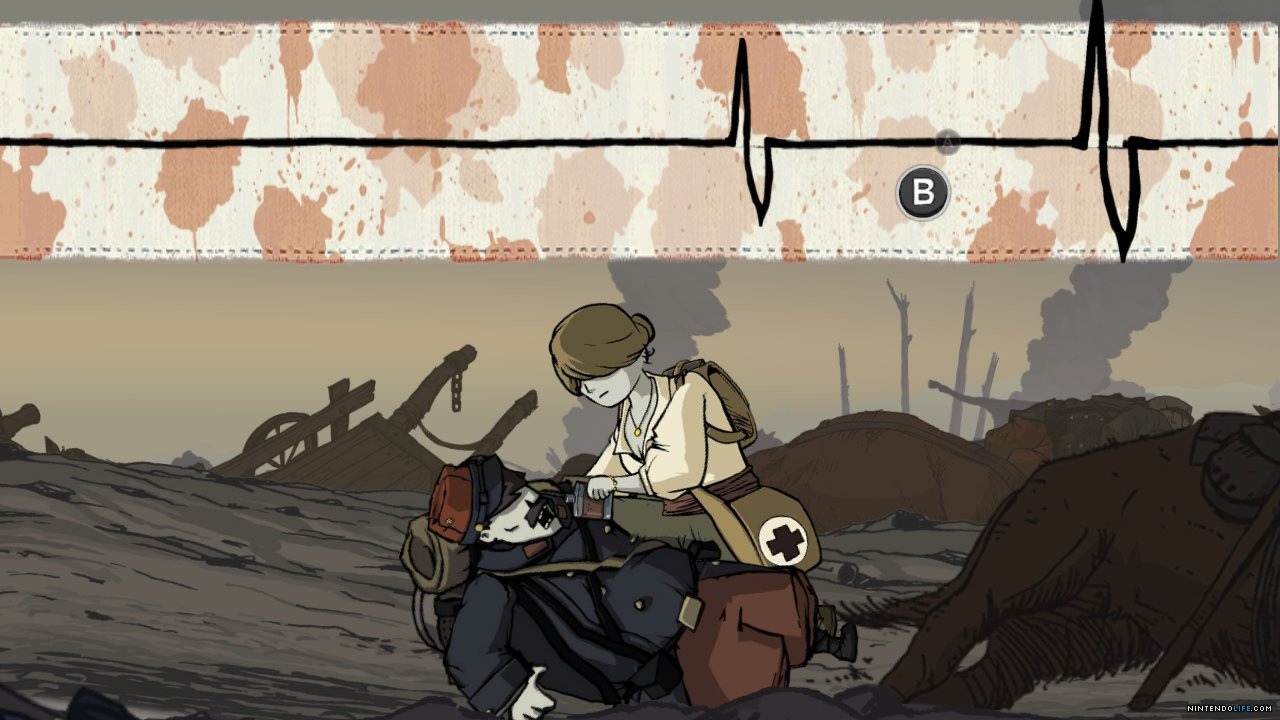
Quick-time events appear during the game's healing moments.
After the narrative, perhaps Valiant Hearts' greatest highlight is its soundtrack. Composed and adapted by Ian Livingstone and Peter McConnell, it is a blend of classical music, jazz, and instrumental chanson française, in which everything is beautiful and fits perfectly with the context surrounding the characters at each moment. I would especially highlight the stage in which we drive a taxi while being targeted by a zeppelin, all to the sound of classic can-can music. It turned out incredible.
Below is the incredible soundtrack of Valiant Hearts.
Our Conclusion
Ubisoft, known for big-budget games such as Assassin's Creed, Watch Dogs, and Far Cry, tried something different here and demonstrated that narrative can take precedence over beautiful graphics and long campaigns. Valiant Hearts showed that the company we all know can create something accessible and high-quality that teaches us about the world we live in. I hope this gaming giant looks to this recent legacy and values those who tried something new and accomplished, and that the future of games brings more experiences at the level of the one we had the pleasure of writing about.
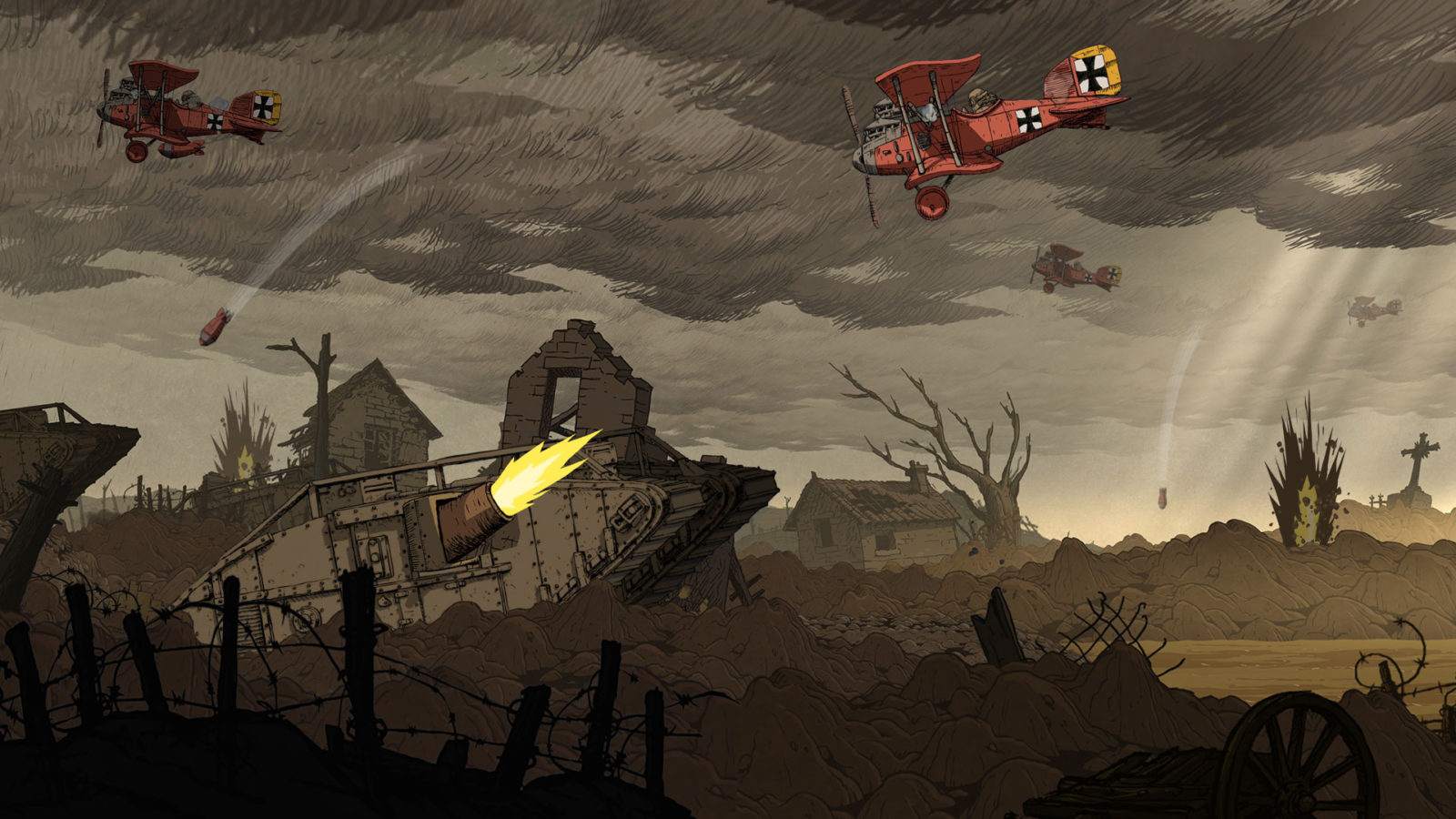
We control vehicles at certain moments in the game.
Rating: 8.5
Played on Xbox One