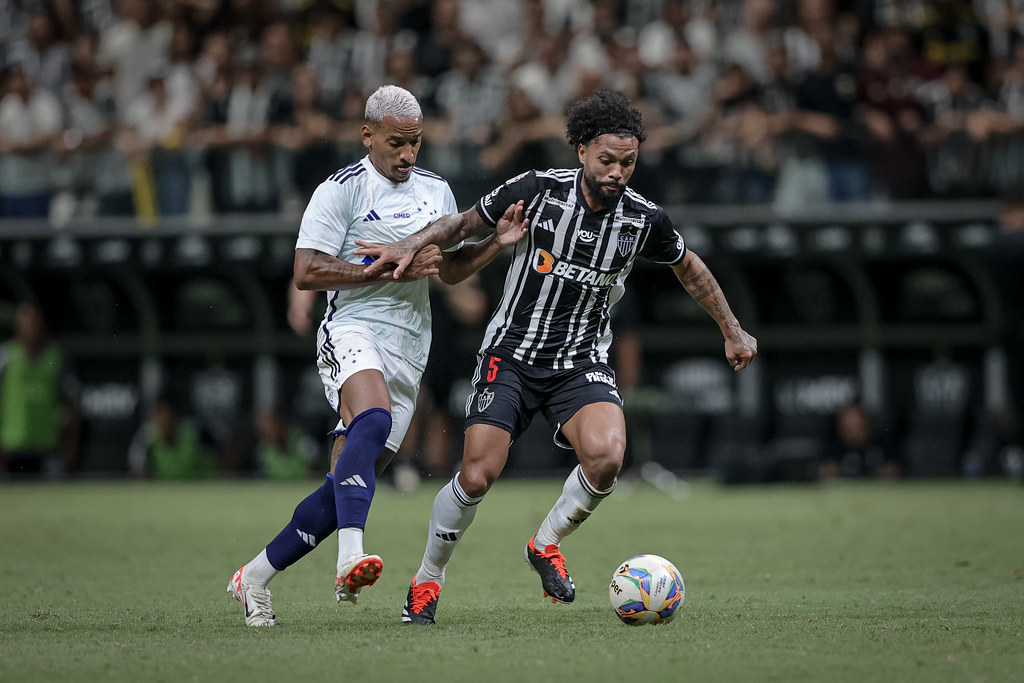
In Brazilian football, state championships occupy an ambiguous and controversial position. Some consider them an important tradition and an opportunity for smaller clubs to stand out. However, they also receive considerable criticism, especially regarding the calendar.
Because state championships generally end in April, they end up "compressing" the calendar for other national competitions, such as the Copa do Brasil and the Brazilian Championship. Despite these complaints, the state championships are not expected to end anytime soon.
In this article, we at Eu, Brasileiro will explore the role of state championships, criticism of their calendar, and why proposing changes is important for Brazilian football.
How Did State Championships Emerge in Brazil?
Ironically, one of the main reasons state championships came into existence was an effort to "save time." Brazil is a country of continental proportions, its states are large, and some are very far from others. To avoid the time that would be lost traveling, local teams began focusing solely on playing state championships. Creating a national championship at the beginning of the last century was therefore genuinely unfeasible.
The Campeonato Paulista, a pioneer among state championships, began in 1902. At the time, only five teams took part in the competition: Germânia, now Pinheiros; Internacional; Mackenzie; Paulistano; and São Paulo Athletic (SPAC). Other Brazilian states soon sought to establish their own competitions. State championships reached Bahia in 1905, followed one year later by the creation of the Campeonato Carioca.
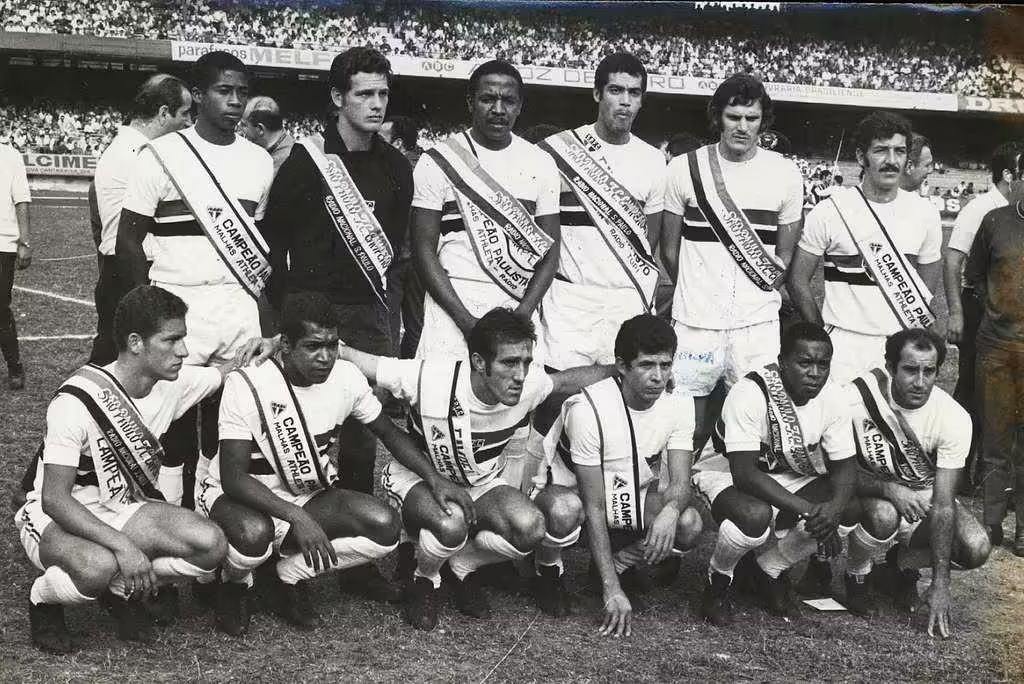
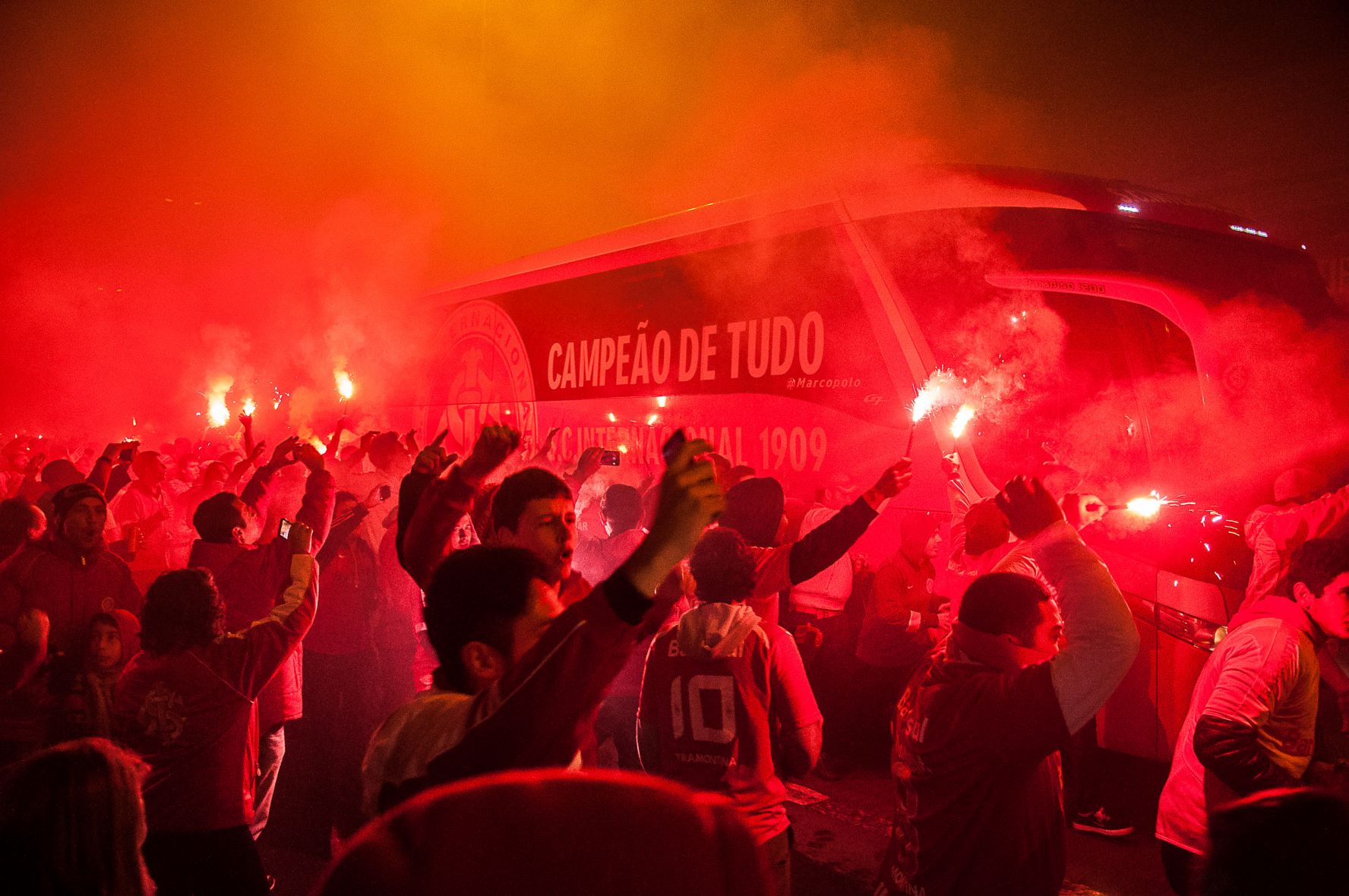
Today, state championships take place across Brazil's 26 states and the Federal District. This helped create a certain cultural identity connecting teams with their communities, intensifying healthy rivalries that drove Brazilian football as a whole. In other words, denying the historical importance of state championships would be a mistake.
The Controversies of a Model That Serves No One
Many specialists argue that the current state championships have no sustainable, positive, or useful aspects. In their current configuration, they overload the calendars of major clubs while leaving smaller clubs, which make up the vast majority, with very few available match dates per season.
Others defend state championships by citing precisely the issue of smaller clubs. Most of these teams have no competitions to play until the end of the year, causing them to stake everything on the state championships. Série D, the lowest division of professional football in Brazil, has specific places for teams that perform well in state championships. The problem is that these places are limited and, in most cases, teams that fail to finish in good positions must end their calendar after the state competition ends.
Local championships are therefore not exactly positive for smaller teams, functioning more as an opportunity for survival. It would be better if clubs had a long championship occupying much of the year, which would make fundamental matters of financial and squad management easier.
Regarding revenue, state championships can be said to have more disadvantages than advantages. They rarely manage to generate significant broadcast-rights revenue. In São Paulo, clubs with a modest supporter base receive more than all the major Copa do Nordeste clubs combined.
After the Campeonato Paulista ends, players commonly move to clubs in other states because smaller teams cannot maintain their salaries during the national championship. Even with revenue from state competitions, teams from inland cities continue to face financial problems.
This discrepancy in objectives makes state championships increasingly unequal and uninteresting. It is a situation in which major clubs appear to view them as a "burden," while smaller ones struggle to survive with few opportunities.
Why Does This Situation Need to Change?
State championships are sustained primarily by their cultural and historical importance. This includes rivalries and major local derbies, which keep the championships' "flame" alive. In practice, however, these competitions are unfeasible for most teams, including the major ones. This is reflected in the lack of interest from supporters, who generally attend stadiums in large numbers only during the final stages.
Creating another national league, which could be known as "Série E," would not mean the end of the state championships, but would make better use of the Brazilian calendar. The lowest national division could be contested within each state federation without the participation of the "major clubs," while having sporting significance of its own—promotion to Série D in a genuine competition that would not leave teams ending their activities prematurely.
Clearly, all this speculation runs up against the political model supporting the CBF, which gives greater power to the state federations. But the tendency is that, even with the political maneuvering between the CBF and local federations, the model will become unsustainable for most teams and the need for change will become an urgent matter for the good of Brazilian football.
Meanwhile, CBF Leads the Digital Ranking Among Brazilian Sports Federations
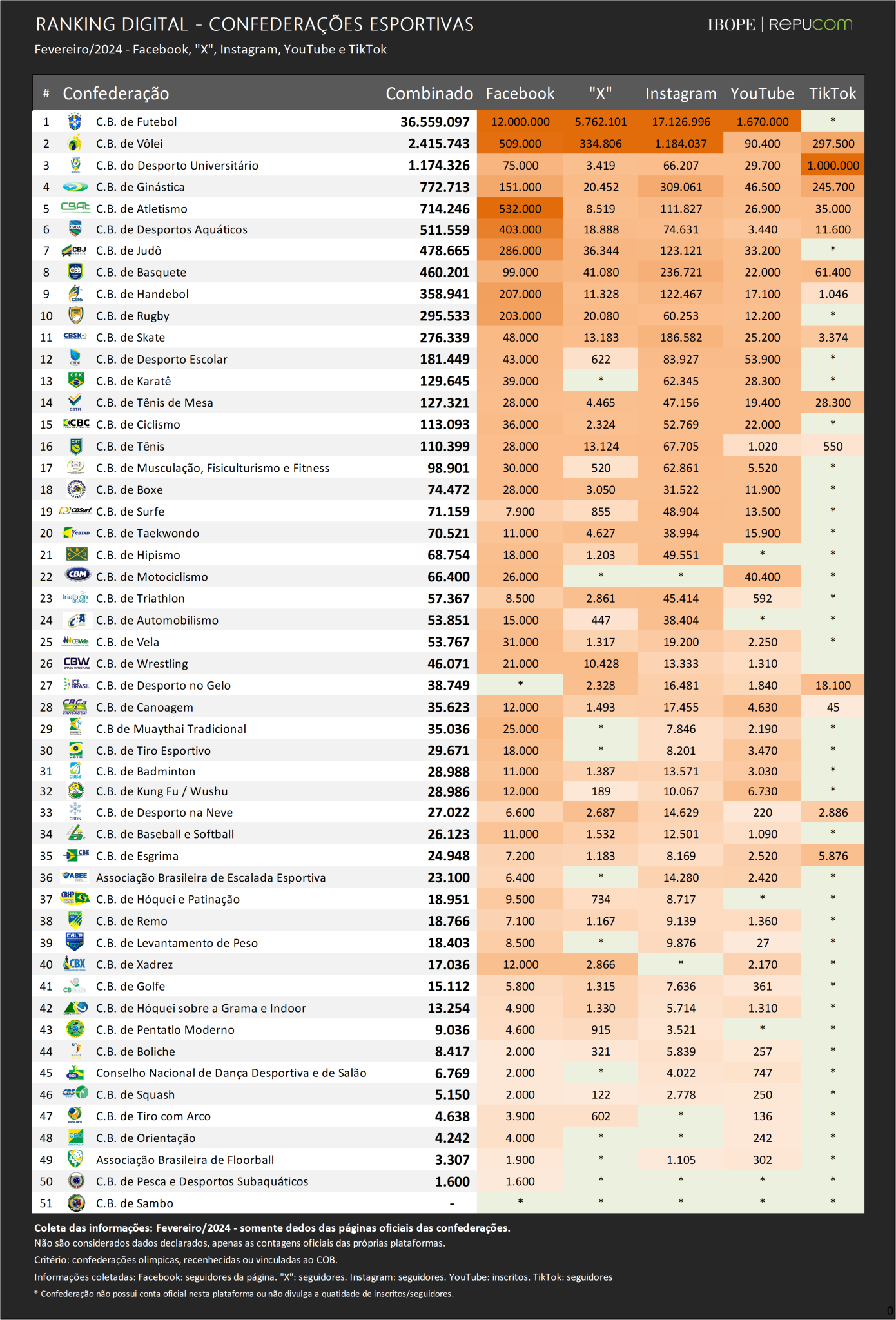
In the digital ranking published by IBOPE Repucom, the Brazilian Football Confederation (CBF) reaffirmed its prominence by leading follower growth with seven million new followers, representing 72% of the total growth among all organizations. Compared with the previous survey, official sports-confederation social networks gained more than nine million new followers. The five confederations that stood out most were:
- CBF (7 million new followers)
- CBDU (1 million)
- CBV (580,000)
- CBG (188,000)
- CBB (184,000)
Together, they represent 93% of all new followers over the past two years.
Performance on Instagram was decisive for the CBF's lead, with 6.1 million new followers on that platform, corresponding to 90% of its total growth. The confederation surpassed 37 million followers across its official social networks.
CBDU ranked second in growth, driven primarily by TikTok, which accounted for 97% of its one million new followers. CBV, in third place, added 580,000 new followers, with 63% coming from Instagram.
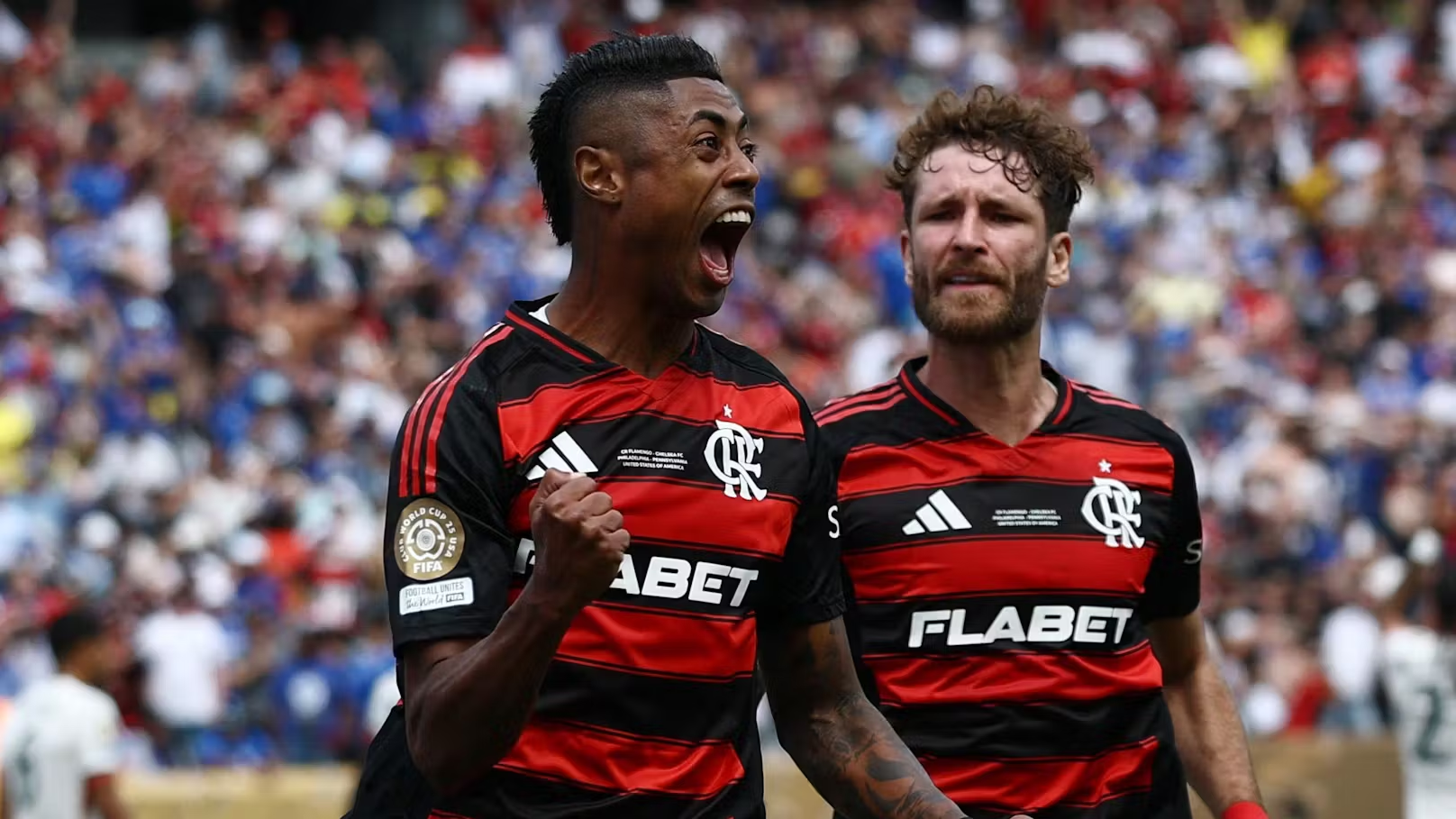
Among clubs, Flamengo stands out as the leader in social-media engagement, widening its advantage in number of followers. The club reached an unprecedented mark of eight million followers on TikTok, nearly twice the total of second-place Corinthians, with 4.1 million.
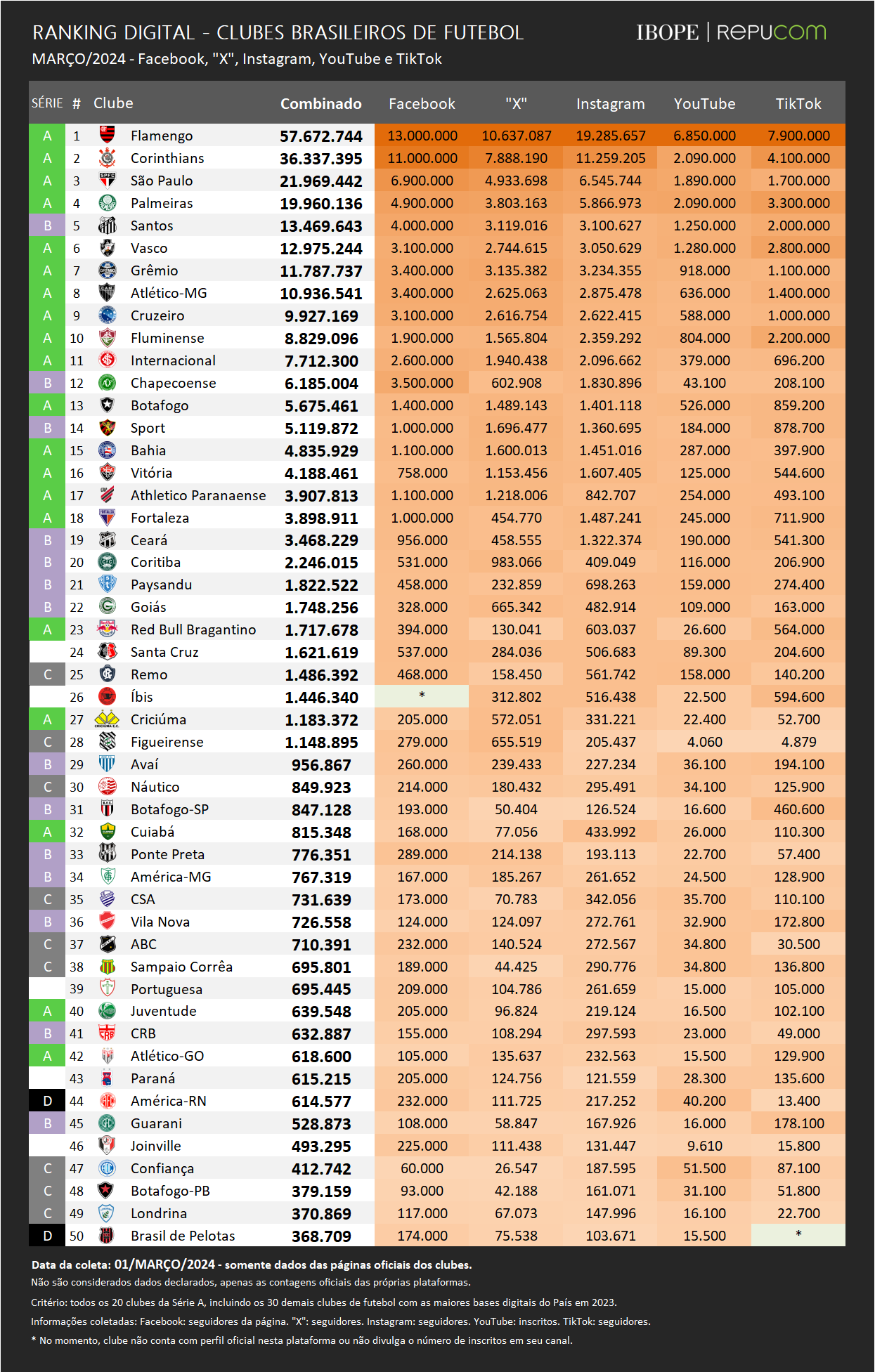
With a total of 57.9 million followers, Flamengo was the club that gained the most new followers on Instagram (137,000) and X (30,000). Its performance on social networks reinforces the importance of a digital presence for Brazilian clubs.