
Calling Brazil the “Country of Football” may seem like a fair title, especially amid the fervent atmosphere of the World Cup, but Brazilians' passion for games goes far beyond the four lines of the pitch. eSports, competitions related to games, have emerged as a prominent form of entertainment and established themselves as entertainment with popular reach.
In recent years, the eSports scene has also witnessed a significant positive change with the notable growth of women's presence. What was once considered predominantly a male domain now sees more and more women assuming prominent roles as players, streamers, commentators, and team leaders.
According to a recent study released by the “Game Brasil” research group, women now represent an incredible 51% of the gaming audience in Brazil, and this brings a very positive new perspective to the market, so to speak.
For example, the growth of women gamers who compete and take an interest in the subject within this environment is crucial for promoting diversity, inclusion, and positive changes in the community. This presence helps bring new perspectives, even on in-game strategies, while also challenging gender stereotypes that associate gaming exclusively with a male audience and leading companies in the sector to make room for other kinds of games and new ideas.
This inclusion fights the toxicity that is unfortunately still present, creating a more welcoming and respectful environment. Successful women in the eSports scene can inspire other players, encouraging greater participation and strengthening women's representation in electronic games, which drives the evolution of eSports as a whole.
Which Platforms Do Women Use Most?
Also according to Pesquisa Game Brasil, smartphones have been the most popular platform among women. The main reasons are quick and convenient access to games on mobile phones, not to mention the lower costs involved in getting started, which makes it much more affordable compared with other consoles and PCs.
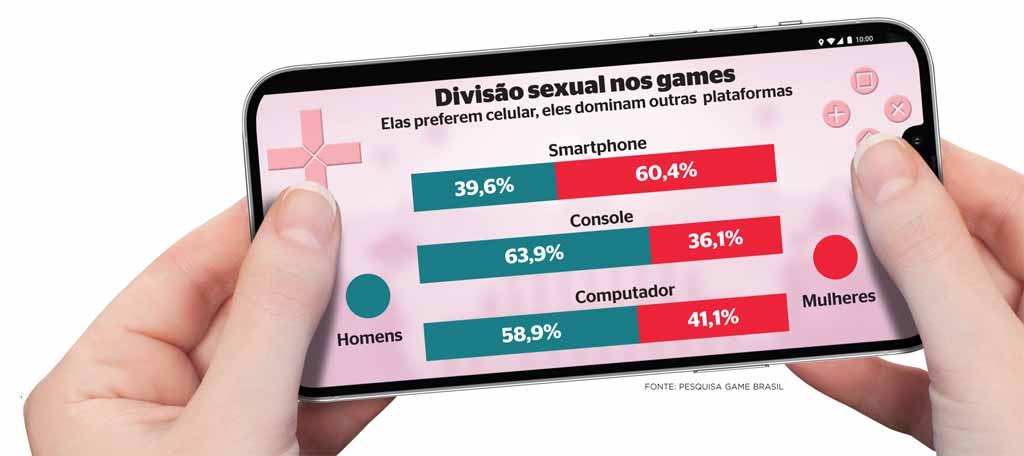
Despite the massive presence of women specifically on smartphones (60.4%), this does not mean that consoles and computers do not later become part of women's participation in this universe as well. In search of professionalization or new experiences, they are increasingly venturing into games outside the mobile sphere. The survey also reveals that console use among women reached 36.1%, while computer use surpassed 41.1%.
Despite the Advances, Challenges Remain
Despite the notable advances, it is crucial to recognize that women still face obstacles in the market. Unfortunately, most of those obstacles are connected to misogyny. A woman who joins a server to play Rainbow Six or Counter-Strike still runs a high risk of having to hear disrespectful and sexist jokes, as openly presented and discussed in communities. This shows that progress is still needed, although we may be entering a period in which these problems occur on a smaller scale as the years pass.
With this in mind, advertising agency Africa, in partnership with the American NGO Wonder Women Tech, launched the #MyGameMyName campaign, publicized by Google, which seeks to raise awareness about the harassment women face in gaming environments. The initiative challenged male content creators, streamers, and influencers to play online using female names, exposing in practice the attacks and sexist comments directed at women. The action had an impact by revealing the prejudice present in online games, encouraging reflection, and promoting a broader debate about respect and inclusion in the gaming community.
Perhaps the most important thing to consider about this without needing any “direct” involvement with a movement is: What are we doing to contribute to a less toxic community for everyone? After all, when there is a good environment for everyone, everyone wins.