Toyota is recognized worldwide for its model of operational excellence, known as the Toyota Production System (TPS) or Lean Manufacturing, which aims to improve product efficiency and quality.
Over the decades, Toyota improved and refined this model, establishing a standard of excellence that has been studied and adopted by companies in a wide range of industries around the world. Implementing TPS not only produced significant improvements in Toyota's production processes, but also profoundly influenced how other organizations approach management and continuous improvement.
How Did the Toyota Production System Emerge? Who Created It?
During the period after World War II, major Japanese factories faced an urgent need to increase the efficiency of their production processes. Japan, with its limited territory, suffered devastating consequences from the conflict, resulting in shortages of labor and raw materials. Faced with these challenges, Japanese factories were severely affected and encountered major difficulties in recovering and rebuilding their operations.
In this context of scarcity, and inspired by the ideas of Taiichi Ohno and Eiji Toyoda, Toyota developed practices to optimize its production, such as eliminating waste and standardizing tasks.
Taiichi Ohno was the Japanese engineer who created the Toyota Production System, helping eliminate waste and improve efficiency in Toyota's factories. He also developed Kanban and the Just-in-Time concept.
Eiji Toyoda was the Toyota leader who helped the company grow and supported Taiichi Ohno in creating and expanding the production system that made Toyota famous for its quality and efficiency.
TPS was inspired by Ohno's 1953 trip to the United States, where he noticed that Americans bought products only in the quantities they needed. After returning to Japan, Ohno developed Kanban, a system that uses cards to control production according to demand, increasing efficiency and reducing waste.
What Are the "Pillars" of Toyota's System?
The Toyota Production System is based on two essential principles that form the foundation of its philosophy: Just-in-Time (JIT) and Jidoka. These foundations work together in an integrated way to ensure efficiency and quality, eliminating waste and valuing workers' capabilities.

Just-in-Time: The On-Demand Production Approach
Just-in-Time synchronizes production with demand, manufacturing only what is needed, in the right quantity and at the right time. This TPS principle seeks to reduce imperfections caused by the "excessive" production of cars at a multinational company of this kind and by excess inventory. In this way, the company can reduce storage costs, free up capital tied to inventory, and improve workflow efficiency.
For Just-in-Time to be implemented successfully, customer demand must be understood accurately and efficient communication must be ensured across every area supplying production. This generally entails a substantial cultural transformation within the organization, because it involves moving to a production model in which the quantity produced is driven by actual product demand, avoiding inaccurate forecasts as much as possible.
Jidoka: What Is It?
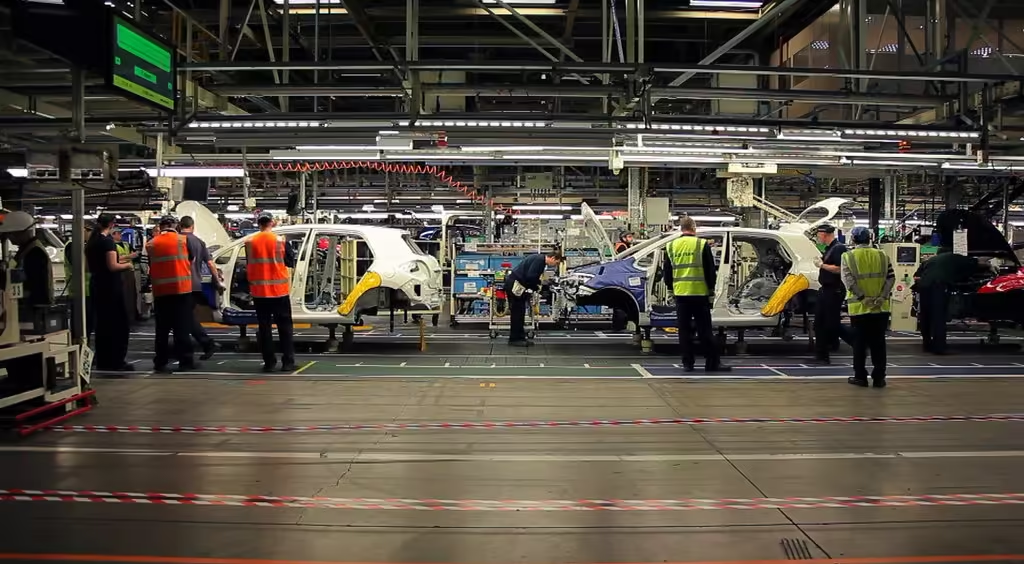
Jidoka is a Japanese concept that ensures immediate correction of production problems. It causes a machine to stop automatically when it detects a fault, preventing the production of defective parts and waste.
Jidoka gives machines the ability to detect failures and stop operating, preventing the production of defective items. This feature allows problems to be corrected promptly, ensuring that only high-quality products proceed along the production line.
In addition, the process has a significant human aspect. It empowers workers to intervene in the production process and stop the assembly line if they identify any anomaly.
Techniques and Tools Used in the System
In addition to the philosophies Toyota practices in its production, there are techniques that enable these philosophies to be implemented more efficiently. These techniques were developed over time through constant reevaluation of the company's production process. The main tools used by the Toyota Production System are:
Kanban
As explained earlier, the Kanban technique was created by Taiichi Ohno after a trip to the United States. The term "Kanban" means "visual card" in Japanese, and it is a system that uses cards or visual signals to indicate when and how many items should be produced or moved at each stage of the process, helping control workflow and prevent waste.
Each Kanban card represents a production unit or batch of materials and is used to request the replenishment of items as they are consumed. When an item's inventory reaches a predefined level, the corresponding card is sent to the preceding process or supplier, signaling that it is time to replenish it and ensuring a continuous, efficient production flow.
Kaizen
The term "Kaizen" consists of two Japanese words: "kai," meaning change, and "zen," meaning good. Thus, Kaizen can be translated as "continuous improvement." At Toyota, Kaizen is incorporated into the organizational culture as a daily, systematic practice. Employees are encouraged to continually improve processes, reduce waste, eliminate activities that do not add value, and improve the quality of products and services.
The "5S" Tool
"5S" is an abbreviation of five Japanese words representing the fundamental principles of this tool: "Seiri" (sense of utilization), "Seiton" (sense of organization), "Seiso" (sense of cleanliness), "Seiketsu" (sense of standardization), and "Shitsuke" (sense of discipline).
These five principles are applied systematically to improve efficiency, safety, quality, and the work environment. "Seiri" involves identifying and removing unnecessary items from the workplace, keeping only what is essential for operations. "Seiton" concerns properly organizing the remaining items so they are easily accessible and visible to everyone. "Seiso" refers to the practice of regularly cleaning and maintaining the workplace, ensuring a safe and healthy environment for employees.
"Seiketsu" seeks to establish standards of cleanliness and organization throughout the company, ensuring consistency and standardization of practices across different areas and teams. Finally, 'Shitsuke' reinforces the discipline and commitment needed to maintain these good practices.
Hoshin Kanri
Hoshin Kanri, or policy management, is a strategy that aligns continuous-improvement initiatives with the company's objectives, ensuring that everyone works toward the same primary goals. This concludes the most basic techniques and principles of the Toyota Production System.
For in-depth information about the system and all its nuances, we recommend Yasuhiro Monden's book "Toyota Production System: An Integrated Approach to Just-in-Time," released in Brazil by the publisher Bookman.