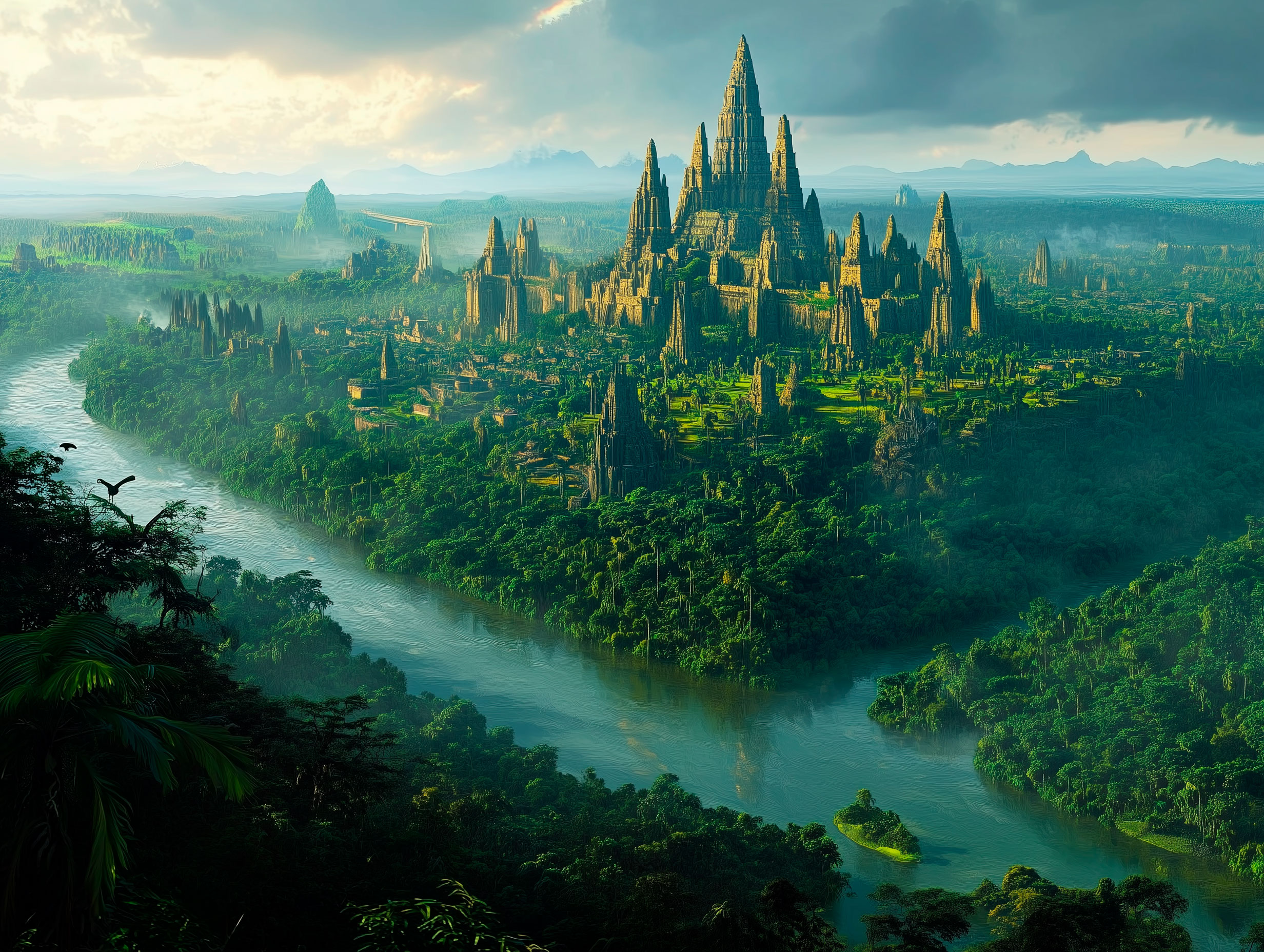
Imagine a legendary city hidden deep within the vast and mysterious Amazon, filled with riches and ancient secrets. Ratanabá, as it is called, has been the subject of countless legends and much speculation over the years.
Could an advanced civilization have existed at the heart of the world's largest tropical rainforest?
The Ratanabá theory emerged from various Indigenous legends and historical accounts of an ancient, advanced civilization that supposedly inhabited the Amazon region. These stories passed from generation to generation, fueling the imagination of explorers, historians, and archaeologists. In the 21st century, the theory gained greater prominence because of new archaeological discoveries.
More recently, the "conspiracy theory" about Ratanabá went viral again on TikTok, Twitter, and Instagram. Posts went so far as to claim that Ratanabá was an immense city, larger than Greater São Paulo, regarded as the "capital of the world" at the time and home to great riches such as gold sculptures and advanced technologies belonging to our ancestors.
Some versions go even further, suggesting that discovering this city could reveal the real reason so many powerful men have such a strong interest in the Amazon.
Did the city exist 450 million years ago?
Supporters of theories about the city believe it existed 450 million years ago and is now buried among three pyramids in the states of Amazonas, Pará, and Mato Grosso. Ratanabá is said to have been a great empire founded by the Muril civilization, regarded as the first to inhabit Earth around 600 million years ago.
Some legends also say that a network of underground tunnels extends throughout South America and connects to Ratanabá. One entrance to these tunnels is said to be hidden in the Príncipe da Beira Fortress in Costa Marques, Rondônia. It is believed that these tunnels connect not only places in South America but the entire world, and that major world leaders use them to meet and discuss hidden riches.
A brief list of the most widely shared "curiosities" about Ratanabá
Some are more utopian than others. The cited legends may lack multiple sources, but they have been widely shared in various forms.
- Mysterious origin: The legend of Ratanabá describes a lost city in the Amazon that many supposedly date to more than 450 million years ago, often identifying it as the cradle of human civilization or the capital of the ancient world.
- A technologically advanced city? Ratanabá is said to have been a technologically advanced city with knowledge of engineering, astronomy, and other sciences that could surpass the present day, now covered by dense forests.
- Believed to be the Atlantis of the Amazon: Some enthusiasts compare Ratanabá to the famous lost city of Atlantis, suggesting that the two shared the traits of advanced and mysterious civilizations.
- Extraterrestrial influence: Some theories say that Ratanabá's inhabitants were in contact with extraterrestrial beings or were even descended from them, similar to other legends about the creation of Egypt's pyramids.
- Hidden guardians: According to some legends, Ratanabá is protected by mystical or supernatural forces that prevent ordinary people from finding it.
- Powerful energy: Ratanabá is said to contain a "powerful energy source" that our society has not yet discovered.
- Possible ruins found: Some research points to the existence of ancient structures in the Amazon, fueling speculation that they may be parts of Ratanabá, although there is no scientific evidence.
- Government conspiracies: The legend attracts conspiracy theories that governments and corporations are concealing information about Ratanabá to control power, for example.
- Cultural heritage: Ratanabá is frequently associated with Indigenous legends, suggesting that the Amazon's native tribes know the city exists and keep secrets about its location and power.
- Hidden pyramids: There is speculation that Ratanabá contains great pyramids hidden beneath the dense Amazon rainforest, similar to those found in Egypt and serving as centers of power and spirituality.
- Sacred geometry: Some suggest that the city was built using principles of sacred geometry, aligning with constellations and astrological phenomena to channel cosmic energy.
- Deep underground spaces: As noted, Ratanabá is said to have had a vast network of underground tunnels extending throughout the Amazon, connecting it to other regions and ancient civilizations around the world.
- Symbol of rebirth: For some, Ratanabá represents more than a lost city—it would be the symbol of a spiritual rebirth and a new era of knowledge for humanity if its secrets were uncovered.
- Antigravity technology? According to some theories, Ratanabá's inhabitants possessed technology capable of defying gravity, allowing them to move large structures such as pyramids with ease.
- Secret mapping: Some theorists claim that the Brazilian government and other institutions have already mapped parts of the city using advanced technology such as LIDAR, but are keeping the data confidential.
- Hidden riches: The legend also speaks of incalculable treasures hidden in Ratanabá, including gold, precious stones, and artifacts of great historical and spiritual value.
- Post-cataclysm survival: According to some narratives, the city survived major global cataclysms such as floods and volcanic eruptions thanks to its advanced knowledge and technology, which preserved it in the depths of the Amazon rainforest.
How did the civilization end?
Although some theorize that part of it still exists and remains protected, most legends state that the lost city of Ratanabá no longer houses any civilization, with only small archaeological traces remaining of a great civilization that once existed.
Here are some of the most frequently discussed reasons for the "end of Ratanabá":
- Natural cataclysm: Its population may have been wiped out by a major natural disaster such as a flood or earthquake. Severe climate changes, including droughts or shifts in the course of rivers, may also have made the region inhospitable and caused it to become covered by forest.
- Intentional disappearance: The inhabitants are said to have used advanced technology or something mystical to hide the city and protect it from invaders.
- Decline of the civilization: The city may have been abandoned because of a lack of resources, conflicts, or environmental disasters, leading it to be forgotten.
- External invasion: The city may have been destroyed by invaders or a rival civilization that coveted its riches and technology, leading to its fall and disappearance.
- Epidemic: An unknown disease may have wiped out the population, leading to the city's abandonment and the eventual disappearance of its civilization.
- Social collapse or alien intervention: Internal disputes, political conflicts, or rebellions may have caused the social structure to collapse, resulting in the city's fall. An alien intervention may also have formed part of a greater decision concerning its inhabitants.
Despite the theories, experts reject the hypothesis that Ratanabá existed
Many researchers and archaeologists state that Ratanabá does not exist for several reasons. First, even the dinosaurs did not exist 350 million years ago, so it is unlikely that a civilization existed 450 million years ago. Moreover, the Príncipe da Beira Fortress, mentioned as an entrance to the tunnels, was actually used in the 18th-century border disputes between Spain and Portugal.
Another reason for rejecting the claim is the practical impossibility of an underground tunnel network connecting all of South America and the world. Building and maintaining such an extensive and complex structure would be extremely difficult, especially without leaving detectable traces. In addition, the idea that major world leaders would use these tunnels to discuss hidden riches in the Amazon is considered highly unlikely and lacks any kind of factual evidence.
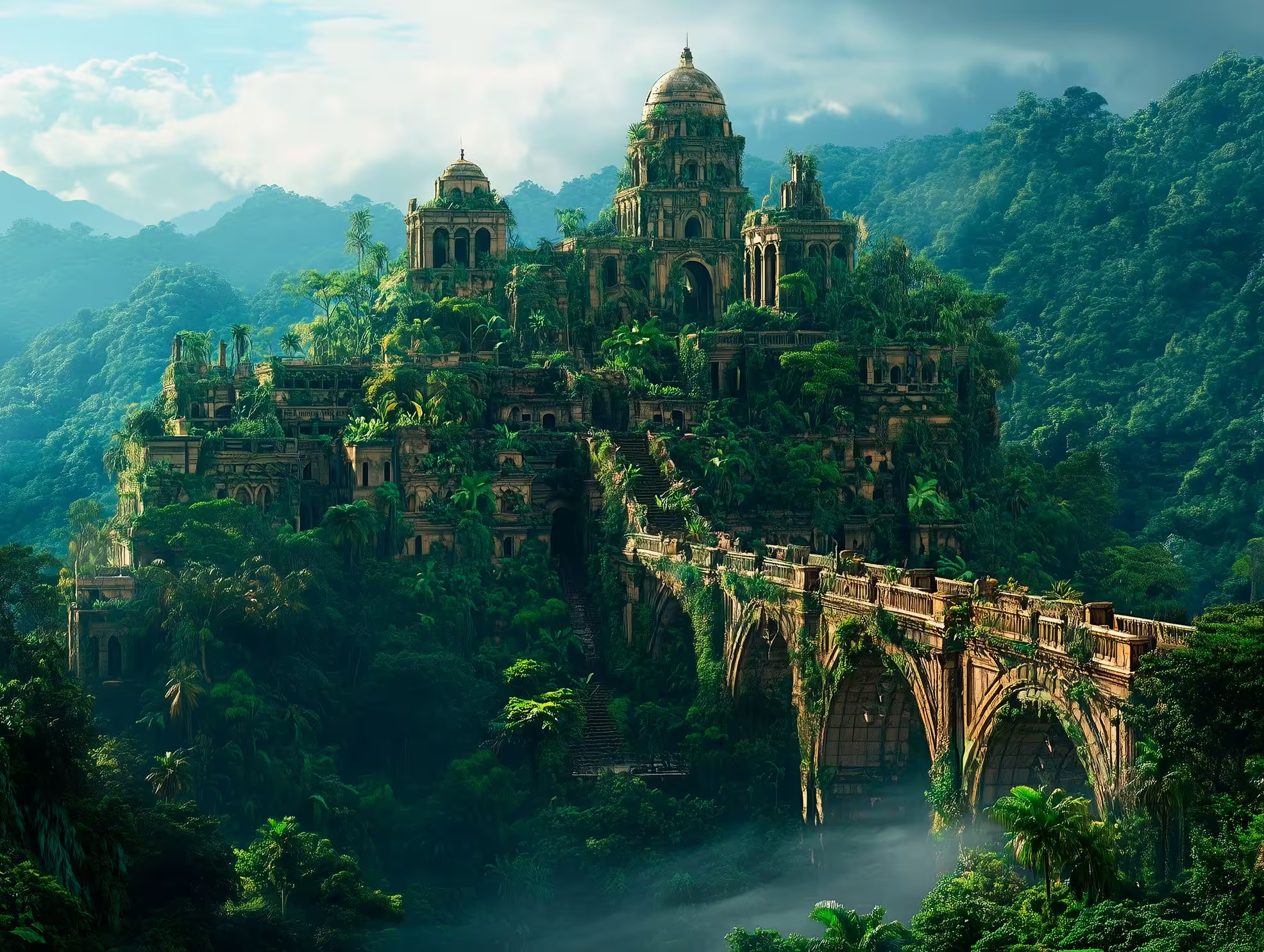
Greater São Paulo currently has around 22 million inhabitants. Experts estimate that before Europeans arrived in the Americas, there were around 10 million Indigenous people throughout the Amazon. It is therefore unlikely that the city of Ratanabá reached a size similar to or greater than Greater São Paulo.
USP professor says theory went viral because of economic interests
Archaeologist Eduardo Goés Neves, a professor at the University of São Paulo's Center for Amerindian Studies (USP), gave an interview to G1 in which he shared his view on why the theory of Ratanabá's lost city went viral even after so many years.
Neves said he had not heard of Ratanabá until 2022. When he began receiving questions about it, he conducted research and consulted colleagues, but none of them knew the story. Although social media profiles and books had discussed the supposed "lost civilization" in recent decades, the subject only recently drew popular interest and had been widely debated for a little over two years.
According to Neves, this phenomenon may be attributed to several factors. "I see it as a combination of people's credulity, their desire to believe this kind of narrative, and the economic interests tied to exploiting the Amazon," the expert suggests, recalling similar legends such as the city of El Dorado, which attracted explorers because it was supposedly made of gold.
Neves says these far-fetched stories may also serve as a smokescreen for issues that are genuinely important in the Amazon, such as fires, deforestation, and illegal practices that have long destroyed one of humanity's greatest natural treasures.
What do you think about this legend? Do you believe it is possible that such an imposing and technologically advanced city existed so long ago?