When we decide to buy a Nintendo console, we can be certain of a few things. I am referring to the quality exclusives released for all the company's video game systems. The Mario Kart franchise is certainly one of these major titles. Initially released on Super Nintendo, it has been successful ever since, not only with critics but through strong sales and fan satisfaction. It is even worth noting at the outset that its Wii installment is the best-selling racing game of all time. If you, the reader, are also a fan of this series, let us examine how it all began in the early 1990s, before the blue shell was even invented. Those were good times.

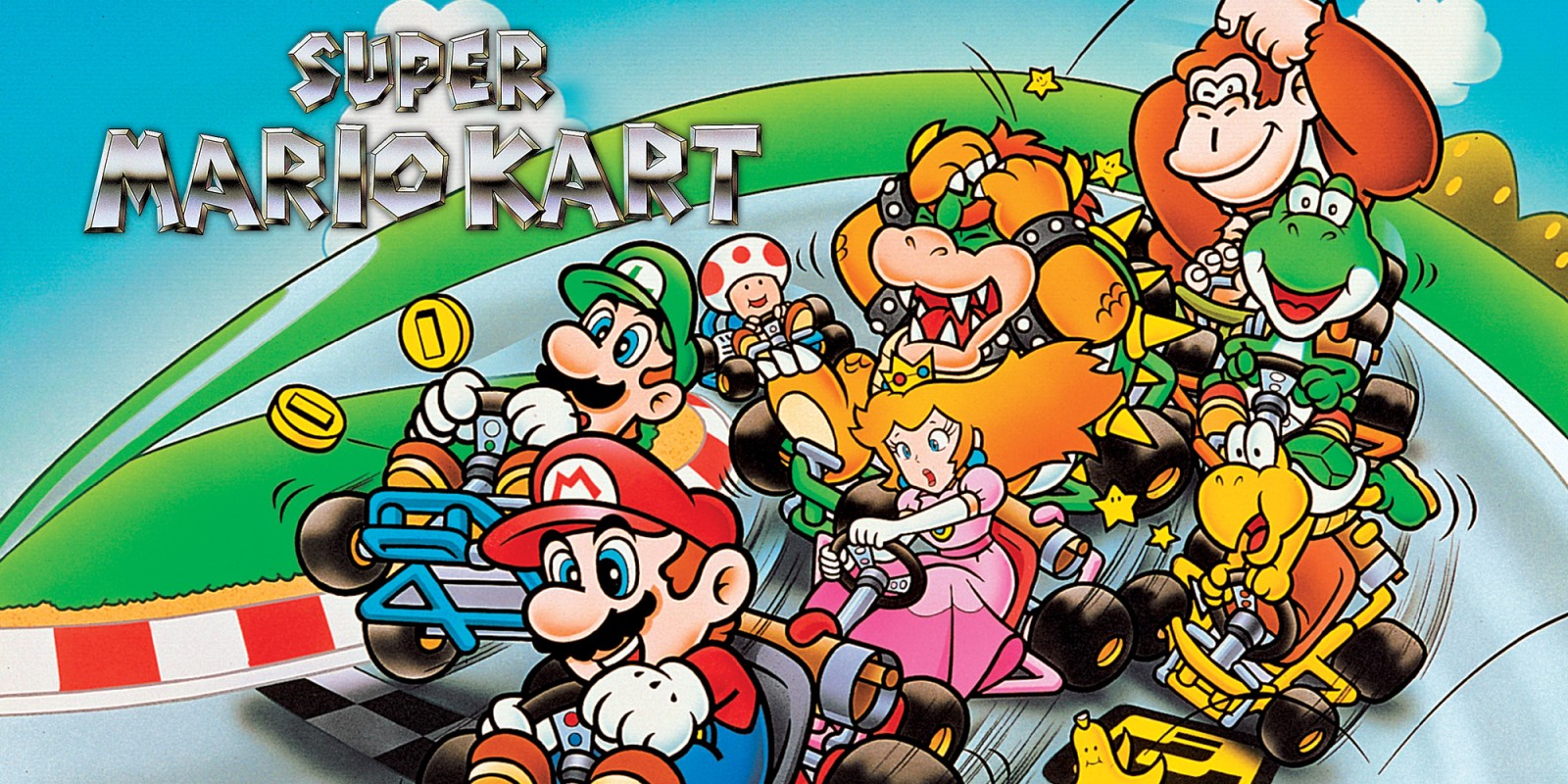
Looking at this image, the music already comes to mind.
Super Mario Kart is a racing game developed by Nintendo EAD and published by Nintendo on August 27, 1992. It was rereleased in 1996 because of its success and eventually received a Wii Virtual Console version in 2009. This was the first title in one of the most successful franchises in Nintendo and video game history.
Behind the Greatest Reference in Kart Games
Super Mario Kart was produced by Shigeru Miyamoto—as always—and directed by Tadashi Sugiyama and Hideki Konno. The main production goal was apparently to make the game multiplayer, as the team was reportedly frustrated that it had been unable to implement this mode in F-Zero, which Nintendo had produced earlier. Unfortunately, because of the limitations of the Super Nintendo and its cartridge at the time, the game could not feature tracks as elaborate as those in F-Zero, and the single-player experience also had to use a horizontal split screen.
Few people know that the game's protagonist was not originally going to be Mario, but a simple character in overalls. When Miyamoto proposed changing to the Mushroom Kingdom cast, everyone loved and supported the idea. Another difference in the beta version is that banana peels were originally going to be oil cans.
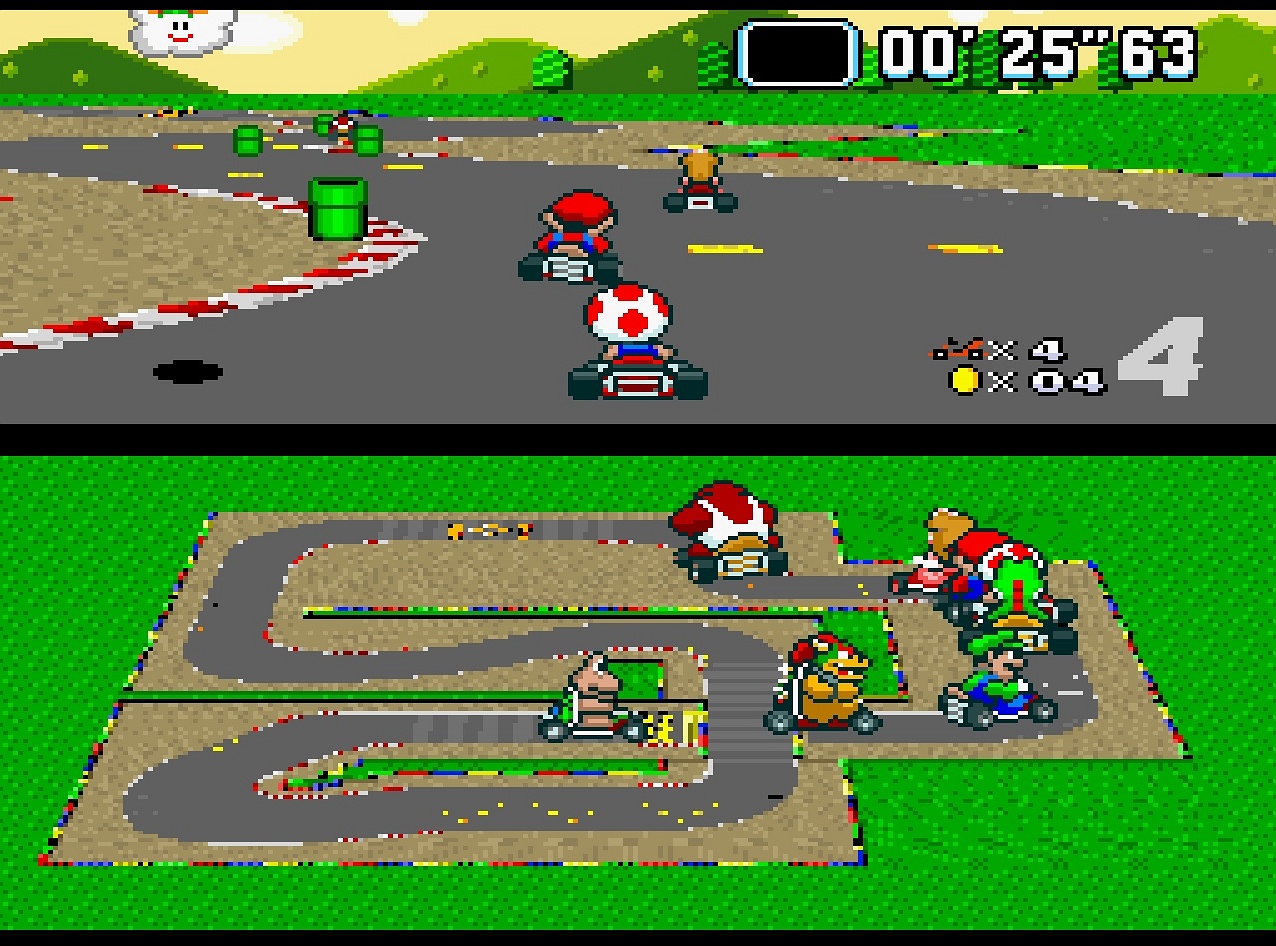
Split screen even in single-player, just like in Top Gear.
The Super Nintendo's Mode 7 feature was used extensively while programming Super Mario Kart. For those unfamiliar with it, Mode 7 is a texture-mapping mode that allows the environment to rotate and scale freely, creating a pseudo-three-dimensional appearance. Another important detail is that the game forced Nintendo to use an extra chip in the cartridge, called the DSP-1, which was responsible for the fluidity of the game's graphics.
Fun fact 1: As usual, Nintendo of America censored certain details in its games. In Super Mario Kart's case, it was the celebration in which some characters drank from a champagne bottle while standing on the podium. In versions released outside Japan, they merely throw the bottle into the air.
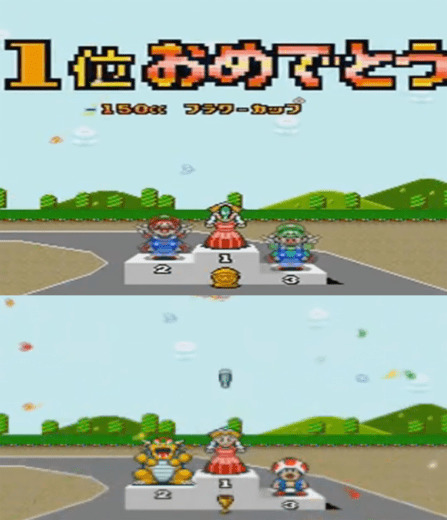
The original Japanese celebration and its Western counterpart.
Technical Analysis
Nintendo often does something interesting that generally achieves considerable success: it selects one of the market's many genres and transforms it in its own image, with numerous original additions and a great deal—truly a great deal—of fun. We can name several examples of this strategy, from its Kart franchise, Pikmin, and Smash Bros. to the more recent Splatoon. Super Mario Kart introduced an innovative mechanic that players could easily understand, a formula competitors have copied tirelessly ever since.
We have even become convinced that if a mascot succeeds, it will soon receive a kart game in Mario's mold. Examples of series that received titles in this style include Sonic, LittleBigPlanet, and Crash Bandicoot. Without a doubt, Super Mario Kart was another incredible revolutionary idea from Shigeru Miyamoto and his team.
The main difference between a game in the Mario Kart franchise and any conventional racing game is the use of special items found during races. These extra abilities either improve our characters' attributes, as with the star, or hinder opponents' performance, as with the turtle shells.
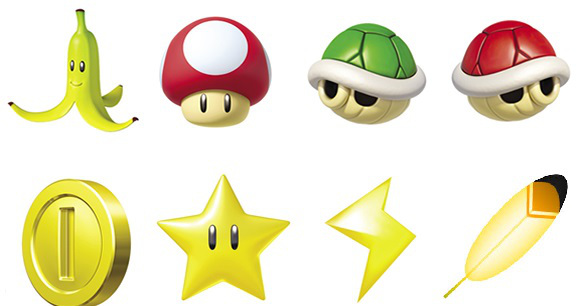
These are the eight items used in races in the first Mario Kart. Note: this was the first and last time the feather appeared in a game in the franchise.
The gameplay responds well to commands, and players need only a little time to become accustomed to the sharp turns already present in this first franchise entry. Executing them perfectly requires mastering the "drift," a slide performed by holding the jump button after hopping.
Another distinctive aspect of Mario Kart gameplay is knowing the exact moment to press the accelerator at the start. If you learn this, your character effectively begins with an extra turbo boost and leaves the opponents behind.
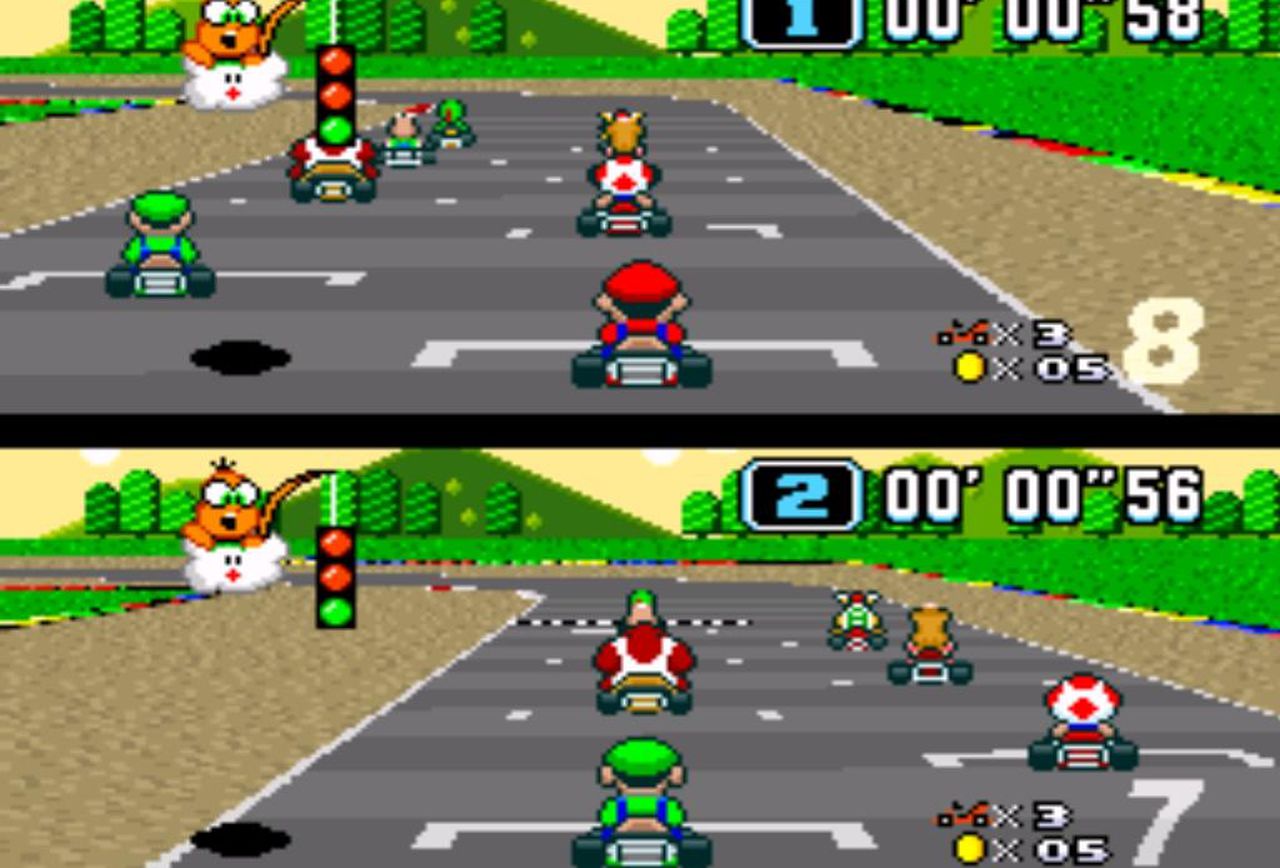
The eternal quest for the perfect start.
Coins are an important feature in this first franchise entry. The number we begin with depends on our starting position. Eighth and seventh place start with five coins, sixth and fifth with four, fourth and third with three, and second and first with two. Coins are lost when we make contact with other racers, are hit by an item, or are rescued from outside the track by Lakitu. We lose one, four, and two coins in those situations, respectively. If our balance reaches zero, our car spins when it comes into contact with opponents. New coins are acquired along the course and through the item specifically designed for this purpose. Here is a tip: if you accumulate more than ten coins, your car receives increases to attributes such as top speed, acceleration, and others.
In campaign mode, we must overcome four tournaments. The final one, the Special Cup, is unlocked only on the 100cc and 150cc difficulties if the player earns gold trophies in the first three competitions. Speaking of which, the difficulty is reasonably high by the standards of current games and, in my view, this is the hardest title in the Mario Kart franchise, without the later miraculous items that let us jump several positions during a race. This first game also includes lives, which are lost if we fail to score on a track. Fortunately, this feature was removed in the series' sequels.
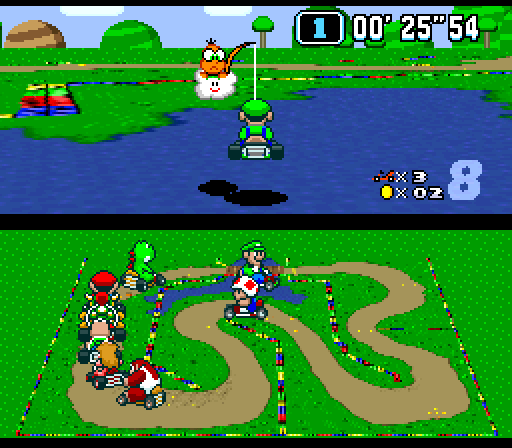
Lakitu rescues us for the price of two coins. That is fairly cheap.
The graphics are simple but beautiful and colorful, using the Super Nintendo's Mode 7 effects during races. Unfortunately, the screen remains divided even in single-player. When playing in this mode, we can choose whether the lower screen displays details such as the track map or rearview mirror.
Although the soundtrack is not as revolutionary as those in some of the company's other games, it is very good and perfectly suits each setting: cheerful on Mario's tracks, dark in the haunted houses, and festive on the beaches. Credit goes to Taro Bando, responsible for the sound effects, and Soyo Koda, responsible for the music. Replay value is also excellent, especially because playing the two-player modes with a friend is so enjoyable.
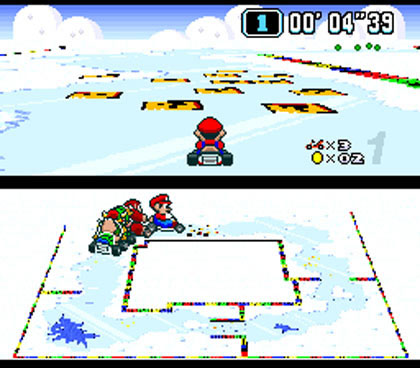
Slippery ice tracks were indispensable in the 1990s.
One highlight is certainly the ability to play in multiplayer. As I said in my Top Gear review, released in the same year as Super Mario Kart, several of the period's best racing games could not be played with a friend, including OutRun, F-Zero, and Super Monaco GP for Mega Drive. This seems even more important in the Mario Kart franchise because much of the fun comes from making the opponent in the next chair spin with a turtle shell or banana peel.
The game's courses are based on the worlds of Super Mario World, so franchise fans feel at home while traveling through settings such as Ghost Valley, Bowser Castle, and Choco Island.
Below is the complete Super Mario Kart soundtrack.
Fun fact 2: In 2009, the Guinness Book of Records decided to create a list of the 50 most influential games of all time, and Super Mario Kart took first place. According to them: "Super Mario Kart for Super Nintendo has had the greatest influence on future games and should be considered the most important in video game history." However exaggerated this statement may be, it is important to highlight the recognition the game received from this renowned award. If you are curious, Tetris and Grand Theft Auto took second and third place, respectively.
The Drivers of Super Mario Kart
The game's podium contenders come from the Super Mario franchise, except Donkey Kong Jr. To make character selection easier, they are divided into four classes, represented here by the four columns on the selection screen.
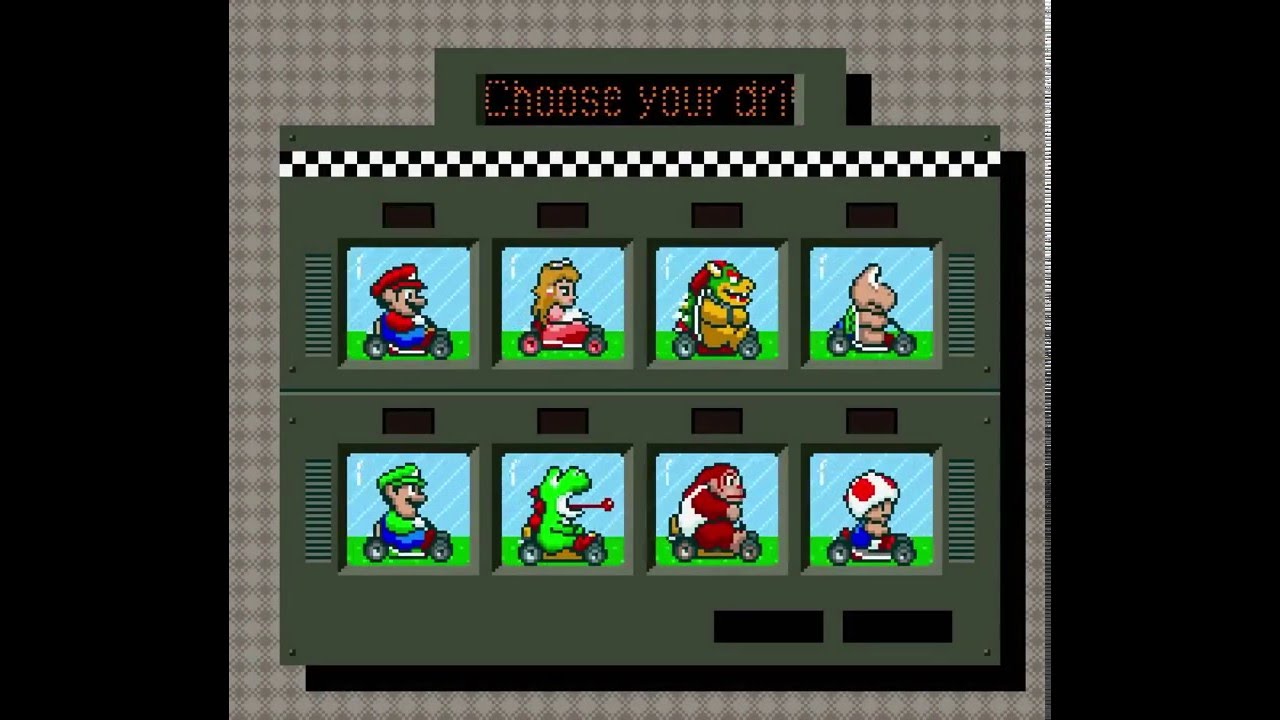
The drivers are divided into four categories, represented here by four columns.
Balanced across every attribute:
- Mario: Nintendo's protagonist has the most balanced kart among all available choices and does not stand out in any ability. When controlled by the computer, he has the star power for a limited time;
- Luigi: Very similar to Mario, he apparently offers only better cornering performance and a lower top speed than his brother. Like the protagonist, he has the star ability when controlled by the console.
Those with the best acceleration:
- Peach: With her kart's outstanding acceleration, she is highly recommended for Mario Kart beginners. When controlled by the computer, her ability is throwing mushrooms that shrink us if they hit;
- Yoshi: His attributes are very similar to Peach's, leaving no major details to mention. When faced in races, he throws eggs that make us spin.
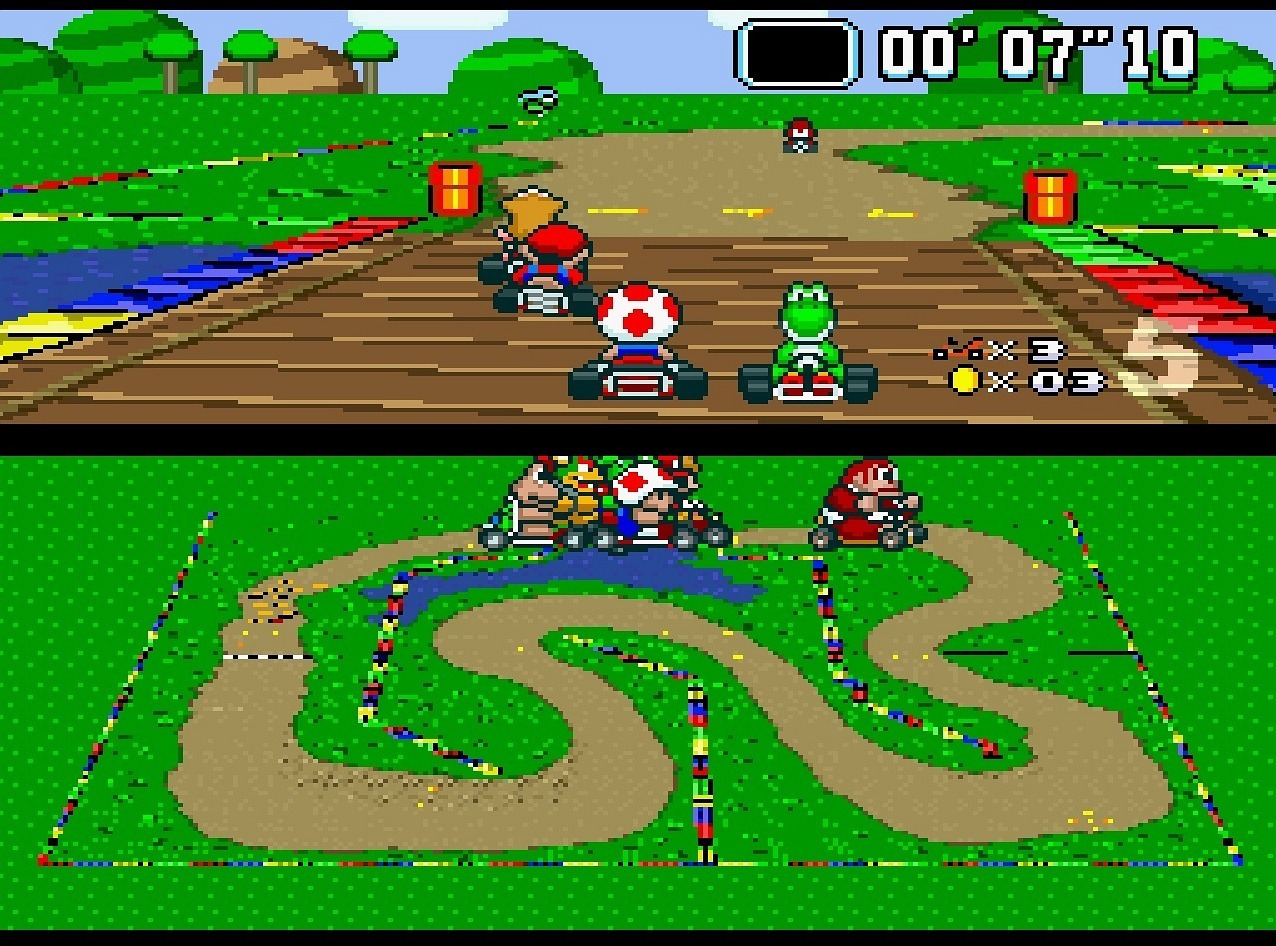
One of the game's rare bridges in good condition.
The karts with the highest top speed:
- Bowser: The heaviest competitor drives like a tractor as he strikes opponents. His low acceleration makes him recommended for more experienced players. When controlled by the computer, he uses extremely troublesome fireballs;
- Donkey Kong Jr: The character with the best top speed among the competitors, making him difficult to steer through turns. He leaves banana peels on the track when we face him.
Those with the best handling:
- Koopa Troopa: The available character with the best cornering control, also making him highly recommended for beginners. He throws green shells when controlled by the computer;
- Toad: Similar to Koopa Troopa, he has slightly inferior handling offset by greater acceleration. Like Peach, he leaves mushrooms on the track.
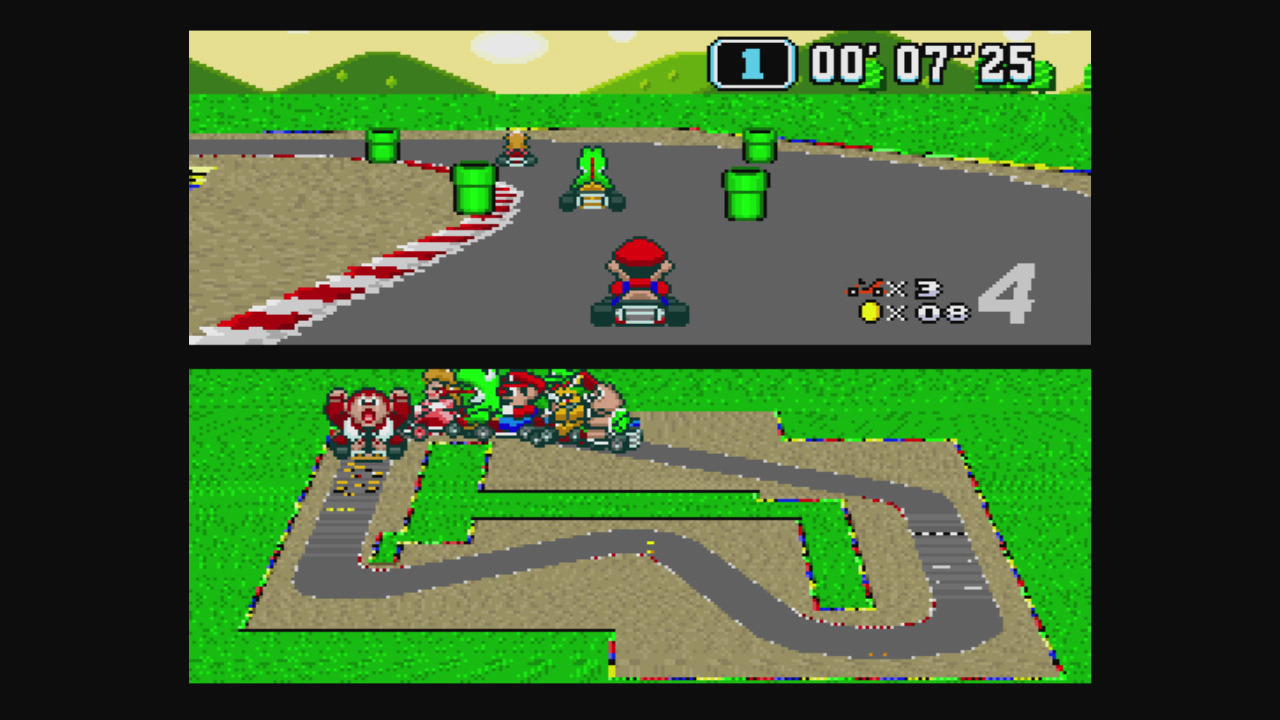
Who builds a track over exposed pipes like this?
Fun fact 3: For several years, Tokyo has offered a kart tour on which people rent these vehicles together with costumes of characters from Mario's cast. Unlike in most countries, these vehicles are allowed to travel on Japanese roads alongside passenger cars. I only hope they do not leave banana peels along the way.
The "Cheating" Items
Of all the innovations the Mario Kart franchise brought to video games, the presence of power-ups found along the courses is undoubtedly the most important. In this first franchise entry, we acquire them by driving over question marks drawn on the track. The quality of the item received is random, although racers in the lowest positions have a greater chance of receiving the best ones.
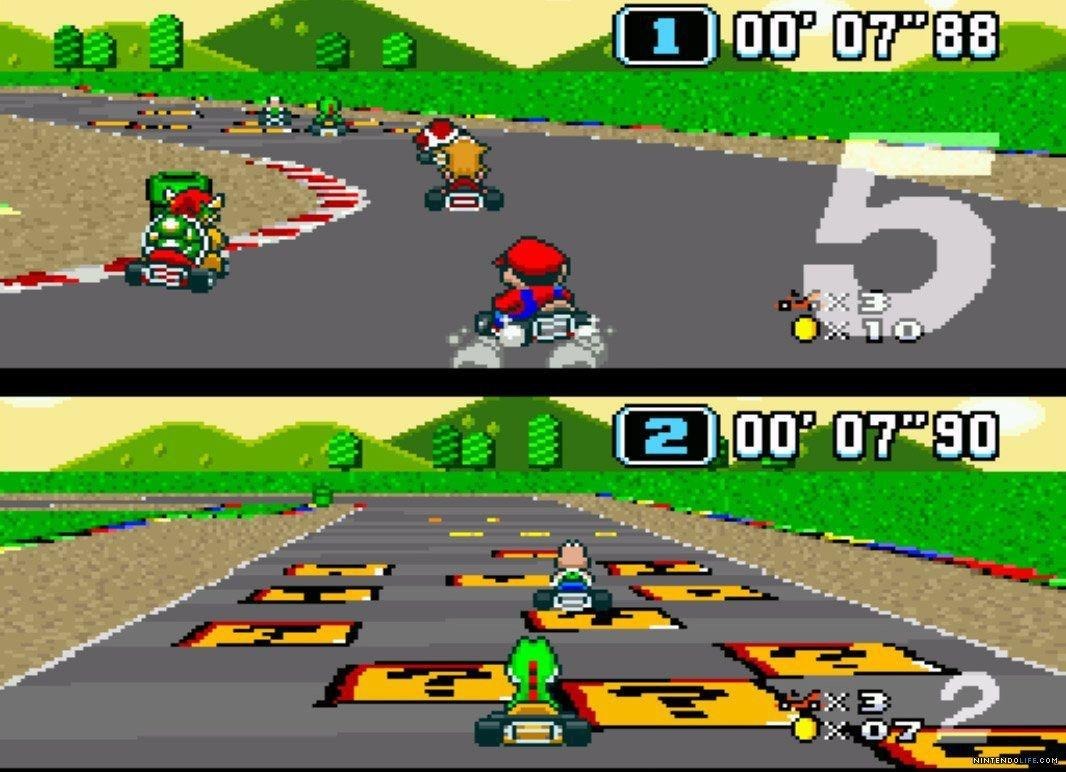
Question marks on the ground. Be careful not to swerve around them.
- Green Shell: A straight-line projectile. If it hits someone, they spin and lose considerable time before regaining speed. Be careful, because it bounces off walls and often harms the person who fired it;
- Red Shell: It has the same effects as the green shell but homes in on targets. It is quite limited in this first game and useless if the opponent is too far away or too close;
- Feather: When used, the kart jumps. It can be used in front of obstacles and to access shortcuts;
- Mushroom: A good, classic turbo boost. Simply choose the right moment to overtake and take shortcuts;
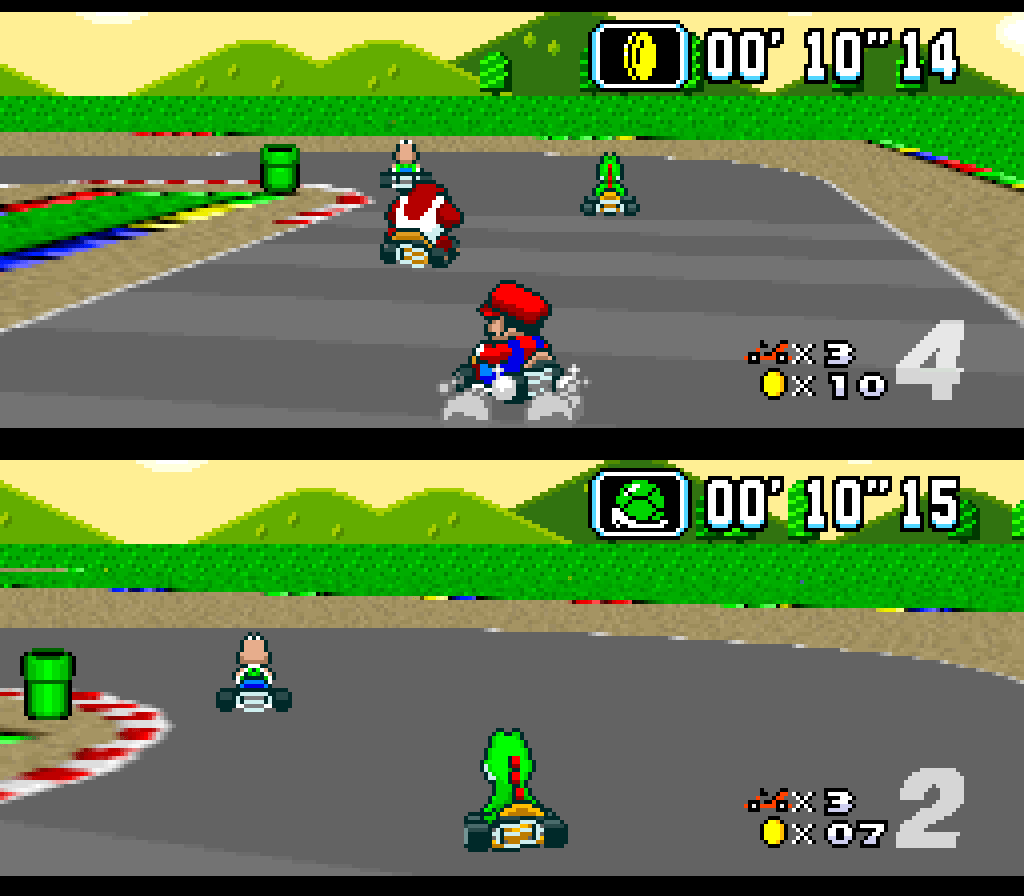
- Coins: This item is worth two coins. Note: in this first game, computer-controlled opponents do not collect them, only players do;
- Banana Peel: We place it on the track so opponents will slip on it. Unfortunately, we are often the ones who hit it on the next lap. "Who hasn't done that?";
- Star: The best item in the game. It gives us greater speed and invincibility and prevents us from losing acceleration on terrain outside the track. It is excellent for taking shortcuts;
- Lightning Bolt: This power-up hits everyone except the person who uses it. Its effect shrinks and slows the competitors, allowing its user to run over the others.
Note: Battle Mode and Match Race also feature the Ghost item, which makes the player invisible and allows them to take an opponent's items.
Fun fact 4: Super Mario Kart was a major critical and commercial success from its debut, reaching an incredible 8.76 million units sold for its original Super Nintendo version alone and ranking fourth among the console's best-selling games.
Game Modes
- Mario Kart GP: The game's main mode, which can be considered its campaign. It is divided into 50cc, 100cc, and 150cc categories, representing easy, medium, and hard difficulty, respectively. The differences between engine classes involve not only opponents' competitive ability but also the maximum speed they reach. In this first franchise entry, races have five laps and the player has a limited number of lives. One is lost if we finish below fourth place among the eight competitors.
- Match Race: A two-player-only mode in which the first person to complete five laps wins. Because there are no other competitors, new obstacles are added to the course;
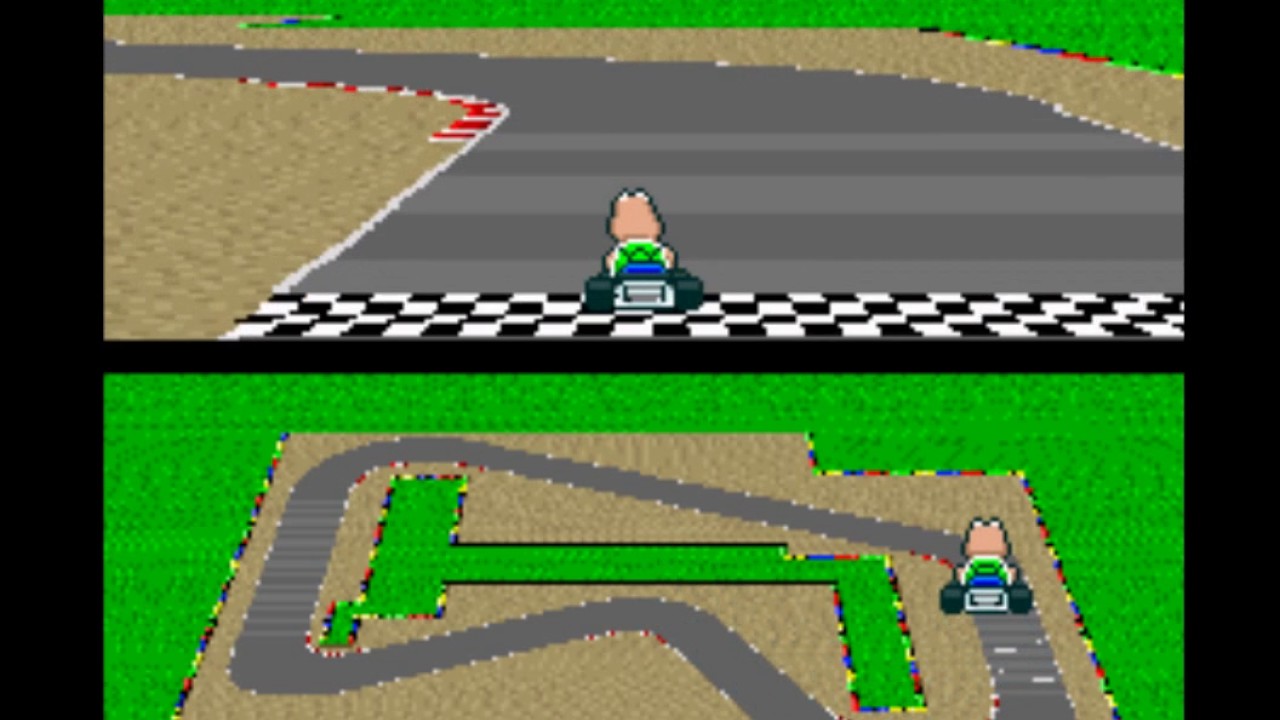
The solitude of Time Trial.
- Time Trial: The classic single-player mode in which the player pursues a record time;
- Battle Mode: The famous balloon battle was already present in the franchise's first game. Matches take place inside arenas, and the first person to hit the opponent three times wins. Our health is represented by balloons attached to our karts.
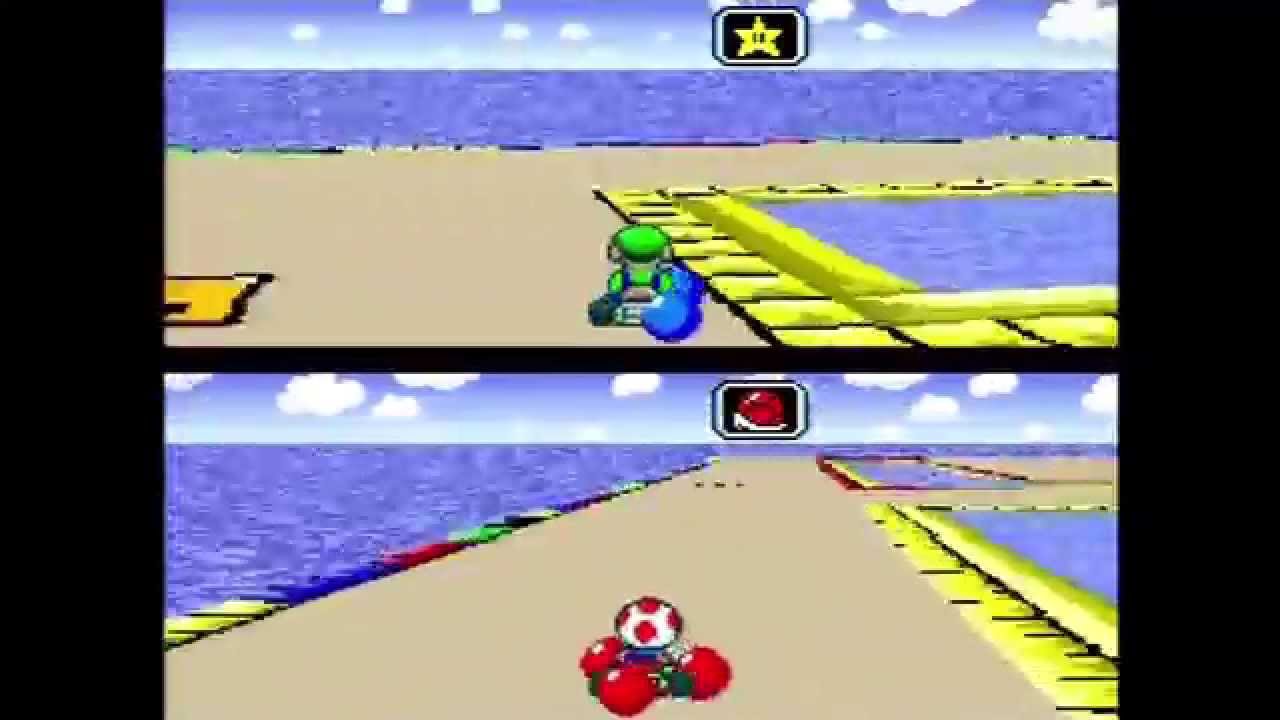
The famous balloon battle.
The Mario Kart Courses
As noted earlier, the Super Mario Kart tournament apparently takes place somewhere in the world of Super Mario World. Returning to a game that practically everyone liked already helped make this new title memorable.
The courses in the Mario Kart franchise depart considerably from convention, with unusual boundaries such as water, holes, cliffs, and more. Along the tracks, we encounter objects that get in our way. They may be inanimate, such as pipes, or animate, such as moles.
Several tracks feature shortcuts and opportunities to cut across the course. These advantages are generally accessed with help from special items, especially the turbo boost and star.
The turns are initially wide and open, but 90-degree corners soon appear and require some time to master.
Some tracks have barriers along their edges while others do not, making it easy to fall off and lose coins and precious time. Who remembers the final track, Rainbow Road, and how easy it was to fall?
Some courses have "zippers" on the ground. These V-shaped designs give racers a powerful turbo boost that often lets us gain positions. Other courses also contain small speed bumps that make us hop. Mastering all of this is more important than receiving good items during a race. Together, these features make Super Mario Kart one of the Super Nintendo's most technical and competitive games.
Our Conclusion
It is no exaggeration to conclude that Super Mario Kart was the first game in a subgenre within the racing genre. The game introduced a degree of strategy that had previously been unknown at a time when only skill was evaluated in these competitive games. The "drift" itself became widespread in racing games after 1992. There is no need to reproduce lists of the greatest games of all time on which this title appears. The number of clones the game has produced demonstrates its success. If you have never played Mario Kart, if that is even possible, try to give it a chance. Perhaps it will make you view racing games differently from then on.
Rating: 9.5
Played on Super Nintendo.