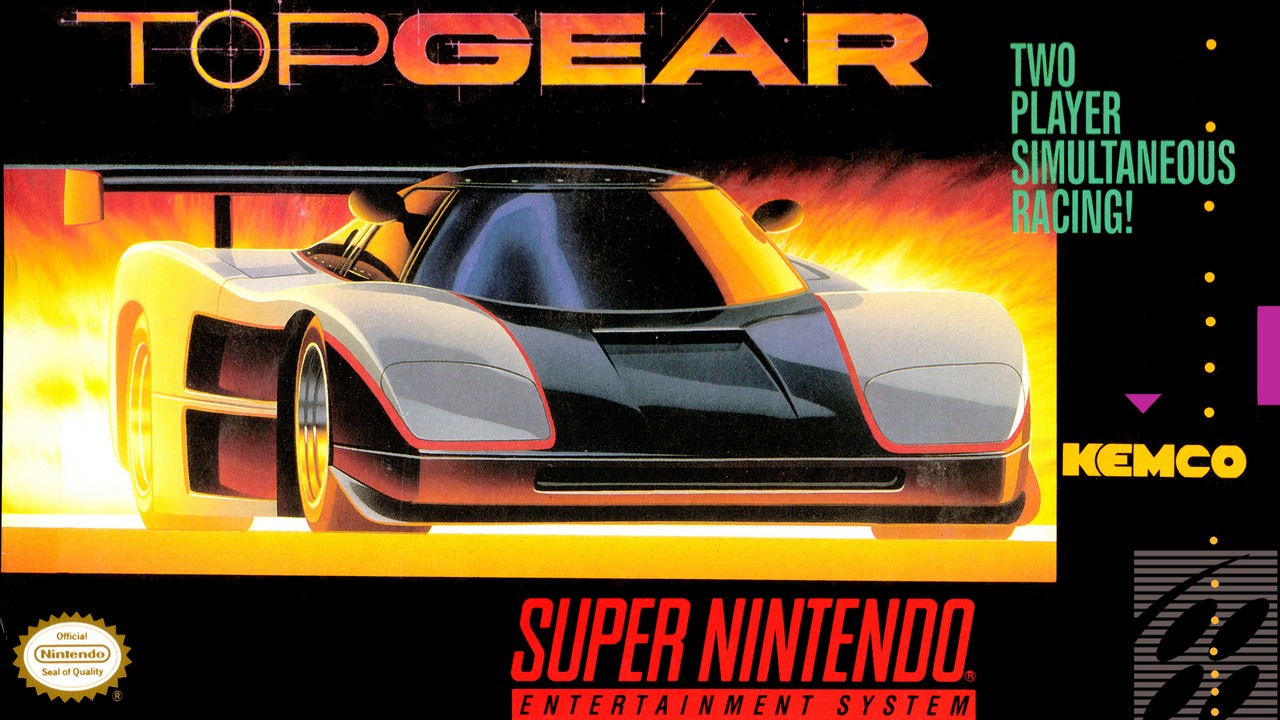
Top Gear was a classic of video game rental stores and one of Nintendo fans' strongest arguments during the greatest console war ever fought. For many, the fourth generation—SNES versus Mega Drive—was the best period gamers ever experienced, not only because of the great number of quality games, but because of the quantity of exclusives. Whether you chose SEGA's console or Nintendo's, you would inevitably turn your back on an enormous number of excellent games from every genre. Among racing games, the Mega Drive had OutRun and Super Monaco GP, but the Super Nintendo needed more than the excellent F-Zero; it required something more "realistic." Thus, Top Gear came into Brazilian hands, a great classic in our country that is ignored and even forgotten abroad. We are fortunate to live in Brazil.
Top Gear, known as Top Racer in Japan, was released for Super Nintendo in 1992. It was developed by English studio Gremlin Graphics and published by Japanese company Kemco. Although recognized for its earliest games, the franchise had more than ten releases, with the final one being Top Gear RPM Tuning in 2004 for PC, PlayStation 2, and Xbox.
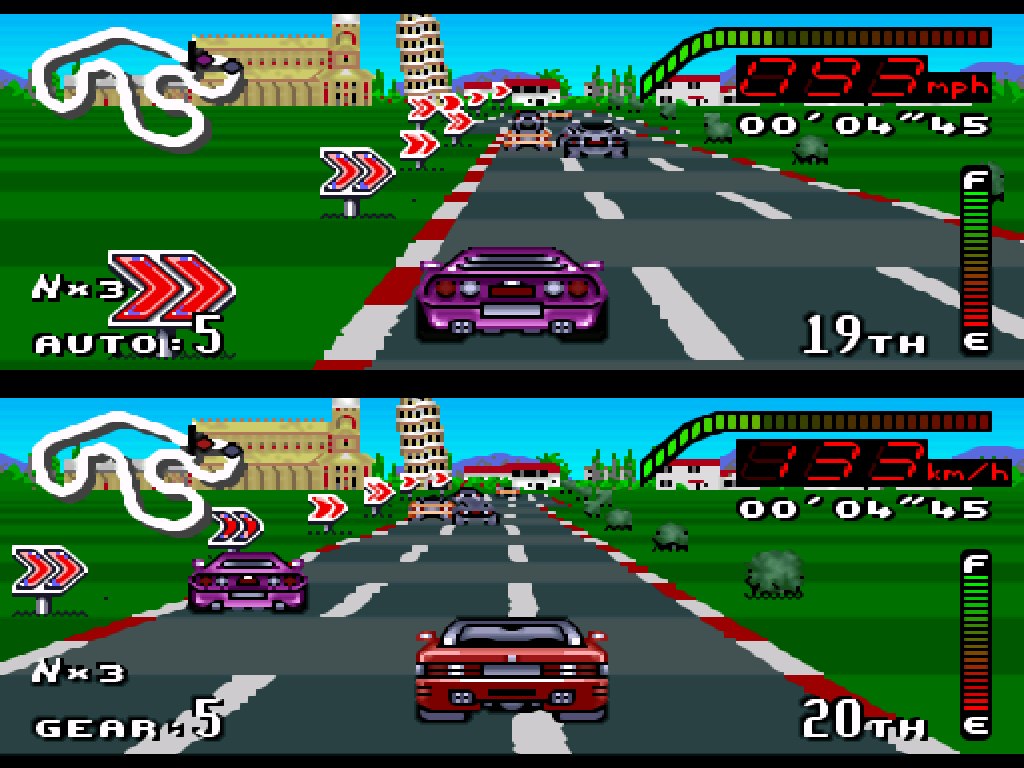 That overwhelming desire to look at your friend's screen, "block" them, and still receive a boost
Fun fact: For a long time, people believed that Top Gear was a sequel to an NES game made by Squaresoft called Rad Racer (1987). This false rumor originated on a Wikipedia page containing incorrect information, which was unfortunately spread across Brazilian websites and forums. The franchise's true source of inspiration lies in the Lotus series, a classic on Amiga computers. When Ritchie Brannan, programmer of the first three Top Gear games, was asked about the subject in an interview, he responded: "I didn't even know Rad Racer existed until today."
A Brazilian Classic
There is no way to know precisely why Top Gear is so well known and admired in Brazil and so little recognized elsewhere. The Brazilian people's passion for motorsport undoubtedly helps, especially in the early 1990s with our hero Ayrton Senna. Many people, however, cite as one of the main reasons the presence of pirated multicarts that brought together several titles from different companies and genres on a single cartridge, with Top Gear among them. From the first time Video Games Live came to Brazil, its organizer Tommy Tallarico found it curious that audiences only here relentlessly requested Barry Leitch's music from the game. In response to our countless requests, a medley of the game's music is performed when the incredible orchestra comes to our country.
Books, magazines, and websites from other countries often create lists of the best games of all time without ever including Top Gear. I would highlight the recent book 1001 Video Games You Must Play Before You Die by Tony Mott, also released in Brazil, which does not even mention a single game in the franchise.
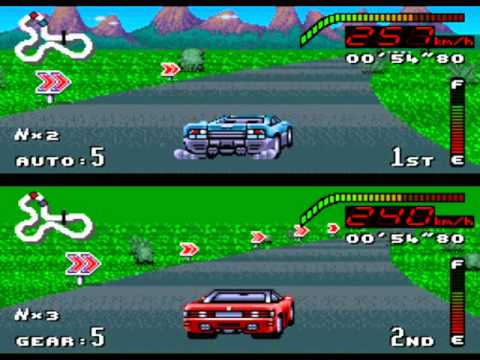 To this day, I do not know whether the shape of the Peru track was an extremely tasteless joke
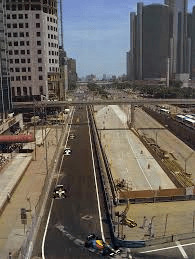
Fun fact: The photograph used on Top Gear's menu screen was a mystery for many years. Only recently was the image's origin discovered: the Detroit street circuit in the United States. Formula One races were held there from 1982 to 1988. According to the game's producers, there was no reason for this photograph to have been used; it was merely a coincidence. It is worth noting that, like Monaco, the Detroit course runs through city streets, and Ayrton Senna was its most successful driver, winning three times.
Top Gear's Cars
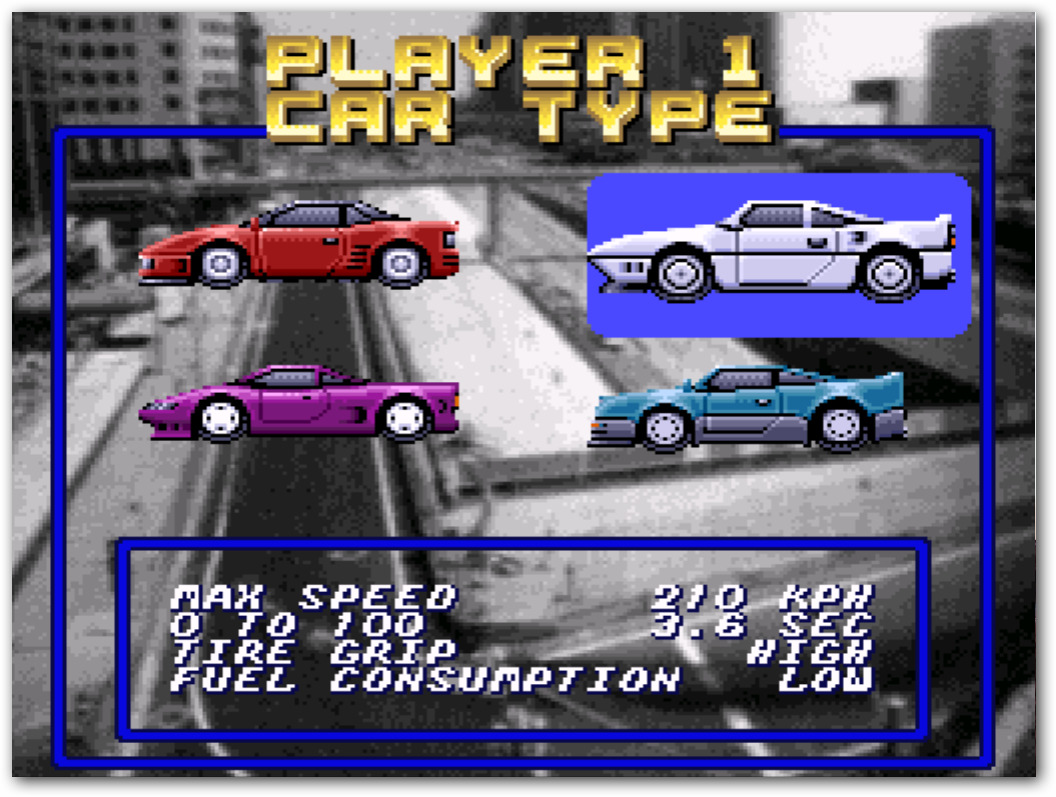
Few classic racing games had cars as iconic as those in Top Gear. Although we referred to them only by their colors, they were quite distinct, even possessing names of their own and inspirations in real models.
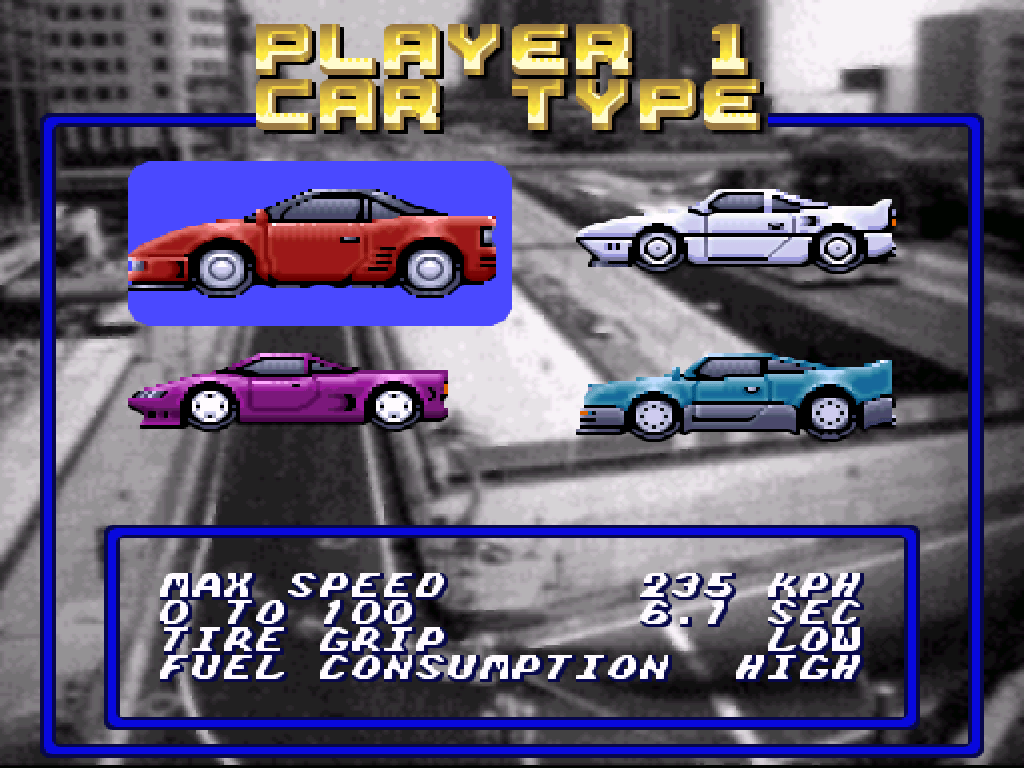
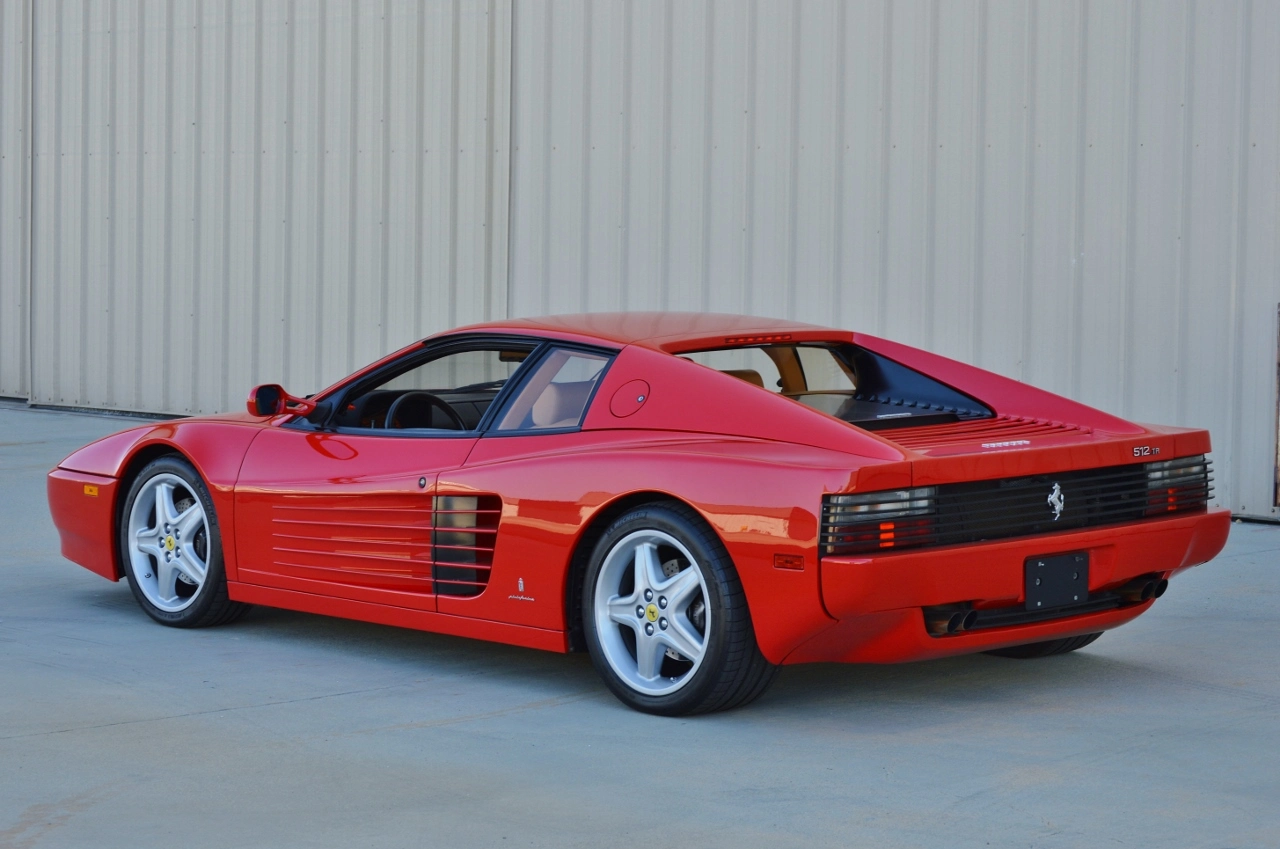
- Cannibal (red car): Highly tempting to the eye, this vehicle has the greatest top speed. It is also known as a "leaky tank," however, because it consumes the most fuel among the available models. It is useful in the first tournaments but difficult to manage in later ones because of longer races and the greater need to stop for fuel. Recommended for more experienced players. It was inspired by the classic Ferrari 512 TR, or Testarossa, the same car from SEGA's OutRun.
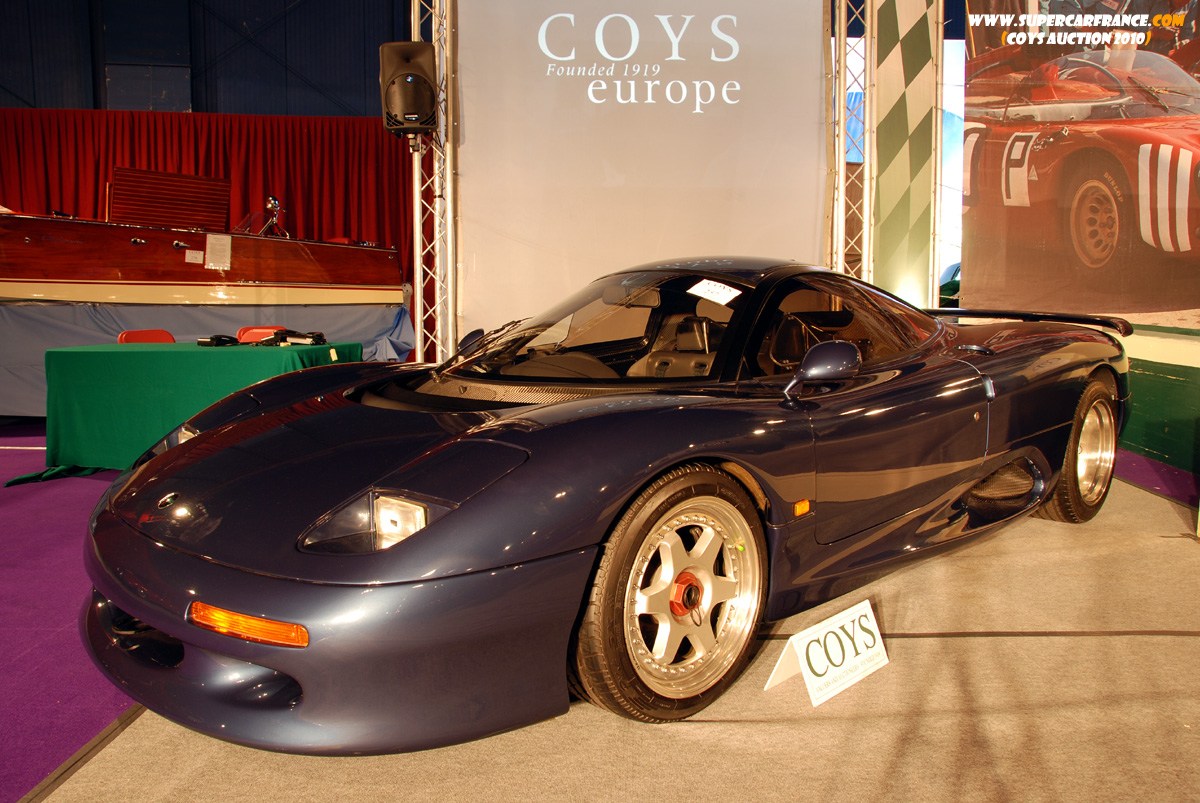
- Razor (purple car): In addition to possessing a good top speed, it performs well in turns, has reasonable acceleration, and is advisable for those who already have some practice with the game. Its model was based on the Jaguar XJR-15.
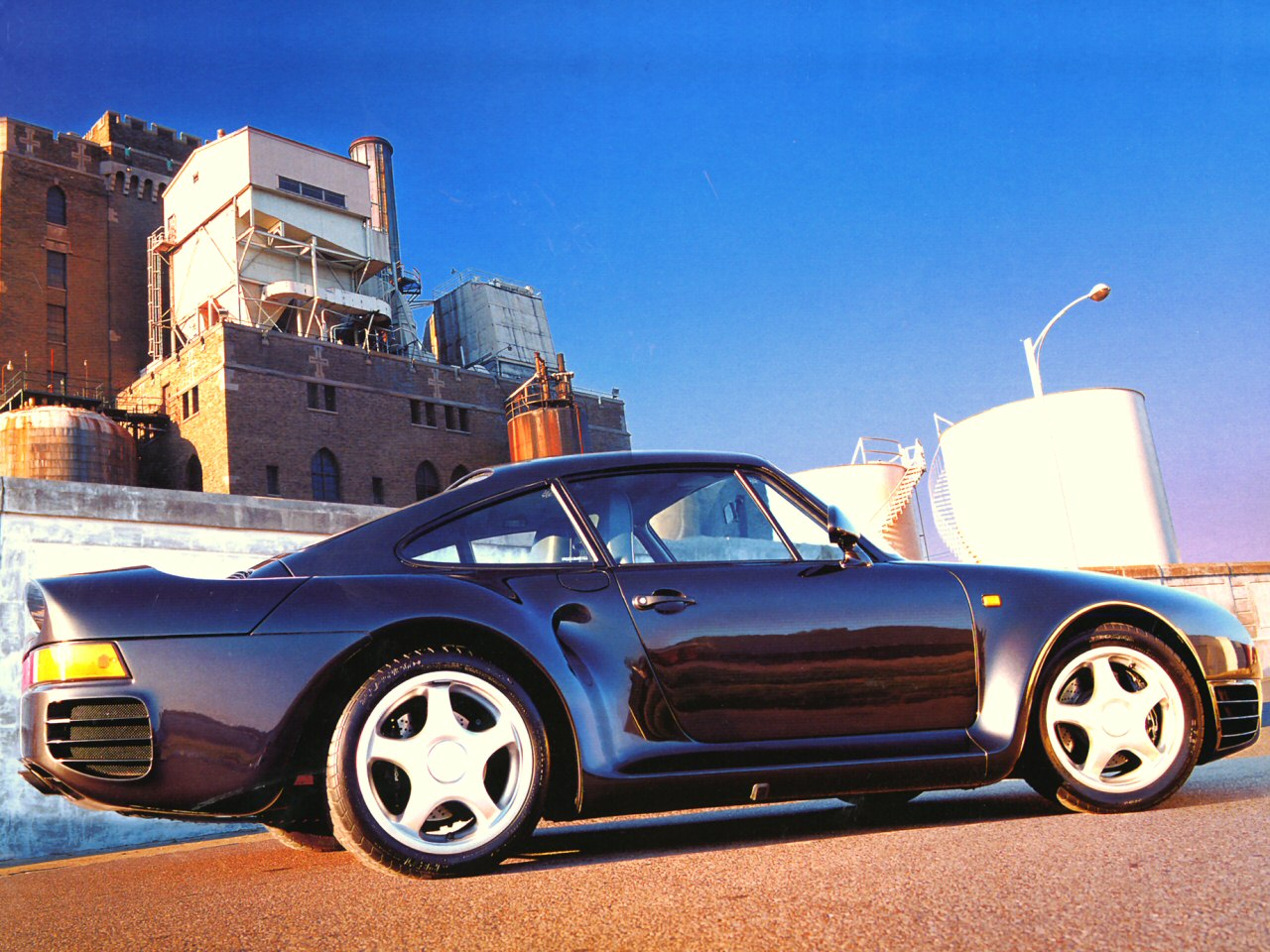
- Weasel (blue car): A highly balanced car without excessive fuel consumption. It is somewhat more sensitive in turns. Its model was based on the Porsche 959.
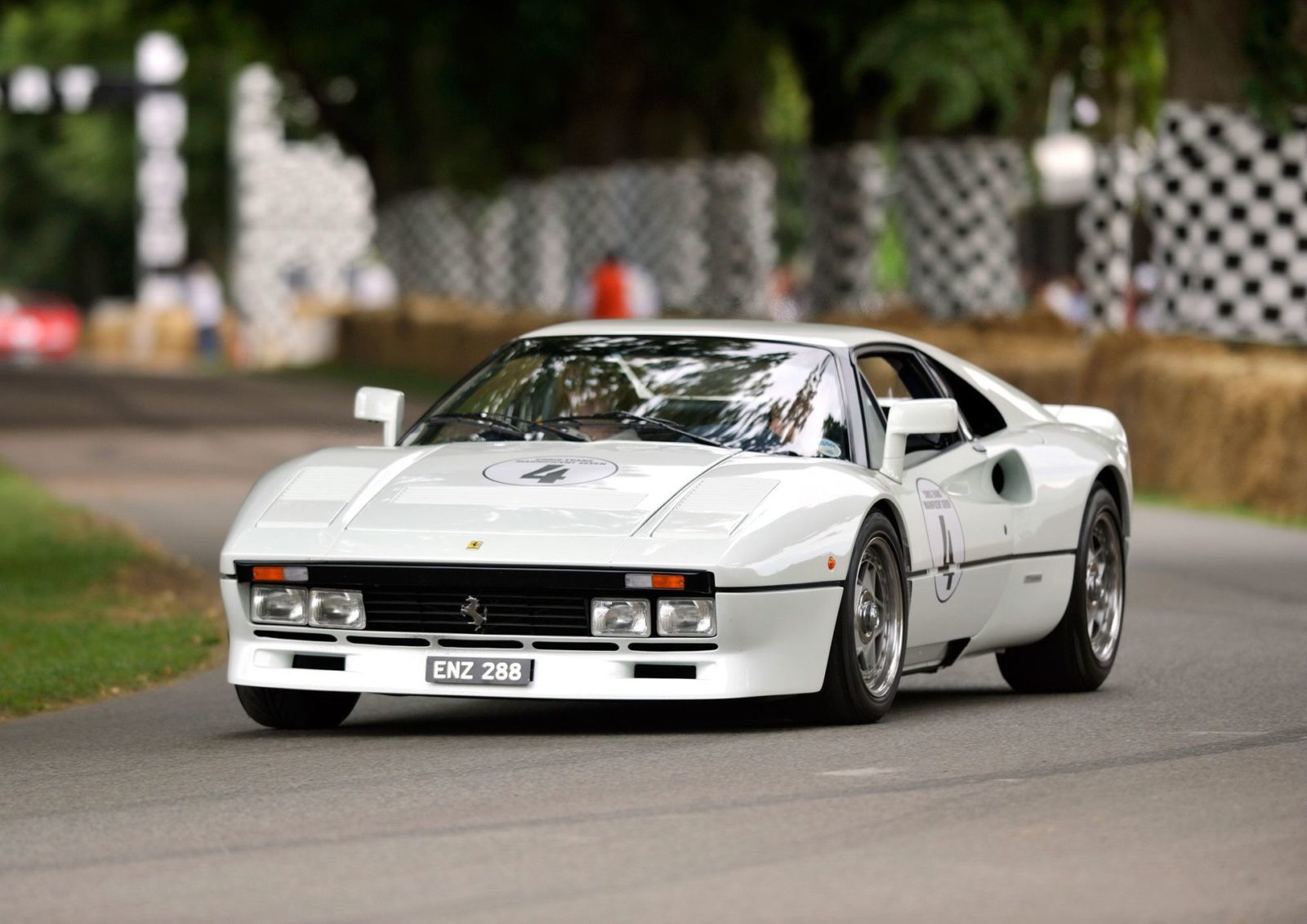
- Sidewinder (white car): Perhaps the most popular car in the entire Top Gear franchise, it is recommended for beginners because of its excellent handling and low fuel consumption. It is difficult on early tracks and excellent on later ones because it does not require players to stop constantly for fuel. Its model is based on the Ferrari 288 GTO.
Fun fact: Few people know that a British automotive television program called Top Gear has existed since 1977. This relationship between the brands caused legal problems when Kemco decided to register the game. The legal deadlock continued until 1999, when a court ultimately allowed the brand name to be used in games. Despite this, the issue is believed to be one reason the franchise ended during the sixth console generation.
Technical Review
Top Gear's gameplay is entirely arcade-based and ignores any kind of realism found in competing games such as Super Monaco GP. We can easily take turns at speeds above 200 km/h, regardless of the selected car. The controls respond very well to players' movements, and the presence of three nitro boosts per race adds a good strategic factor to the courses, requiring us to know the right moment to use them. The cars' high speed is a hallmark of the franchise, especially in its first games. The producers themselves said this was the gameplay's great focus and that nitro boosts were therefore added during development.
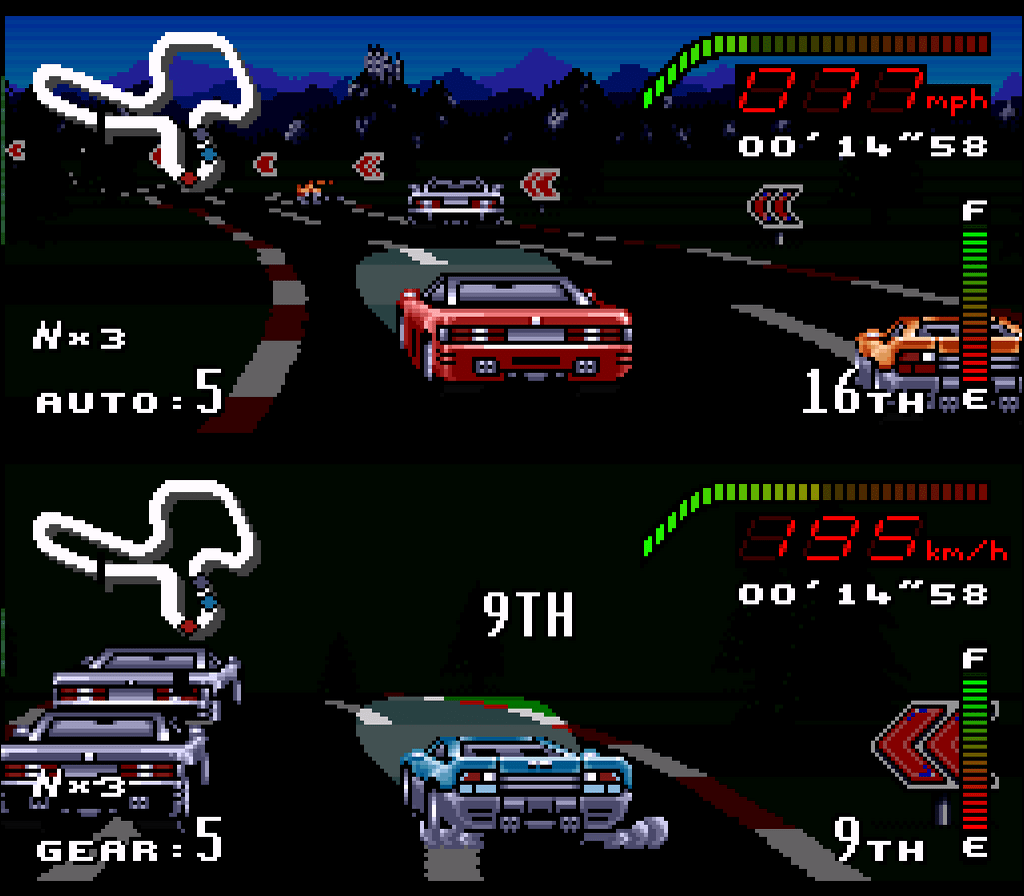
Beautiful night races with purely decorative headlights
Another distinction in Top Gear is the fuel gauge, which also contributes to the game's strategy. Throughout races, we constantly wonder whether our fuel will last until the end of the course and whether it is better to fill the tank completely or halfway to save a few seconds, then hope it does not run out. The fact that the cars have different fuel consumption rates also makes us consider which vehicle would be best for each track. This idea from the programmers was genuinely brilliant.
Top Gear was heavily influenced by the Lotus franchise, especially its first game, Esprit Turbo Challenge from 1990. That game has the same split screen, pit stops that contribute to strategy during races, and above all a soundtrack also composed by Barry Leitch. Developers from Magnetic Fields, the studio that created Lotus, had mixed reactions when they saw such extensive similarities, but nothing could be done because both brands belonged to Gremlin Graphics.
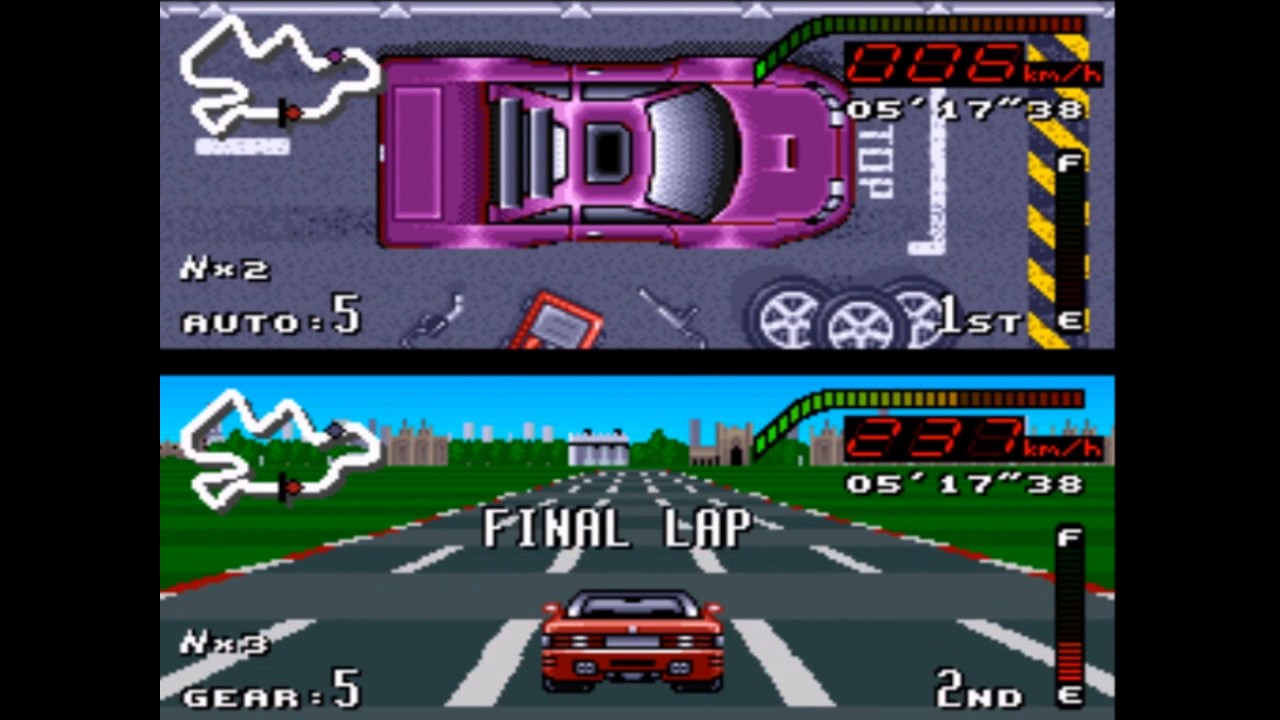 The pit stop made you want to bite your nails from anxiety
The difficulty is divided into "amateur," or easy; "professional," or normal; and "championship," or hard. When playing on normal, we still encounter no major difficulty finishing the game, especially when comparing Top Gear with other competitors from its time. A little practice is enough to avoid significant problems placing among the leaders in each tournament.
The presence of multiplayer certainly helped drive the game's popularity. Saying this may sound silly today, but several of the best racing games at the time did not support the feature, including OutRun, F-Zero, and Super Monaco GP in its Mega Drive version.
The game's "campaign" consists of eight tournaments with four tracks each. At the end of every tournament, you receive a password to continue later from where you stopped. These championships take place at several tourist attractions around the world, so the background scenery is worth watching. Two courses are set in Brazil: Rio de Janeiro and Rain Forest, or the Amazon, with classic signs based on our stereotype reading "save the trees" and "fun in Rio."
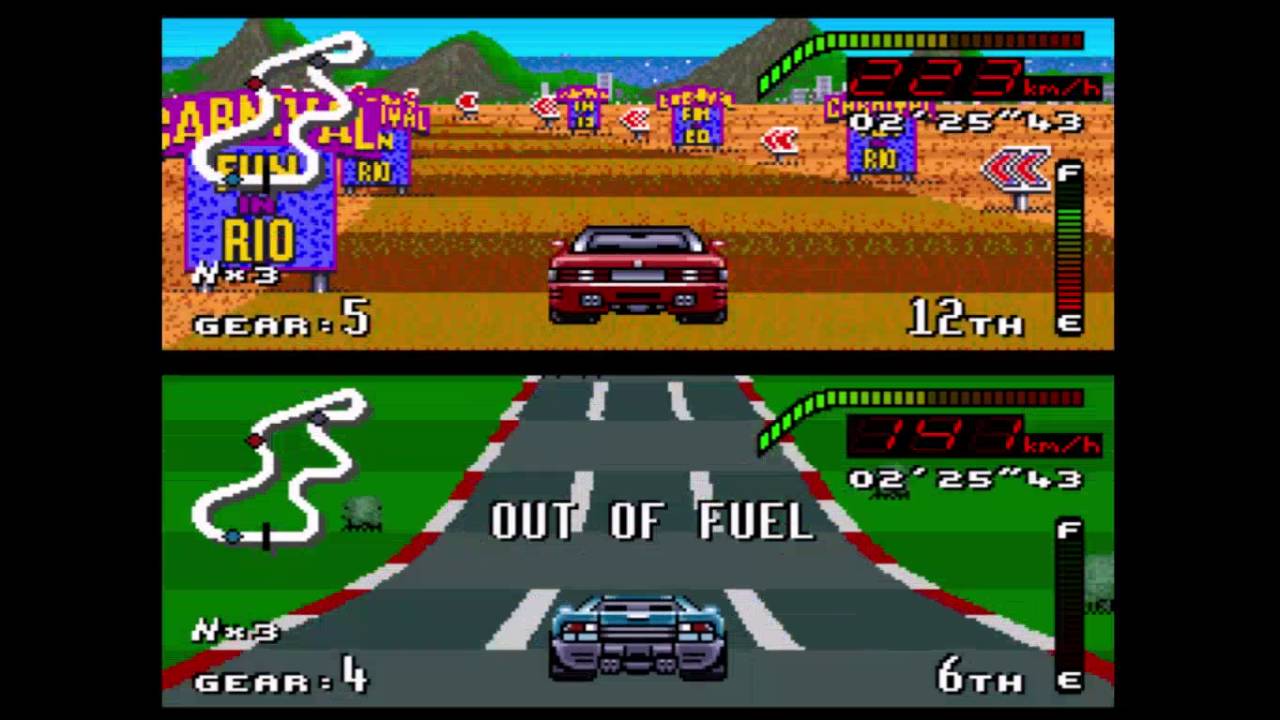 Here we see the beauty of terrain variation on the same track and the sadness of running out of fuel.
Top Gear's graphics are probably its greatest weakness, with little detail in the environments and a requirement to play in split screen even when alone. These points reveal its limitations. Part of this certainly comes from the fact that the Top Gear cartridge has a capacity of only four megabits, the same as some Master System games and the earliest titles on fourth-generation consoles. Even so, I would highlight a few moments, such as the transition from night to day on certain courses, the presence of tunnels, and different types of surfaces on the same track.
We cannot forget the classic "speech bubbles" containing phrases spoken by drivers during races. Some expressions were even modified when the game was released in the United States. "What the hell??" became "What the heck??"; "Yo butt head" became "Yo bone head"—that makes perfect sense—and others such as "Kiss my ass" were simply removed.
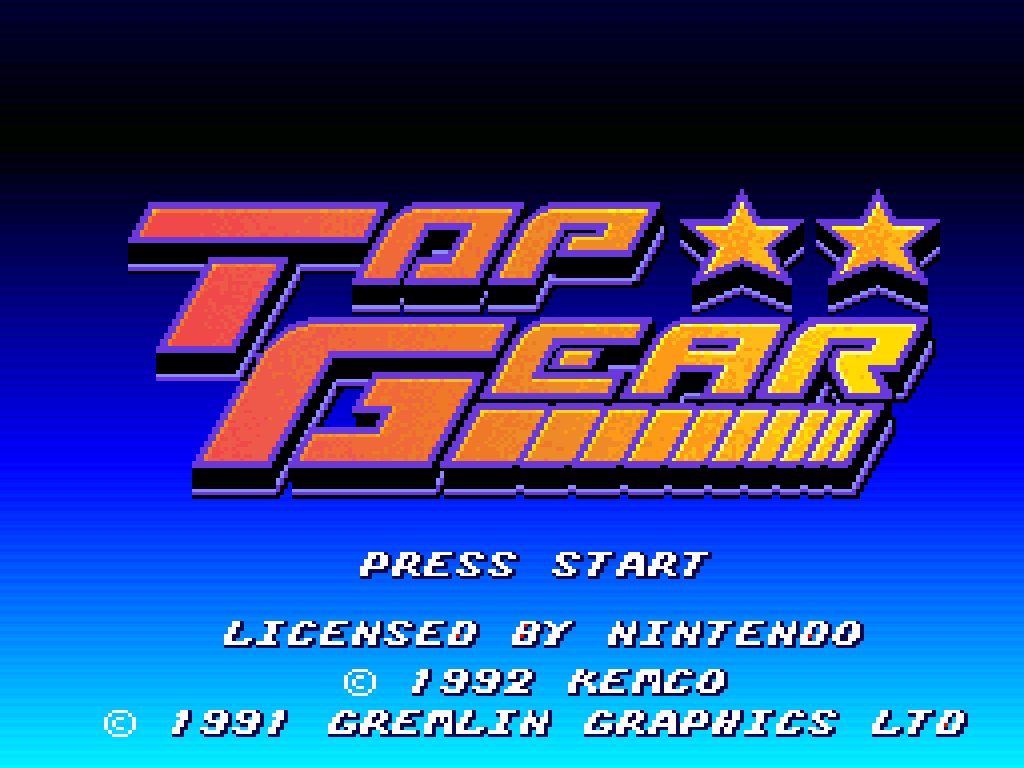 Top Gear's title screen used Mode 7, like almost every game from the beginning of the SNES's life
The game offers enormous fun and remains an excellent option for playing alone or with a friend today. Everything flows without causing significant frustration for the player. Top Gear has no story; it is the pure pleasure of overtaking at high speed and seeking first place in a race.
As for the soundtrack... Well, it deserves a subtitle of its own.
Fun fact: An easy-to-perform bug made it possible to occupy two positions in the standings simultaneously. I will not describe how to do it because that is not the purpose of the review. Anyone who wants to learn can easily find the method online. It was a cheater's paradise.
The Incredible Soundtrack
Probably one of the main reasons Top Gear is remembered today is its excellent music. What few people know is that composer Barry Leitch created it in only five days and that most of the soundtrack consists of remixed music from the Lotus games. This happened because Leitch spent two days making just the first race's track, the only one to use all eight audio channels available on the Super Nintendo. Aware that completing the work would be impossible, Barry revealed: "Because very little time remained, it was decided that I was allowed to reuse and improve some tracks I had created for the Lotus series." Below is the original Top Gear
soundtrack.
Among the many Brazilian versions of the classic
Top Geartheme, below is the one by our own Lord Vinheteiro.
Fun fact: For anyone who thinks they have seen everything in life and doubts the influence Top Gear had on Brazilians, below is a music video by a forró band that uses a track from the game as its foundation. A funk song also exists, but I will leave that for you to find on YouTube. Note: in the video, the boys are playing Top Gear on PlayStation 2—wow.
Getting to Know Top Gear's Musician Better: Barry Leitch
 Top Gear composer Barry Leitch
Barry Leitch was born on April 27, 1970, in Strathaven, Scotland. He is a musician and composer with more than 200 video games on his résumé. Regarding the Top Gear series, Leitch composed the music for the first game and, years later, Top Gear Rally for Nintendo 64.
Discussing the soundtrack of the first Top Gear, he emphasizes that the Las Vegas music is his favorite because it is the only track to use all eight Super Nintendo audio channels. The others use only four because of the lack of time and because they are conversions of music from the Lotus series.
Leitch learned of Brazilians' affection for Top Gear only after the 2000s, when fans began sending emails asking about him and sharing versions of his tracks. When they said the game was as popular as Mario and Sonic here, he did not believe them. It finally "sank in" when Tommy Tallarico, creator of Video Games Live, invited him to help arrange the Top Gear music that would be performed in Brazil. Barry came to our country because, as he himself said: "I have to go to Brazil to see an orchestra play my music. Every composer dreams of that." After arriving, Leitch spoke with people on the street and, according to him, everyone knew Top Gear, including a police officer with whom he chatted. The day of the performance in Rio de Janeiro arrived, and according to reports, he stood beside the stage listening to the audience shout for Top Gear among all the music being performed. After his song was played, his eyes filled with tears and the composer thanked us Brazilians, because here he had the chance to feel like Koji Kondo, creator of the music for Super Mario and The Legend of Zelda.
Grateful, Barry Leitch says he has three flags flying in front of his home in Ohio: one from the United States, one from Scotland, and one from Brazil.
When asked what he thinks about Brazilian forró and funk bands using his music as inspiration, he is modest: "It is flattering, (...) but I still do not understand why they use that horrible sound as a foundation."
Below is a Video Games Live clip with Barry Leitch watching from the stage, wrapped in our Brazilian flag.
Fun fact: Who is Ritchie? Anyone who paid close attention to the scores at the end of each race and tournament may have noticed that among the NPCs, there was always a driver named Ritchie who placed very well. Ritchie Brannan was the lead programmer of the first three Top Gear games and put his name among the racers as an Easter egg. It is worth noting that Brannan remains active in the world of racing games, creating titles in the Grid franchise.
Our Conclusion
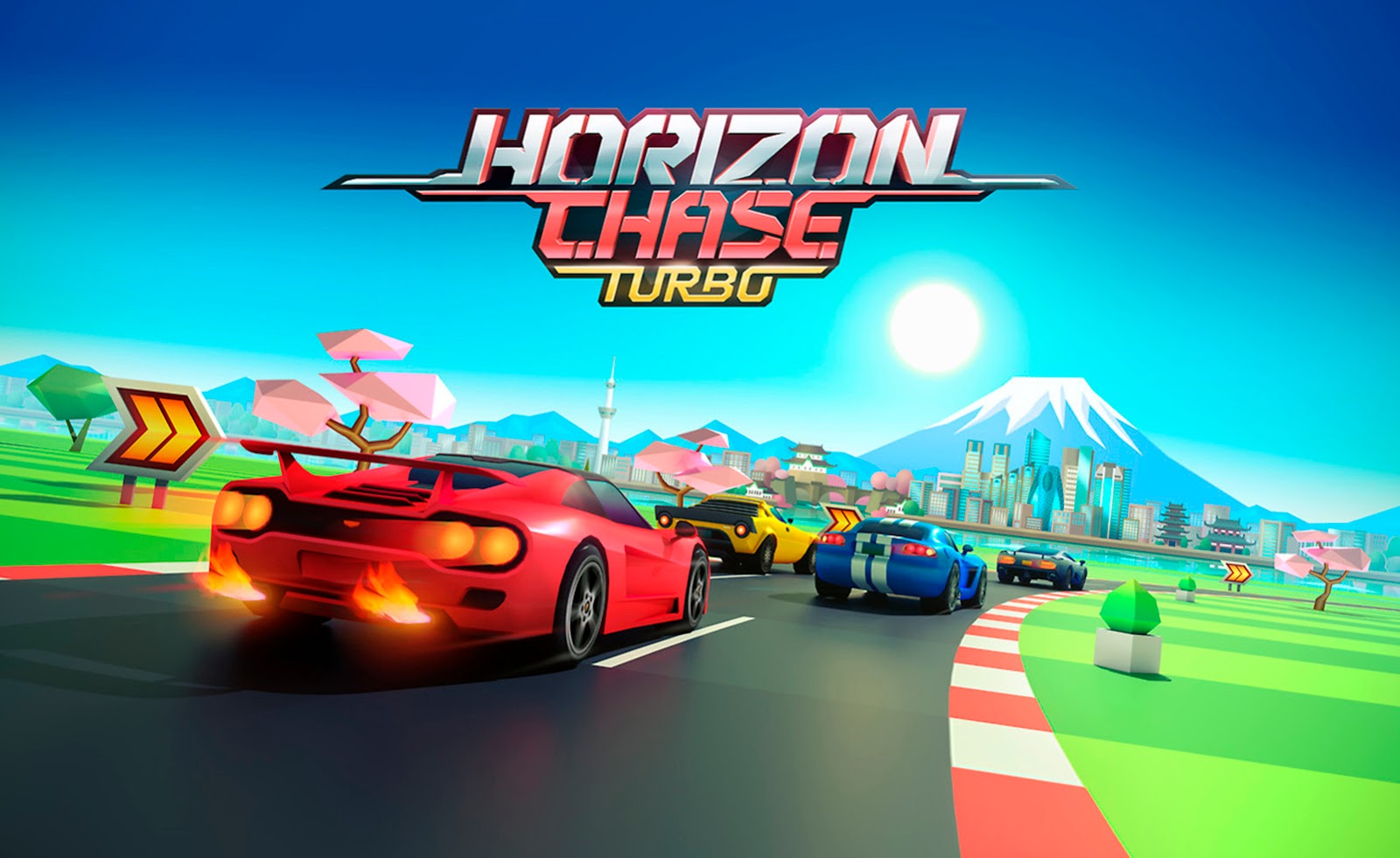
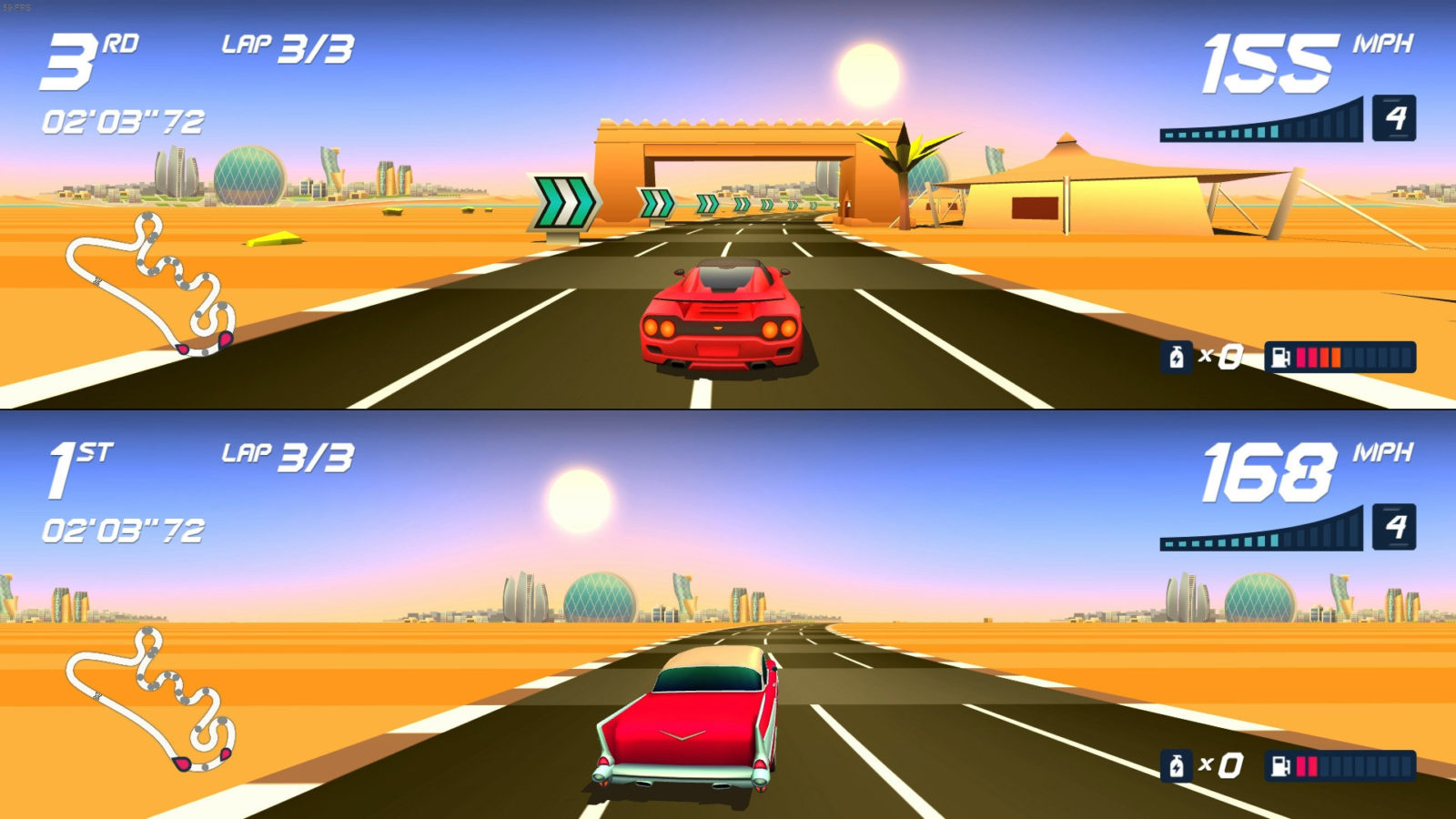
Top Gear brought no revolution or major innovation to the racing genre in games, but its fun was and remains incredibly strong. A teenager reading this review would only need to ask a gamer over 30 which racing games defined their childhood, and they would probably say Top Gear. Great Nintendo designer Shigeru Miyamoto once said that a game's principal function is the enjoyment it provides, and Top Gear performs that function very well. Finally, in programmer Ritchie Brannan's own words, the formula for a successful game lies in "simple but refined gameplay and an incredible soundtrack." Fun fact: In 2015, a Brazilian developer from Porto Alegre called Aquiris released Horizon Chase, considered a spiritual successor to the earliest games in the Top Gear franchise. Everything in the game evokes its inspiration, including the invitation for Barry Leitch to compose the music. The game is very good, and if you are a fan of the franchise who has not yet had the chance to play Horizon Chase, play it. Initially available for Android and iOS, it has also been available on PlayStation 4, Xbox One, Switch, and PC since 2018.
Rating: 9
Played on Super Nintendo.